Subscribe in a reader or enter your address to get posts via email: 
Like this blog on Facebook!

Tuesday, March 12, 2013

Disobedient to the Songs (Worship, Part 1)

'THE SIMON SAYS TRAFFIC COP' photo (c) 2012, KarmaCat_SF - license: http://creativecommons.org/licenses/by/2.0/
The Worship Police
I have been disobedient lately. And maybe a bit of a liar.

These are things I have said that I was doing, but I actually didn't do them at all:
  • Fall on my knees
  • Lift my hands and spin around
  • Stand with arms wide open
  • Running to your arms
  • Bow down before you now
  • Shout out, sing loud
  • Find myself here on my knees again
But it gets worse. Much worse. You see, I didn't lie about doing these things while sitting on my couch with my wife, or at Starbuck's with a friend, or even on Facebook with who-knows-who. I said these things... in church.

And it gets EVEN WORSE.

I wasn't just in the vestibule of the church talking about doing these things. I wasn't at Men's Breakfast on a Saturday morning, or chaperoning some Youth Group event, or even confessing to the pastor.

I was right in the sanctuary. During worship. Singing those phrases.

TO GOD.

Yes. I lied, directly in God's face, during a time specifically intended to show Him love and respect. And what did I do? I sang to Him that I was "running to His arms" when in actuality, I wasn't running at all. I was standing still not even walking. Arguably, barely moving. I wasn't shouting out, or falling on my knees (ouch!), bowing down or spinning around. I may not have even had my hands lifted or my arms wide open.

Why do people who write worship songs put this kind of stuff in them? Certainly, everyone is supposed to be participating, and singing (loud or otherwise) and even lifting hands are appropriate in many churches. Bowing down, yes, if the situation is appropriate and the mood strikes. But most churches don't do that much spinning and running during services. So why do these songwriters force us to lie like that?

I'll take it a step further. I would be surprised to find out that any of the people who wrote those lines were actually doing what they were writing, as they were writing it. Although I would like to see someone trying to write "I'm running to Your arms" on a sheet of paper while actually running, or "lift my hands and spin around" while actually lifting their hands and spinning around. Those folks were making liars out of themselves as they wrote the lines on the paper! I guarantee that each of these songwriters, as they wrote those lines down, was sitting somewhere with a pen or pencil (or a laptop, or whatever) and not doing any worshippy actions at all.

I'm not particularly a person who likes to be told what to do. I don't consider myself rebellious, but I like to be authentic... if I raise my hands, I want it to be because I felt love for God well up in me and my body wanted to express it that way. If I shout, I want it to be because a shout built up in me until keeping it in wasn't an option anymore. Once upon a time, I would kind of feel guilty if a song said something like "I wave unto God" and I didn't wave. Or "Shout to the Lord" and I didn't shout (by the way, who actually does shout during that song? Nobody!) I would feel like I was being disobedient, and on one level, I suppose I am.

But that's not the important level.

Worship, I've learned, comes from your heart. Not from your hands clapping, or your feet jumping or dnacing, or even from your voice singing. Worship, like everything else that matters at all to God, occurs long before it is visible to the naked eye. Things that you do during the worship service are only the physical sign of something that has already occurred on the inside. So you don't have to fall on your knees, earning yourself a visit to minor emergency because you've fractured both of your kneecaps. You can worship God standing up.

But don't refuse to lift up your hands just because you want to be difficult, either. Because you know what else occurs in your heart before the action occurs on the outside? Rebellion. Resistance to authority. If you're refusing to play Worship Simon Says on principle, then you're actually being counterproductive to worship... you're distancing yourself from God.

Make sure the next time you are in worship that you are offering your heart to God. Not your hands, although they are His, not your clapping or your singing or your running or jumping or standing on your head, but your heart. That's what God really wants. If you've got that going on, it doesn't really matter if your voice shouts to the Lord or not. Your heart does the shouting for you.

This week I have several posts planned about worship - I hope you enjoy them! What are your thoughts about worship songs that tell people what to do? Are they like playing Red Light, Green Light... or do they actually provide a useful structure for people to worship within? Sound off in the comments below and join the discussion!


Tuesday, March 5, 2013

Who's Doing The Work Around Here?

For we are his workmanship, created in Christ Jesus for good works, which God prepared beforehand, that we should walk in them. - Ephesians 2:10 ESV
We've been studying the first few chapters of Ephesians in Wednesday night Bible study, and last week we were talking about this verse. The verses before say that we are saved by faith in God, not by our "works" (doing the right things), but then this verse turns around and talks about us doing good works. Isn't that strange? So should we do good works, or not?

George's Dance Class
When I read the verse, two things came to mind. One of the things is the stereotypical dancing class you used to see on old TV shows, where the instructor lays down pictures of footprints on the floor so that the students can be sure to put their feet in the proper places to do the appropriate dance moves. So in a class like this, is it the student's dance, or the teacher's? Well, maybe a little of both, but the student is not yet capable of making the dance happen on his own. The student is doing the moves, but the teacher is the one who laid out the dance.

The other thing that I thought of when I read this verse is Lowe's Build And Grow. If you don't have children, it's likely you haven't heard of Lowe's Build And Grow. Basically, you walk into a Lowe's hardware store with your child on specific Saturdays at the right time, they hand you a little kit to make a wooden toy of some kind, and your child gets to make the toy. The kits usually are made up of pre-cut pieces of wood, a dozen or so nails, and a sheet of stickers to spruce things up. Lowe's also gives each child an apron (just like the ones the grown-ups wear at Lowe's!) a pair of safety glasses, and a little hammer (you have to give back the hammer when you're done). My son who is now twelve used to go to them all the time, and now my daughter who is five has started going to them. They're popular events, because the kids have a great time, and they get to go home with a free toy!

When my little girl goes to the event, I have to open the package, lay out the parts, help her look over the instructions, line up the pieces, and hold the nails while she hammers (this can be quite dangerous, but during my son's run I learned to be an expert at keeping my fingers clear!) Usually I even start the nails for her, and often I do the final whack or two, too. So who's building the toy? Is it her, or is it me? Well, I let her do as much of the project as she can - and hopefully, as happened with my son, she will eventually be doing the projects completely on her own, with no help at all from me. For now, though, most of the work is done by Yours Truly.
For we are his workmanship, created in Christ Jesus for good works, which God prepared beforehand, that we should walk in them. - Ephesians 2:10 ESV
Curiouser and Curiouser!
When we are doing God's good works, and doing them by the prompting of the Holy Spirit, we are doing a job God has lined out for us. Like I do for my daughter, he has provided all of the things we need to successfully complete the project, laid them out, given us the instructions, and maybe even started a nail or two. Like a dance instructor, He has laid out the steps for us to walk in. We are both the workmen, and the project. In the end, as it turns out, the job was actually being done by God all along. We may be doing the dance or building the project, but really, the work is done by God, and the glory goes to Him. The greatest part is that we're the ones who get to go home with something for free! "For by grace you have been saved through faith. And this is not your own doing; it is the gift of God, not a result of works, so that no one may boast." (Ephesians 2:8-9 ESV)


How do you know what "good works" God wants you to do? Do you pray and then sit and listen until you hear something? Do you ask a pastor or other trusted Christian? Do you set your Bible up on its edge and let it fall open to a Scripture that tells you what to do? Join the discussion by clicking the Comments link below!

Wednesday, February 27, 2013

Strong Phone

I can't believe the amount of difficulty I've had finding the Bible app feature I wanted for my Android phone.

Don't get me wrong... there are a BAZILLION Bible apps out there. The #1 app I would recommend to any Android user is the YouVersion app (actually, for pretty much any platform YouVersion has an app, and they are all terrific!) If you don't have a Bible app on your phone, just get YouVersion. Just click over and download it. Now. It's totally a no-brainer. I love YouVersion, but it doesn't really have one of the things I wanted: to be able to look up original-language definitions for individual words. Basically, I wanted to be able to click on something and see the Strong's Concordance definition. YouVersion is focuses on getting people to read devotionally, not really on drilling deeper with Word Studies and such... not a criticism, just an observation. I still have YouVersion on my phone. I still use it quite often. And I still highly recommend it; it's one of the first things I install on any new phone. But it didn't have the one function I wanted.

So I looked further. I have invested some time and money into modules for my Logos desktop software, so I decided to try out their app, figuring that since Logos is designed for serious study, it would probably have by dream feature. The Logos Bible app does link up to most of the modules I've purchased for my desktop version (though not all of them), and it does have some pretty nice study features for a mobile app. It also has a split-screen function so you can view two books (two different translations, a Bible and Study Bible Notes, a Bible and a Bible Dictionary, etc.) and I use that constantly. And it has some Greek/Hebrew language functions, but strangely enough, trying to click an English word and find out what the original-language word means is a little bit hit or miss. I still have it installed, and I use it quite frequently in church, but it didn't have that one key thing I wanted: click the word, read the definition. (By the way, there are some free Logos modules, but you'll get access to a lot more translations for free with YouVersion than with Logos.)

There are mobile versions of a lot of the Bible Web sites out there, too, and quite good ones: Bible Gateway, My Study Bible, and even YouVersion have standout mobile sites, and I bookmarked all of them. The problem with those is that the cell data reception inside my church is pretty awful, and at the time they didn't have WiFi for use by the congregation, so using those in church wasn't going to happen. It needed to be an app with offline versions, like YouVersion or Logos.

So I started trying out apps that were being developed by some of the other Bible Web sites I was familiar with. Bible Gateway released an app which is pretty good. Bible.is has an app which incorporates video clips from "The Jesus Film," which is sort of an unusual feature. eBible.com took an interesting tack with their app: you actually speak the Bible reference you want to look up, and it reads it back to you audibly! I tried all of those, and even installed the plain-vanilla ESV only app, mainly just because I'm a big ESV fan and wanted to take a look at it. They all had good points and bad points, but none of them had what I wanted: direct links from the Bible text to Strong's numbers.

A very recent entry into the fray deserves a mention: the Faithlife Study Bible. This app is actually a whole self-contained Study Bible with several available translations and with study notes that are actually tweaked specifically to match whatever translation you are reading. The notes will actually grow and evolve over time, as readers email in questions and new articles are added. It's a really cool deal, and I like it a lot... but it uses the Logos engine, so still no direct-to-definitions functionality.

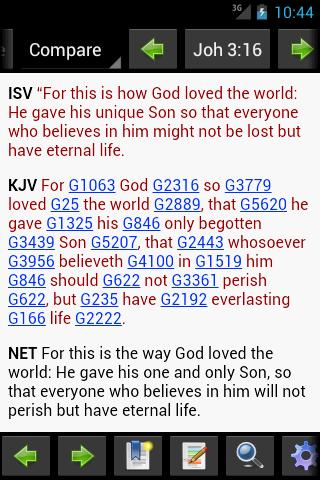
Finally I just dug in until I found an app with a screen shot that looked like exactly what I wanted. I installed it, and it works like a charm... not only does it have Strong's definitions, but it also has Thayer's definitions, which are broader in scope than the brief Strong's definitions. The app is called MySword Bible, and the screen shot you see at right shows the KJV translation with the Strong's links inline. It does exactly what I had hoped all those other apps would do, so I use it only for that... I never switch from the KJV+Strong's translation. It's very easy to find a verse (some of the apps listed above are surprisingly hard or slow to navigate, particularly Logos), and if I want to read Strong's/Thayer's definitions, I just click on the Strong's number.

But I didn't get rid of the other apps, no sir! I have MySword installed, but I also have YouVersion, Logos Bible, and Faithlife Study Bible installed. Some church services I'll actually run all of them concurrently, with different translations open in each! That way I can switch between five or six translations very quickly and never lose my place in any of them. (The danger is that you can get so distracted by driving your phone that you forget to listen to the minister... but I digress.) It's incredible the sheer volume of information about the Bible that is accessible from my little $200 cell phone. Sitting in church, I have in my hands the equivalent of a whole bookshelf full of Bible translations and study works. It's funny, though, that it took me over a year to find an app with the one single feature I was looking for!

Monday, February 18, 2013

Invisible Lion

'glass lion' photo (c) 2008, nanao wagatsuma - license: http://creativecommons.org/licenses/by/2.0/
"Oh, Aslan," said she, "it was kind of you to come."

"I have been here all the time," said he, "but you have just made me visible."

"Aslan!" said Lucy almost a little reproachfully. "Don't make fun of me. As if anything I could do would make you visible!"

"It did," said Aslan. "Do you think I wouldn't obey my own rules?"

- from The Voyage of the Dawn Treader by C. S. Lewis

Lucy Pevensie had just done a very brave thing when this exchange occurred. To save the lives of her friends, she had braved the frightening upper floor of a house she had been told was haunted by a very dangerous magician (who was either alive, dead, awake, sleeping, upstairs, downstairs, or somewhere else... nobody was sure) in order to read from a specific book a magic spell which would turn invisible things visible again. She and her party, who were on a grand seafaring adventure, had been captured by some individuals who had read the reverse spell from the book and made themselves invisible. After a while they had become tired of the "invisible" gig and decided they actually did want to be visible, but they were too scared to go upstairs again because the magician had also become invisible when they read the invisibility spell. If Lucy wouldn't go upstairs, find the magic book, and read the spell, the invisible people (or whatever they were) had promised to cut the throats of Lucy and everyone with her.

Lucy went upstairs and eventually found the right spell, but when she read it, just as the invisibility spell had unintended consequences (turning the magician invisible), the visibility spell had the unintended consequence of turning anything visible that was invisible - and apparently Aslan had been hanging around those parts invisible when Lucy read the spell.

When I read this passage to my daughter a few nights ago, a few things jumped out at me. (SPOILER: in case you don't already know it because you've been hiding under a rock since 1950, Aslan is the character in the world of Narnia who is similar to Christ in our world.) The first thing is that Aslan tells Lucy that he "obeys his own rules." In the context of the story, he's saying that if there is a magic spell that is constructed based on principles that have been put into place in that world, he will not go against them. But in the context of the Christian faith of the author, the famed apologist C. S. Lewis, this idea is used to explain that evil exists in the world not because God is not powerful enough to eliminate it (He certainly is powerful enough), but because He has given mankind the option to follow or reject Him, and He will not forcefully take it back without giving mankind ample time to make our decision.

The other thing that jumped out at me was that Lucy, without knowing it, had in her hand the power to make Aslan visible to herself and to others. Think about that for a moment, knowing again that Aslan is a Christlike character. Is Lewis saying to us through story that each of us has the power to make Christ visible to others? I think that's exactly what he was saying. By simply following Christ, obeying His word to the best of our ability and relying on His grace both to help us when we are too weak to obey and to forgive us when we fail, we make Christ visible to others. Lucy was engaged in a completely selfless act when she made Aslan visible; she was scared to go upstairs, but she did it to save the lives of her friends. Although the book doesn't put it this way, if you had asked Lucy, doubtless she would have told you that she was only doing what Aslan would expect her to do. When we live our lives as we know Christ desires us to, when we begin to exhibit some of the characteristics of Jesus because we are letting Him live through us, we start to give people some idea of what Christ looks like. We make Him visible by being faithful representatives of Him on the earth.

Of course, when we make Jesus visible, we may not get to hug a lion afterward... but we may get something far better. Two words from the mouth of Jesus: "Well done."

Thursday, February 14, 2013

In Your Eyes

'Should Have Been You' photo (c) 2011, Seth Anderson - license: http://creativecommons.org/licenses/by-sa/2.0/ in your eyes
the light, the heat
in your eyes
I am complete
in your eyes
I see the doorway to a thousand churches
in your eyes
the resolution of all the fruitless searches
in your eyes

from "In Your Eyes" by Peter Gabriel

What do you suppose Peter Gabriel meant by equating the gaze of the one you love to a church doorway? That doesn't seem nearly as romantic as something like "limpid pools," or stars, or the ocean or whatever. I was thinking about it this morning, and I realized that the lyric means that in the eyes of his lover, he can see something very special and wonderful, the thing he had been looking for all along, something that is so special that it almost seems holy. And that pretty accurately describes what you see when you look into the eyes of someone who loves you. There is something special there that is so pure that it almost seems holy.

And that's no mistake!

Throughout the Bible, God describes His chosen people as His bride. Sometimes His bride is spotless and beautiful, and sometimes His bride has been "unfaithful," chasing after other things instead of pursuing our relationship with Him, but we are always His bride. When we come to Him, he washes us and makes us holy. What He sees when He looks into the eyes of His bride is His holiness. And when God created romantic human love and marriage, He created it to mirror the relationship between Him and His bride, the Church.

So when you look into the eyes of your loved one this Valentine's Day, enjoy the love they have for you, but also know that the love they have for you is a reflection for the love God has for you!


Husbands, love your wives, as Christ loved the church and gave himself up for her, that he might sanctify her, having cleansed her by the washing of water with the word, so that he might present the church to himself in splendor, without spot or wrinkle or any such thing, that she might be holy and without blemish. -Ephesians 5:25-27 ESV

I keep asking that the God of our Lord Jesus Christ, the glorious Father, may give you the Spirit of wisdom and revelation, so that you may know him better. I pray that the eyes of your heart may be enlightened... -Ephesians 1:17-18a NIV

I found it hard to believe
Someone like You cared for me,
You put this love in my heart!

I tried but could not refuse,
You gave me no time to lose.
You put this love in my heart!

from "You Put This Love In My Heart" by Keith Green

Monday, February 11, 2013

A Matter Of Procedure

'Hearts Wrippled in Time' photo (c) 2008, LadyDragonflyCC <3 Canon~vs~Samsung - license: http://creativecommons.org/licenses/by/2.0/Recently a reader posted a comment on one of my blog entries from a couple of months ago, and although I replied there in the comments, the reply was getting long and I wanted to develop it into something more in its own post. The original comment (which oddly seemed to have little to do with the original blog entry) is:
Your verse in john 3:16 has a miss print "He that believes and is baptized shall be saved " there are plenty if others here's a couple mark 16:16 Jesu says it again ,acts 2:38 the whole bible is inspired by God not just what we edit for what ever reason Billy Gramm once said he don't preach baptism because he wouldn't have as many followers oops I give anyone $500 if they can prove you don't need baptized
My reply was as follows:
Acts 16:30-31 - the Philippian jailer asked "Sirs, what must I do to be saved?" Paul and Silas simply replied, "Believe in the Lord Jesus, and you will be saved, you and your household." Although the jailer did ultimately get baptized, Paul and Silas, in a simple answer to a simple question, did NOT include it as a requirement. He was saved as soon as he believed in the Lord Jesus.

Romans 10:9 states the requirements for salvation this way: "...if you confess with your mouth that Jesus is Lord and believe in your heart that God raised him from the dead, you will be saved." Again, no requirement of baptism is included.

I've matched your Mark 16:16 and your Acts 2:38, which seem to include baptism as a requirement, with two verses that absolutely do not include it as a requirement. Maybe the "misprint" you're talking about is in your two verses? I'm feeling pretty safe in saying that John 3:16, which is probably the most popular Scripture verse in the whole entire Bible, has been gone over with a fine-toothed comb any number of times. Do I get $500, or since I proved it twice do I get $1,000?
I don't expect to hear back from commenter "Mark" - at this writing I haven't. If I do, I expect it to be mostly an argument containing a lot of Theological hair-splitting. In fact, I can split some of those hairs myself... if you look at the two verses I cited, they say that if you believe in the Lord Jesus, you will be saved. It doesn't say you immediately are saved. So there's room for bullying people into getting baptized with those two Scriptures too, if you want. But I don't see things that way.

In 1 Samuel 16:7, it is recorded that God said to Samuel "For the Lord sees not as man sees: man looks on the outward appearance, but the Lord looks on the heart." God's not as interested with the procedures we follow as with what's in our hearts when we follow them. The Old Covenant provided tons of procedures that you could follow to bring you nearer to God, and I truly believe that if someone had been able to follow them perfectly, they would totally not have needed the salvation that Jesus brought. They would have been made righteous by the Law alone. The fact is, though, that until Jesus, nobody was able to do it. Everyone had the disadvantage that they were creatures hindered, let's say, as if by a birth defect. We couldn't walk straight, because we were born with a lame leg. No matter how hard we try, we simply are unable to live up to the rules and regulations which, if we had been able to live up to them, would have provided righteousness to us. That's what the Law was given to teach us: we just can't do it. Rules and regulations don't work for us. We needed someone to finish the work for us and give it to us as a gift. That person was Jesus.

Which brings me back around to my point. God spent thousands of years driving home His point that we are unable to obtain righteousness through performing the correct activities. Why would God turn around and load another activity on us as a requirement to come to Him? Wasn't Jesus' work sufficient? Didn't God tell Samuel that He looks at the heart, not on outward appearance? Baptism is an outward act, there to be a sign to other human beings. It's an "outward appearance" thing; it happens to your body, not within your heart.

I am a firm believer in baptism. I think baptism is a wonderful sign of the change that has happened to the believer. I do think that there is something spiritual that happens when you are baptized. But I do not think it is a requirement for Salvation. I just don't think God is looking for excuses to keep people out of Heaven. "Hello, Mr. Jones. I see here in the Book of Life that you believed in the Lord Jesus in your heart... very good, very good... and you even confessed Him as your Lord with your mouth, that's wonderful! Oh... oh no. Mr. Jones, I'm afraid you never were baptized. I'm sorry, but even though you made a heart decision to choose Jesus as your Savior and follow Him, because you did not get baptized, you're going to have to go to Hell instead of Heaven. Too bad for you." The idea just seems kind of ridiculous to me.

I've been baptized. I recommend that everyone who becomes a Christian get baptized. It's a very special, valuable experience. But I think that people become Christians immediately, as soon as they allow the Holy Spirit to change their hearts. I think Jesus did the job completely. I think he purchased the gift, wrapped it up and put a bow on it, and offered it to anyone who would accept it. I just don't think there's any extra requirement for Salvation after that.

Monday, February 4, 2013

Peace in the Midst

This weekend was homecoming at my alma mater, Oral Roberts University. It was something of a triumphant weekend for ORU, too, because not only was it the grand opening of the beautiful new building you see at right, the Armand Hammer Student-Alumni Center, but it was a celebration of the selection of a new president-elect for the school, Dr. Billy Wilson. The outgoing president, Dr. Mark Rutland, was an interim president from the start, and his work during his time at ORU has been nothing short of game-changing.

In 2007, this same school announced that it was $55 million in debt. To say that the doors were in danger of closing forever is absolutely not an exaggeration. A wealthy family from the Oklahoma area stepped in and donated a huge hunk of money to eliminate that debt, but they added a stipulation: the leadership of the school would have to be reorganized, including the selection of a new president. Dr. Rutland was brought in and a new Board of Trustees was created. Amazing strides were made during the next five years under this new leadership, and now ORU is, to all appearances and with no reason to think otherwise, better off than it's been in a long time. I would say without reservation that the school has every indication of being in better shape now than it was 20 years ago when I graduated. The buildings are being kept up, technology is being brought up to date, there has been four straight years of enrollment growth, and student morale seems high. Plus, there is that new $12 million building that was built in one single year with dollars donated by alumni... debt free.

Visitors to the ORU campus over the years have often reported feeling a sense of peace when they walked around the property. As I was walking across campus after leaving a homecoming event Saturday, I noticed that I could feel that peace; after a lot of transition and change, ORU is flourishing, and God is still clearly in focus. And it struck me that there is quite a contrast between what is happening at ORU - unity of vision, economic advancement and progress, a heart turned toward God - and what seems to be happening across much of this nation (see my recent blog post about praying for things to get better!) In the United States right now, we're seeing divisive partisan politics, economic upheaval, and in general, people not seeking God's help. At ORU, we're seeing unity of vision, financial accountability and responsibility, and a new student-initiated emphasis on prayer.

The contrast was, for me, striking. ORU is a microcosm of what God can and will do for His people when we seek his face (and walk in His wisdom in areas like finances). Just as God has been providing for ORU, a school founded to train students to live their lives for Him, in a tough time... and just as God provided water for His people who were wandering around the desert way back in the time of Moses... God can provide for each of us. I'm not at all saying that seeking God will make your life an instant utopia or that there are never problems for the Christian, but I am saying that we can each have the peace present in our lives that is present on campus at ORU. Streams of water in the desert. Peace in the midst of the storm. I've seen it this weekend. You can see it too.