Subscribe in a reader or enter your address to get posts via email: 
Like this blog on Facebook!

Showing posts with label Study Bibles. Show all posts

Monday, April 15, 2013

Faithlife Study Bible FREE - and win even more!

There will be a new full-fledged post tomorrow morning, but I wanted to share something I just ran across in my emails. Logos is running a contest to give away a digital Bible study prize package containing almost 2,000 Bible study books! They say it's $100,000 worth - that's a LOT of materials! And just for entering, you get the chance to download the Faithlife Study Bible for free... it's a pretty cool concept in electronic Study Bibles which I mentioned in a previous blog post. To enter the contest and download the Faithlife Study Bible, visit http://win.logos.com. I know I entered!

Actually, the Faithlife Study Bible is currently free anyway, at least on the Android platform... I haven't checked the others. I do understand they plan on charging for it eventually, and it's a pretty amazing resource, so get it while you can!

Wednesday, February 27, 2013

Strong Phone

I can't believe the amount of difficulty I've had finding the Bible app feature I wanted for my Android phone.

Don't get me wrong... there are a BAZILLION Bible apps out there. The #1 app I would recommend to any Android user is the YouVersion app (actually, for pretty much any platform YouVersion has an app, and they are all terrific!) If you don't have a Bible app on your phone, just get YouVersion. Just click over and download it. Now. It's totally a no-brainer. I love YouVersion, but it doesn't really have one of the things I wanted: to be able to look up original-language definitions for individual words. Basically, I wanted to be able to click on something and see the Strong's Concordance definition. YouVersion is focuses on getting people to read devotionally, not really on drilling deeper with Word Studies and such... not a criticism, just an observation. I still have YouVersion on my phone. I still use it quite often. And I still highly recommend it; it's one of the first things I install on any new phone. But it didn't have the one function I wanted.

So I looked further. I have invested some time and money into modules for my Logos desktop software, so I decided to try out their app, figuring that since Logos is designed for serious study, it would probably have by dream feature. The Logos Bible app does link up to most of the modules I've purchased for my desktop version (though not all of them), and it does have some pretty nice study features for a mobile app. It also has a split-screen function so you can view two books (two different translations, a Bible and Study Bible Notes, a Bible and a Bible Dictionary, etc.) and I use that constantly. And it has some Greek/Hebrew language functions, but strangely enough, trying to click an English word and find out what the original-language word means is a little bit hit or miss. I still have it installed, and I use it quite frequently in church, but it didn't have that one key thing I wanted: click the word, read the definition. (By the way, there are some free Logos modules, but you'll get access to a lot more translations for free with YouVersion than with Logos.)

There are mobile versions of a lot of the Bible Web sites out there, too, and quite good ones: Bible Gateway, My Study Bible, and even YouVersion have standout mobile sites, and I bookmarked all of them. The problem with those is that the cell data reception inside my church is pretty awful, and at the time they didn't have WiFi for use by the congregation, so using those in church wasn't going to happen. It needed to be an app with offline versions, like YouVersion or Logos.

So I started trying out apps that were being developed by some of the other Bible Web sites I was familiar with. Bible Gateway released an app which is pretty good. Bible.is has an app which incorporates video clips from "The Jesus Film," which is sort of an unusual feature. eBible.com took an interesting tack with their app: you actually speak the Bible reference you want to look up, and it reads it back to you audibly! I tried all of those, and even installed the plain-vanilla ESV only app, mainly just because I'm a big ESV fan and wanted to take a look at it. They all had good points and bad points, but none of them had what I wanted: direct links from the Bible text to Strong's numbers.

A very recent entry into the fray deserves a mention: the Faithlife Study Bible. This app is actually a whole self-contained Study Bible with several available translations and with study notes that are actually tweaked specifically to match whatever translation you are reading. The notes will actually grow and evolve over time, as readers email in questions and new articles are added. It's a really cool deal, and I like it a lot... but it uses the Logos engine, so still no direct-to-definitions functionality.

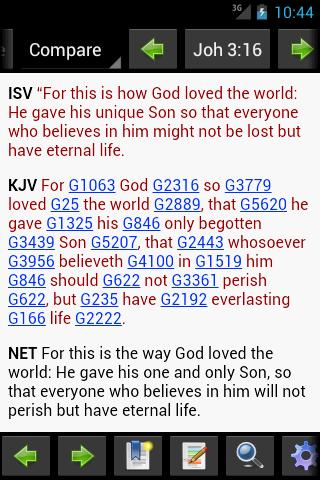
Finally I just dug in until I found an app with a screen shot that looked like exactly what I wanted. I installed it, and it works like a charm... not only does it have Strong's definitions, but it also has Thayer's definitions, which are broader in scope than the brief Strong's definitions. The app is called MySword Bible, and the screen shot you see at right shows the KJV translation with the Strong's links inline. It does exactly what I had hoped all those other apps would do, so I use it only for that... I never switch from the KJV+Strong's translation. It's very easy to find a verse (some of the apps listed above are surprisingly hard or slow to navigate, particularly Logos), and if I want to read Strong's/Thayer's definitions, I just click on the Strong's number.

But I didn't get rid of the other apps, no sir! I have MySword installed, but I also have YouVersion, Logos Bible, and Faithlife Study Bible installed. Some church services I'll actually run all of them concurrently, with different translations open in each! That way I can switch between five or six translations very quickly and never lose my place in any of them. (The danger is that you can get so distracted by driving your phone that you forget to listen to the minister... but I digress.) It's incredible the sheer volume of information about the Bible that is accessible from my little $200 cell phone. Sitting in church, I have in my hands the equivalent of a whole bookshelf full of Bible translations and study works. It's funny, though, that it took me over a year to find an app with the one single feature I was looking for!

Monday, March 19, 2012

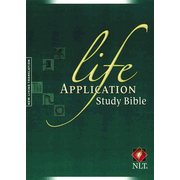
My New Study Bible: Life Application NLT

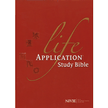
This past week I got a new Study Bible... the Life Application Study Bible in the New Living Translation. This is a hardcover copy that I won in an online contest; I actually already had a paperback personal size copy of the same thing on my shelf for a while, waiting until I had time to spend with it (I gave it away when I got this hardback copy), and my wife has had the NIV version for some time (she got it for Easter several years back). This is the first time I've really opened one up and spent quality time with it. I'm actually more impressed than I thought I would be!

For the past several years I've been a huge fan of my ESV Study Bible. I've read through most of it in my quest to read through the whole Bible in a year (which is now several months into its third year... go Ezekiel!) and learned an awful lot. The ESV Study Bible has tons of notes that give historical background, cross-references, and other supporting material to help you understand the text. I've also been using the NIV Study Bible, which contains materials along the same line (I've been reading them together, which has been very interesting... usually they have completely different supporting material, sometimes they are complimentary, and occasionally they come close to contradicting each other! But both are outstanding). The Life Application Study Bible is not like that. Certainly it has a copious amount of notes, but the study notes in this Bible are not primarily of a historical or even of a Theological nature, at least not in the academic sense. These study notes are firmly focused on one thing: showing you ways that the Bible text applies to your day-to-day life. They're not concerned so much with telling you how someone lived in the first century; they're concerned with how the Bible is telling us to live in the twenty-first century. They're very good at helping you start thinking about what the text means to your life, right now, today. I'm duly impressed!

Is this the only Study Bible I would want to have? Definitely not. Not for me personally, anyway. I'm very interested in all of that historical background and learning how different passages of Scripture interact with one another (by the way, the Life Application Study Bibles do have book introductions which provide some historical background, so it's not like they leave you high and dry). I enjoy a more academic take on the Word sometimes. I also find that I don't particularly trust the New Living Translation for serious study; it's still way too close to paraphrase for me, although it is less relaxed about fidelity to the text than the classic Living Bible, and of course almost anything is more literal than something like The Message. The NLT is more like having a good friend explaining to you what the Bible says, though, and I do kind of dig that for casual meaning. The Life Application Study Bible matches the NLT incredibly well because reading the study notes feels kind of like having that same good friend tell you what they learned from reading the Scripture passage they just told you about. For me, the overall effect is like listening to a message by a pastor who has a very relaxed style and who is very good at bringing the topics he finds in the Bible into a daily life context. I'm going to make it part of my devotional life, and I think I'll get a lot out of it!

I'm also pretty sure that it's the only Bible that I've ever seen that includes the little-known apocryphal Gospel According To Spider-Man:


(Just kidding... that's 2 Thessalonians there.)

Wednesday, February 8, 2012

Crossway's Paperback ESV Study Bible - I don't see their logic

Crossway recently released the ESV Study Bible in paperback. Their blog post about the release is mostly about the kinds of people they expect to buy it. I love the ESV Study Bible; it's the keystone of my twice-extended read-the-Bible-in-a-year program. And I don't doubt that people will buy it in the new paperback format, but I doubt that it will be the people they blogged about.

First they mentioned students buying it as a textbook. I guess it's possible that this will happen to some extent, but I think today's college student likes for everything to be as electronic as possible, and I can't see a student dropping $20-$30 for an almost 2½-pound paperback that they'll have to lug around and which will wear out when they could pay $20 for online access indefinitely at esvbible.org, or drop $8.54 and get it on their Kindle or Nook, or even from Google Books. I know some people like to write in textbooks, and other people like to sell them back to the bookstore to be re-sold the next year as used books, but I don't know... after Apple's recent announcements about releasing textbooks for iPad, I just think students are going to continue to go more and more digital.

The second category of buyer they mentioned is travelers. The argument is that a traveler isn't going to want to carry their "good" ESV Study Bible with them in their luggage and risk it getting damaged. But seasoned travelers, I believe, have also already adopted e-Readers, and they're going to want their ESV Study Bible electronically as well. Besides, don't all copies of the ESV Study Bible come with free access to the online version? If so, then folks who already have a "good" copy at home can already hop on some free Wifi, which is all over the place nowadays, and use the online version instead, and not have to carry along anything but the laptop or tablet computer they were bringing along anyway. Why add those 2½ pounds to your luggage when you don't have to? Also, serious traveling Bible enthusiasts are likely to have software like Logos on their computers, and I'm thinking those people will prefer to pony up the extra cash to have it in that software instead.

The final category from the blog post is "the church leader" ...meaning that it might be used for discipleship programs, Bible study groups, that sort of thing, and that churches might buy copies in bulk. This one, I can see. The logistics of having copies available for members on e-Readers are formidable, although I suppose in more affluent congregations the members are not unlikely to own e-Readers already (or be able to use the vendors' computer-based reading applications); since the electronic editions are lendable, I could envision a situation where a church buys a bunch of digital copies and lends them out for study group use, saving themselves twenty bucks a copy over the paperback version, and with the added advantage that the books would not wear out. But out of Crossway's three scenarios, this would be the one I would consider the most likely to generate sales... if, that is, churches are even using the ESV Study Bible in small groups. It would certainly be a good resource if they are, and if they aren't, this might be a good time to take a look at it.

The main people I would envision using this are people of slim means. I speak as someone who has spent a lot of time living on a shoestring, bargain-hunting every chance I get. In the case of the ESV Study Bible, I was so excited about it that I actually preordered mine and picked it up as soon as it was available, but if I wasn't able to afford the standard editions and had just found out about the ESB, and if I didn't have an e-Reader (I happen to have a Kindle, but let's imagine I don't) I would be all about this paperback version. Outside of the e-Reader route (which is an absolute steal!) it's the cheapest way I know of to buy a new copy, and I think bargain shoppers may well go for it. Heck, this puts the ESV Study Bible among the ranks of the least expensive serious study Bibles available! I certainly don't wish the paperback ESV Study Bible ill - I hope it sells remarkably well, because the ESB is an amazing Bible. I know it's changed my life and perspective on things. But I'm not sure Crossway really knows who their ultimate audience is going to be for this one.

Thursday, December 8, 2011

NLT Life Application Study Bible (and more!) Giveaway

Tyndale is running a great contest on the New Living Translation Facebook page. You'll need to like their page (and there's a lot to like about the NLT - my pastor preaches from it every week, and I use it to read devotionals to my kids every night!) and you can enter the contest. What are they giving away? Well, they're giving away a TON of hardcover Life Application Study Bibles. They're giving away a "family pack" of them to one random entrant every day - five Life Application Study Bibles of slightly different "flavors" (the "Guys" edition, the "Girls" edition, the "Student" edition, the regular unleaded edition, and the Large Print edition). And once a week, someone wins an iPad 2! Obviously, since there are daily prizes, there is no time to lose... you'll want to enter right away to have a chance at the good stuff. If you enter and win because you saw the contest here, please come back and let me know in the comments! I'd love it if someone fell deeper in love with the Word because of a contest they won because they saw it on my blog!

Here's the link again: NLT Giveaway on Facebook

I appreciate how many times Tyndale is willing to run these little contests and give away copies of their translation. They don't have to... currently the NLT is the fourth best-selling translation (after the NIV, the KJV, and the NKJV, beating my beloved ESV which is at #5 - see the CBA list here) so obviously they are doing pretty well even without running contests to drum up publicity. They've been known to give away digital copies to all takers, as well. I appreciate a company that, although they obviously need to sell their translation in order to continue to be in business, is also willing to share free copies from time to time.

By the way... I've been a little bit quiet lately, but I do have some good things coming up - a review of a new book called Night of the Living Dead Christian next week, for one thing. There is also something I haven't mentioned here yet, but I should have: for the next few days, you can download an "offline" copy of the NIV to your mobile YouVersion for free! (Normally the NIV is only available if you have a data connection.) This means that you can have the NIV available to read without using your mobile phone's data allowance or being in reach of a WiFi hotspot. Just open up your YouVersion (or download the app, which is always free and which is available on pretty much every mobile platform), find the NIV in the list of translations, and click the "download" icon - there are instructions in the blog post about it if you need them.

Whatever you use to read the Bible... a NLT Study Bible you won from a contest, the NIV you downloaded from YouVersion, some other software or Web site, a dedicated device or an audio Bible... whatever you use, get the Bible into you. Get it rolling around in your mind. It will change your life for the better.

Thursday, October 20, 2011

Bible Closeout Sale

Christianbook.com is having a closeout sale on some great Bibles... including audio Bibles, teen Bibles, Study Bibles (my favorite), and many more! This is a great chance to get some early Christmas shopping done! Could you use a new NIV Bible before the 1984 version goes completely out of print? How about an NIV Study Bible? Or maybe an NIV/The Message Parallel Bible? Do you need an NLT divided into 365 chronological readings? What about a new NAB Gift & Study Bible for a Catholic friend (or yourself, if you're Catholic)? Does your child need a new Adventure Bible, or does your college student need a new HCSB Student Bible? Check out the huge discounts here!

Christianbook.com Bible Closeout Sale

Wednesday, February 9, 2011

Softer Bibles ...Bible series, part 5 of 6

Diskettes 3M 02photo © 2005 Borja Fernandez | more info (via: Wylio)In part 1 of this series I mentioned the first Bible software I ever saw in operation. It was on about a dozen diskettes like the one you see pictured at right; a 5¼" square sleeve with a flimsy disc inside which was capable of holding 720kb of information (for comparison, most of the MP3 songs on my hard drive right now are ten times that size). A search of the Bible text, which was spread across many disks, involved starting the query, listening to the diskette drive thrash around for a while, then when the computer prompted you, taking out one diskette and inserting the next one... for every one of the diskettes. At the time, personal computer hard drives were a bit of a novelty. The software was a bit of a novelty at the time, too; I could look up the words in Strong's Concordance faster than I could look them up using the software. But it was a start!

Fast forward a couple of years. I was at some event, a Christian rock concert or something, and I picked up a demo disk of some software called "Gospel Godspeed." The disk had, I believe, just the four Gospels and not the whole Bible on it, but it was on a single floppy, and the search was lightning fast. The materials that came with the software indicated that the reason for the speed of the search and for the amount of data that would fit on the single floppy was a proprietary compression/indexing method that had been created by the developer. I thought it was incredible! I never ran across the full version, but to my surprise, it appears to still be available. Who would've thought that a piece of Bible software could last 20+ years? If you're under the age of about twenty, click the "Screens of GodSpeed in use and animated demo" link on that page and get a taste of what MS-DOS applications looked like, back before you were born!

The first serious piece of Bible software I ever owned was called QuickVerse. It arrived on the newer 3½" diskettes (a WHOLE BUNCH of them!), and you could buy multiple translations to add in. By this time hard drives were commonplace, which meant that not only could you have the whole Bible available at once, but you could have multiple translations open at once. One of my favorite things to do with QuickVerse was to divide the screen into four quadrants and open a different translation in each one, and link the four parts of the screen so that when you went to another verse or passage in one window, the other windows would change accordingly. Instant parallel Bible!
This may sound commonplace today, but when I first bought QuickVerse, it was an MS-DOS application, and this seemed positively amazing. You could also unlink the quadrants and display different passages, or open a notes screen in one and take notes, including links to other verses. (I spent some time trying to create a notes file which linked parallel passages from different parts of the Bible; I completed the links between identical events in the Gospels, and did some work in the Old Testament, but I never really completed it. The project died a premature death when the disk file got corrupted somehow, but I learned a lot doing it!)

QuickVerse was good software. I used it for a long time, and even purchased the NIV translation and several other add-ons (I honestly don't remember how many translations were available or how many I had, but I do remember there were several to choose from.) I spent many hours looking up Strong's definitions, doing word studies, and generally having a great time with QuickVerse. Later on a book format called STEP was developed, and Bible-related books in STEP format are still there to be found out on the Internet. I stuck with QuickVerse into the era of CD-ROMs; I still have my CDs of an old version. QuickVerse is still going strong today, with multiple editions available. I haven't used the latest incarnations, but it served me well for many years.

The next Bible software that I came across was much cheaper than QuickVerse. It was free! e-Sword is world-class Bible software at below-the-bargain-basement pricing. Rick Meyers, the software's author (and, incidentally, father of Christian Rock artist Krystal Meyers), gives it away for free for no other reason than that he wants to share the Word with others. e-Sword is amazing software; I've recommended it to many people. There are 20+ translations available for free, and 15+ more available for purchase at a nominal fee; you can view and search Hebrew and Greek definitions, Bible (and otherwise) dictionaries, commentaries, and your own user-generated notes. There are even devotionals and maps to download! The software is easy to use, and if you don't have Bible software and aren't ready to invest in a retail package, give e-Sword a download. It might be everything you need and more that you ever dreamed of, or it might even whet your appetite for something more! e-Sword provides the basics of Bible study software. It's not fancy, but it works well and as advertised.

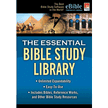
The first couple of copies of the ESV Bible that I bought had postcards in them for a free Bible software package. This software was called Libronix, and was related to a Bible package I had heard of but never tried called Logos. Libronix/Logos provides some pretty amazing tools; you can search for words or topics, or you can generate instant word studies and exegetical guides, or you can pull up several pages of information related to whatever passage you are studying. Within seconds you can literally generate as much information as would have taken a Bible School student a whole day to find 20 years ago. The quality and quantity of information is astounding. A far cry from spending 45 minutes swapping floppy disks to find all the times the King James Version uses the word "love"! The postcards still come free with some new ESV Bible purchases (although I didn't get one when I bought my ESV Study Bible), and the software CD itself comes with some other Bible purchases (The NKJV Study Bible, for example). There are other inexpensive entry-level packages that feature Libronix (like the Essential Bible Study Library, pictured at left); the Logos software packages are fairly high-end and expensive, but that's because they are positively packed with resources. It's great software to check out!

Almost a year and a half ago, I heard about some new Bible software coming out called, simply, "Glo." I looked into the software, and became so interested that I actually blogged about it before it was even released! Since then I have had a chance to try out the software, and it is genuinely revolutionary. That old post has some demo videos embedded that will truly knock your socks off, and the actual experience is just as exciting (and, dare I say it, FUN!) as the videos would lead you to expect. Since its release it has seen frequent updates, which is always nice to see (look back at the Godspeed part of this post for an example of what happens when Bible software is left alone without being updated!) It's even being ported to the Mac and to tablet devices like the iPad. If I had a computer capable of running it, Glo would be the main Bible software on my desktop... unfortunately, it requires a dual-core processor to run smoothly, and my home machine doesn't have that kind of horsepower (it's an older model; if you've bought yours in the past few years, it probably can handle it). I have a copy of it sitting on my bookshelf collecting dust until I get a new computer!

While I was writing this blog post, I installed e-Sword to refresh my memory of what it's like, but besides that I don't actually have any Bible software installed. Why is that? Because online Bible software has just become so darn awesome! Here are a few of my favorite online Bible sites:

BibleGateway.com - this is my go-to Bible site, particularly for viewing multiple translations (I mentioned it in my post about Bible translations last week, in fact). With 25+ translations in English, it's very easy to use for translation comparisons. It's also very link-friendly, so if you want to tweet a Scripture verse or passage, or email a friend a link, or post on Facebook... Bible Gateway is very easy to use. They are currently beta-testing the new version of their site; find that beta version here.

Blue Letter Bible - this oddly-named site is also oddly-designed, but once you get used to the weird "K-C-L-I-V-D" buttons, you will discover some fairly deep information. I use it all the time for Greek/Hebrew tools... it's my favorite place online for drilling down to the Strong's definition, and then spreading back out to find all of the places where that word is used in the original texts.

BibleStudyTools.com - another great multi-translation site. I used to use this one from time to time, but I find most of what I need on Bible Gateway or Blue Letter Bible, so it's not high in my bookmark priority list. But it's absolutely a great site to try out.

The makers of Logos and e-Sword actually have their own online Bible sites. Take a look at Bible.Logos.com or e-Sword LIVE to see what they've got!

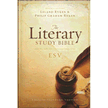
Several years ago, the publishers of the ESV Bible began to make the full contents of their study Bibles available online. The first one I remember being that way was the ESV Literary Study Bible; there was a limited preview period, then you could pay a small fee to have your access continue indefinitely (their shopping cart has been broken for some time, so presumably the online access purchase option wasn't terribly popular). The Literary Study Bible doesn't particularly have a lot of study notes; it's primarily oriented toward book and section introductions, and lets the text mostly speak for itself. Because it's more about reading straight through than pinpointing a particular verse, I don't find digital access very useful (I own a paper copy), but you might. It's free to try out, anyway.

The next online study Bible I heard of was the ESV Study Bible. It was published simultaneously in bookstores and online, and if you bought a physical copy you also got a code you could use to access the online copy, which contains all of the same materials that are in the one on your bookshelf. The original site has been upgraded and now the ESV Study Bible Online lives at ESVonline.org. (I actually wish they would roll the Literary Study Bible site into this one too; it might give new life to that LSB material to have it on an upgraded platform.)

About four months ago I was at my local Christian bookstore looking for a demo copy of the HCSB Study Bible when I saw a sticker on one of them that said something along the lines of "Visit MyStudyBible.com!" I wrote the site name down and looked it up when I got home, and to my surprise, the site contains, and will always contain absolutely free, all of the material from the HCSB Study Bible! ESVonline.org and MyStudyBible.com have a lot in common, and they're both terrific study Bibles, so I would highly recommend both sites. I blogged about MyStudyBible.com here.

But what about when you're not at your computer? Well, there are tons of Bible apps out there for your cell phone, and there are online sites that have mobile versions, but I'll just mention the app that I consider the cream of the crop: YouVersion.
YouVersion
Their mobile offerings include apps for iPhone and iPad, Blackberry, Android, Palm, and even Java and Symbian. Any translation that is available on their Web site is also available over the air via the apps, and some of the translations are downloadable for offline use. And if your phone isn't up to apps, you can use m.YouVersion.com for a phone-formatted version of the Web site. YouVersion is completely free - it is a ministry of LifeChurch.tv church, and a lot of the work on the apps is actually done by volunteers. That doesn't mean that the apps are bad at all, but it does mean that depending on the availability of developers for the platform, some of the apps may have different feature sets than others. The church is deeply committed to YouVersion, and there are several full-time staff members there who are dedicated to it alone. Take a look at the YouVersion blog to see how excited they are about it!

Are digital Bibles making paper Bibles obsolete? Are online Bibles edging out Bible software? Is mobile the way of the future? Well, I'd say that computerized Bibles have made Bible study much quicker and easier, and mobile Bible offerings have made it much easier to read the Bible wherever you are, but I think there is still a place for physical Bibles, and for computer Bibles, and for mobile. To me, the mobile offerings are about convenience, while computer Bible study tools (online or installed software) are best for fast but still in-depth study, and physical Bibles are best just for the sheer joy of reading. I think each is a different experience, just like listening to the Bible on an audio CD is different from reading it yourself. But it's all the Word of God, and I think it's great to have many ways to access it! It's wonderful to live in a time in history when there are so many ways to hide the Word in your heart. Hide it today!


If you're interested in purchasing some Bible software, ChristianBook.com's Bible software store is a good place to start looking!

Monday, January 31, 2011

Too Many Bibles? ...Bible series, part 1 of 6

Bookshelf with many Bibles on it

"Flash poll! How many Bibles do you have in your house?" That was the start of a post I made on Facebook a little while back. The discussion that followed unexpectedly became quite heated, and I wanted to address some of the things we talked about in that thread here in my blog. This will also be the first in a mini-series of posts about the Bible that I've been wanting to do for some time; stick with me this week and next week and see where this goes! Also, although I don't mention this very often, it's always true: the comments area is open for comments and even discussion. I personally approve each comment so that I don't wind up with a bunch of spam or profanity or whatever on the blog, but I don't censor honest differences of opinion. So comment away!

At my house I have more than twenty physical Bibles, most of which are full Bibles instead of just New Testaments. (My friends reported having as few as 2 physical Bibles, and as many as 15-19.) The Bibles you see pictured above came through many different channels before they wound up on my bookshelf, and I want to tell a few of those stories, but first I want to address something: 1980s Translation Fever.

I grew up in the 1970s and 1980s. Prior to the 1970s in the United States (and keep in mind that I am not a historian, so you may be getting a view that is slightly skewed by my own experience) the King James Bible pretty much reigned supreme in Protestant churches. Oh, there were other translations out there... the American Standard Version had been out since 1901, and the modern revision of it, the Revised Standard Version, had been released in the early 1950s. But I never saw much of those translations growing up. What I did see were more and more brand-NEW Bible versions popping up. The Living Bible, which is actually a paraphrase of the 1901 ASV and not a translation (but who understood about that back then?) came out in 1971. The Good News Bible, which actually is a new translation designed to be much easier to read, came out about five years later, followed closely by a translation that has enjoyed an incredible amount of popularity ever since, the New International Version. The early 80s saw the New King James Version in the Christian bookstores. I'm not at all trying to name every single translation that came out, because I've almost certainly missed some, but those are the ones that turned up on my "Hey, I can understand this Bible!" Christian kid radar.

Well, this wealth of new Bibles may have been bewildering to some, but to those of us who had become a part of the "Word movement," these new Bibles contained riches to be uncovered. We also discovered the Amplified Bible, which had come out slowly over the course of a decade or so in the 50s and 60s. These different translations provided different perspectives on what the Bible said, and I think most of us had in the backs of our minds the idea that we wanted to find the "best" translation, the one that was truest to what the original Hebrew/Aramaic/Greek texts said, and also the one that was easiest to read. (I'd say those qualifications are a lot more complex than you might think at first; I'll talk more about that next time.) Point being, there were good reasons for having at least a couple of translations around. If you were having trouble understanding something in one of them, look up the same verse in another translation and see if it could shed some light on it. It was like having several smart people standing around telling you what the Word said: if one of them couldn't explain it well enough, you turn to another one. In the circles I was in, quite often a minister would say something like "This doesn't mean what it says in the King James. I like how it says it in the [INSERT TRANSLATION NAME HERE]..." which made it seem like the King James was a very faulty translation (this is a misconception, and I'll talk about that more next time as well.)

All that to say, back in the day there were extremely good reasons for having two or even three or four translations at your disposal. And remember, for those of you younger than thirty years old, that personal computers were in their infancy then. They were very slow, and no home computer had enough memory to even think about holding even one entire Bible text in memory at a time. The first time I saw a computer Bible I was in high school, and it was King James and it was on about a dozen floppy discs (each of which could hold about 90kB of information... one "kB" is one one-thousandth of a megabyte!) and to search the whole Bible you had to put each disk in, one at a time, and wait several minutes while it searched that part. It took FOR EVER. Hard disks were a strange new world in those days; not many people had them. So in order to have multiple translations of the Bible, you had to open up space on a bookshelf.


Bibles from my childhood
And that's where several of my Bibles came from. I have my first NIV, which I bought for myself with money I was given for college (best purchase I made with that money!) ...you can see the spine of that green-cover Bible, worn to a frazzle, at the bottom of this post. I have a Good News Bible from back then, and a couple of King James Bibles I had as a kid. I have Bible or two that previously belonged to my parents, different translations that they let me keep because they had other copies of them.

I also have Bibles that I keep for sentimental reasons, like the little red King James Gideon Bible I was given (at school!) in high school. I actually carried that one with me for several years; the cover is about to fall off it, but it reminds me of being a Christian in high school. It's something I can show my own children one day if they wonder what I think about having a Bible at school. I have one or two beat-up Bibles that I owned as a child; it's fun to look back and see the things I wrote in them based on my limited kid understanding of the Word and the World. I have a Bible, signed "Oral and Richard Roberts", which was given to me when I graduated Oral Roberts University (all of the graduates got them). I have another Bible that was given me when I completed the membership class at a church I attended for many years. Those last two Bibles have never been read; for me they are symbols of milestones in my life, and I keep them for that reason.

I also have some foreign-language Bibles. One of the Spanish Bibles I have is actually a Spanish/English parallel Bible that I was given by my parents to take on a missions trip to Mexico during my college days. My folks signed it, and it's a keepsake that I won't part with (also, the English translation is the RSV, which I don't have another physical copy of).

2 Spanish Bibles and One Vietnamese Bible
If I remember correctly, the Vietnamese Bible is in my hands because of a small home group I once co-led which consisted of Vietnamese teenagers. I have another Spanish Bible, and I honestly don't remember where that one came from. I don't read Vietnamese at all and I don't read Spanish very well, so now that I'm thinking about it, I may donate those to congregations in my area who speak those languages. But they also represent seasons of my life, so it's nice to have them around for that reason.

For a long time after I bought my green NIV when I went off to college I didn't buy any new Bibles. I had what I needed, I loved my NIV, it fed me the Word. But when the English Standard Version came out a decade ago, I became very interested and bought a new one for myself (it's the translation I generally quote on this blog). The release of the ESV Study Bible piqued in me a new interest in study Bibles, which I had had limited exposure to before then, and now (as you know if you've been reading this blog for a while), I'm darn near obsessed. Many study Bibles are almost like a Bible and a commentary in one book, and I love being able to gain background information and insights along with my reading. So most of my recent Bible purchases have been study Bibles, although I've been trying to diversify the number of translations I pick up at the same time.

Is twenty Bibles too many? Twenty-five? Thirty? How about a hundred? A large Christian bookstore could quite easily have fifteen or twenty different translations on their shelves, and if you went shopping online you could find thirty or forty different translations (legitimate ones; I'm not even counting fringe translations, cult translations, etc.). Heck, there are currently four different versions just of the NIV, with a new one on the way to be published this year. How many do you need? How many is it okay to have? Well, the fact is, the Word of God is the Word of God, and as long as the people who translated your Bible were seeking to represent the truth of the Word to the best of their abilities, if you enjoy reading that Bible and spending time learning from it, that's the only Bible you need. That one Bible will serve you well for a lifetime. But what if you like reading different translations? Comparing, contrasting, seeing different aspects of the text in different phrasings? Is it bad to have many Bibles? Obviously, my answer is going to have to be "no!" It's not bad to have many Bibles. And honestly, if you live in the United States of America, you're not taking a Bible out of someone else's hand to have a new Bible. We're cranking out new ones every day, and if someone wants a Bible, there are churches and parachurch organizations (like the Gideons) who will give them their own Bible for the asking. In fact, if someone asked me for a Bible, I wouldn't hesitate to give them one of mine, or even buy them their own; I have some little paperback ESV New Testaments that I bought specifically for this purpose. Yes, there are people in other countries who have one Bible for their whole entire underground church, or who don't have access to a Bible at all... but if I didn't have the ESV Study Bible that's sitting on my nightstand, they wouldn't have it either. The guy who walked into the Christian bookstore after I did would have it on his nightstand. BUT: if you are concerned about peoples across the World who do not have access to the Bible, I encourage you to look into organizations such as Wycliffe Bible Translators, which supports missionaries who translate the Bible into languages which do not have it yet, or the American Bible Society or International Bible Society which send Bibles to places where they are needed and wanted. Get involved financially, or get involved in missions work or volunteer work within those organizations. Enjoy the Bible(s) you have at home, and make it possible for someone else to experience that same joy!

There's an old saying that if you don't have a red Bible, you might as well not even have a Bible. Oh, did I say "red?" I meant read. If you don't have a read Bible, you might as well not even have a Bible. If you haven't read it, it's not in your heart, and God can't really use the Bible on your shelf to change your life. Only by putting the Word of God in your heart can you gain any benefit from it. So no matter if you have one Bible or fifty, READ. Open them. Study them. Read the notes and follow the cross-references. Find out what God's Word has to say to you. Because no matter how many books you have on your shelf, the one Bible that really matters is the one you have in your heart.


Two Bibles With Covers I've Worn Out

Friday, December 31, 2010

Bible in a Year (and a half)


About this time last year, I decided that 2010 was going to be the year that I read all the way through the Bible. As you can see from my blog post on New Year's Day, I had decided to make it through no matter what. It wasn't a "resolution" as much as just a "decision" - I realize that both words mean pretty much the same thing, but to me a "resolution" sounds like something very formal, something that will have consequences if you don't do it, and something you are destined to fail at. A "decision" is just something that means that you're making a simple change in your life; it used to be this way, and now it's another way.

So I'll cut to the chase: I didn't make it all the way through this year. Today I finish the last chapter of Proverbs. There are a few reasons for this; I want to share them, not to excuse or explain myself (it's not like I did anything wrong, after all!), but I'm thinking that if there are other "Bible-in-a-year-failures" reading this, they may be encouraged by this when something happens to them and trips up their schedule!

I was on track for the first couple of months of the year, right on schedule with the plan I had (pretty much arbitrarily) picked out. I was actually reading the Bible text and the study notes from my ESV Study Bible, which was a bit above-and-beyond the whole "reading straight through" thing, but I wanted to make sure I was understanding what I was reading. A book or two into it, I got an NIV Study Bible too, so I started reading the ESV text, then reading the ESV Study Bible notes, then reading the NIV Study Bible notes. It's like my own little mini Bible school! It's particularly interesting when the two sets of study notes have different perspectives on the same topic; it gives me a chance to see two sides of the story and form my own opinions. After a month or so of this, I started noticing that my attitude and outlook was changing. I was being transformed by the Word!

The problem with adding this extra reading on myself is that it made the schedule that much less forgiving. It was harder to catch up when I got behind, and it was harder to decide to do my reading on days when I was tired and knew concentration wouldn't be easy. And then something happened to make it even harder: We had not one, not two, but three deaths in our family, and all were people I was rather close with: my grandfather, my wife's father, and my wife's brother's wife all died within a span of couple of months. Not only did we have traveling, funerals, and visiting with family to take up our attention, but frankly there were nights when my wife and I didn't get an awful lot of sleep. There were weeks at a time this year when I felt fatigued every single day from not enough rest. If that's not enough to throw you off schedule, I don't know what is.

But I can't blame being this behind on only that, because I'll admit it: some nights I just didn't feel like it. Some nights I could have read, and I didn't. So an embarrassing amount of the "behind schedule" came from plain old laziness.

So I didn't read all the way through the Bible this year. But you know what? I read through more than half of it! And if it takes me all next year to read the other half, and if I do it, then I will have read the whole thing! And learned a lot in the process. One year is not a magic number. There's nothing in the Word itself that says you have to read all the way through the whole thing in one year. It's completely arbitrary. But one big thing I learned this year is that if you immerse yourself in the Word for a long enough time, the Word begins to immerse itself in you! My Bible reading this year had an unmistakably positive effect on me, and I expect my reading in the coming year will have a similar positive effect. Actually, I'm pretty excited about getting into the Prophets... that was one of the things I really wanted to get into! I can't wait to dig deep into Isaiah, Jeremiah, the whole bunch of them. And now that I have a grasp on the historical events surrounding them, I should be able to understand them even better!

I definitely, unreservedly recommend a consistent Bible reading regimen for everyone. If you don't read every single day, that's still OK. If you read maybe three or four days a week, it will still transform your life. But if you do want to go all the way through the Bible, there's an abundance of help out there! If you need help figuring out where to start or how to do it, my blog post from New Year's Day 2010 has some help, but this year I've run across some other resources:


In this age of mobile devices and Internet connections in almost every home, there's no reason not to get involved in the Word. Just make a decision to do it! Become a "fan" of the Word (and I'm not talking about Facebook here!) Get interested. Get excited. Get into it! It will change your life!

Tuesday, October 19, 2010

Win A HCSB Study Bible

Christian Book Distributors has three very nice Holman Christian Standard Study Bibles on their contest page, to be given away October 31. Enter to win at http://tinyurl.com/CBDContests! Bookmark that contests page and visit periodically; they always have lots of contests going on, and they give away all kinds of great stuff, not only Bibles. Christian Book Distributors is a great place to shop online for Christian materials if there's no Christian bookstore in your area!

Wednesday, October 6, 2010

HCSB Study Bible Online

I've been looking at a new Bible Web site. It's pretty great stuff! But before I point you that way, let me give you a quick run-down of how I found it.

Mostly on this blog I talk about the ESV, but I've gained a great deal of respect for the HCSB as a kind of more-literal NIV. I'm also a Certified Study Bible Junkie. So when I recently saw an ad for the new Holman Christian Standard Bible Study Bible, I immediately was interested. Here's a video of some of the features of the paper HCSB Study Bible:


So anyway, last week I was at a local Christian bookstore looking at the HCSB Study Bibles, and I saw a Web link printed on them: MyStudyBible.com. I wrote it on my built-in note pad (my hand), and when I got home I loaded it up. Turns out it's the new online version of the study Bible... and at least for the time being, it's free! Take a look at what it can do:


Right now the system is in beta testing (the link forwards to http://beta.mystudybible.com), and there's no indication whether Broadman Holman intends for it to be free forever, or to begin to charge for it at some point, so try it out while you can!

At first glance, it appears that they've taken some cues from the online version of the ESV Study Bible. Here's a brief video of that (most of the online videos of the ESV Study Bible are for the older version, which has been superseded by a new iteration, so this is all I've got):


Obvious similarities: two panes (actually, the ESV site defaults to three, but I just use two). Scripture on the left (usually), additional material on the right (usually). Bible verse search box above the left-hand pane, with the Scripture reference you're looking at in light gray text except when you're typing in a new one. The notes follow the Bible text as you scroll. But after that, the similarities end and the feature sets diverge a bit.

One thing I really like about the ESV online study Bible is the "endless scrolling" of the Bible text. When you get to the end of a chapter, the next chapter automatically follows it. The Holman online study Bible doesn't do that. The ESV OSB also has configurable bookmarks and a built-in audio player so you can listen to the Bible text. And the ESV OSB has Bible reading plans built in to give you a framework for your Bible study. The Holman OSB, on the other hand, is heavier on word-study tools; you can turn on links to Strong's definitions directly from the text, and the same information is also available in the right-hand side pane. It also incorporates the Holman Illustrated Bible Dictionary for word definitions, and commentaries such as the Holman New Testament Commentary. It's clear that B&H is building a platform on which they can host a lot of material from their library; the ESV Online Study Bible only contains materials from that one book (although there is a VAST amount of information in that one book, and I've read hints that the architecture of this version of that site is designed so that they can add materials later on). For access to deeper study materials, the HCSB OSB currently has the ESV OSB beat by a landslide. When I've wanted access to Strong's word definitions, I've had to get them at Blue Letter Bible; now I could go to the HCSB OSB instead and find a much slicker interface.

There are some clunky parts left to be ironed out; for example, if you click a "read more" link, the full text of the study note opens automatically in the left-hand pane, right over the Bible text. The Bible text is still there, of course; it's just on a separate tab. But I'd rather see the full text of the note appear in the right-hand pane and not cover the Scripture text. You can move the tabs from pane to pane quite easily, but it strikes me as awkward for it even to happen that way in the first place, especially seeing how much effort they've put into the interface. Maybe that's one of the things that will come out in the wash as they move from beta to release version. On the other hand, things like verse popups when you hover over a cross-reference indicator are much more intuitive on the HCSB OSB site than on the ESV OSB site.

A few more odds and ends: the ESV OSB has a really nice setup for copying verses to paste into something else; I use it all the time for this blog. The esv.to Bible verse linking facility points to the ESV OSB as well, which makes for extremely easy linking from blog posts, Tweets, or anywhere you might want to link to a Bible verse. The HCSB site doesn't seem to have anything like those two features, but on the other hand, the HCSB site also contains the KJV text, and you can even set it as your default if you like.

The ESV online study Bible is a pay service; access to the Bible text is always free, but access to the study notes is $19.95, or free to anyone who purchases a hard copy of the ESV Study Bible. Currently the HCSB Online Study Bible is completely free, and I wasn't able to find any indication that they plan to charge for it in the future (see update at the bottom of this post), but I can't imagine a publisher simply giving away all of the resources they're putting out there. My guess is that the free access is a beta testing/generating buzz thing which will eventually lead to a pay service, much like Crossway gave away access to the ESV OSB for a bit back when it was brand new. I'd say if access to this new Holman site is in that same $20 range, and if it includes even only the study resources you can see today, that's a pretty amazing bargain. The HCSB text + Study Bible notes & cross-references + Strong's definitions + Bible dictionaries + a whole shelf full of commentaries = quite a value, even at a much higher cost. The link on The HCSB Study Bible site says that MyStudyBible.com contains "more than $200 in free resources" and I totally believe it. I'm looking forward to spending a little more time with the HCSB Study Bible notes to see how much I like the content, but the site is feature-rich and the materials look very useful. I think it's a great start for a new Bible Web site.

A list of HCSB Study Bibles you can buy

The official site of the HCSB translation

UPDATE: After I wrote this post, I found this in the site's FAQ:
Will this site and this content always be FREE?
Our current intention is to keep all of the books that are in this BETA site free forever! And we plan to add more free books! Later, we expect that publishers will need to charge for royalty-based books. When we add those royalty-based books, we will let you know how to access them.

Thursday, July 29, 2010

The Book of Psalms (not just psalms in a book)

I've been learning all kinds of interesting details on my quest to read the Bible all the way through this year. I'm not just reading the text itself; I'm also reading the study notes from my ESV Study Bible and my NIV Study Bible (although for the book of Job, I decided to stick with the ESV Study Bible only, since interpretations on Job can vary widely and I didn't want to confuse myself).

Well, I'm partway into Psalms now, and I'm learning something I didn't know before! The Psalms are of course individual compositions (with a couple of exceptions where one finished work seems inexplicably to have been divided into two psalms), but the book is actually in some spots pretty tightly organized by theme. I mean, anyone who's read through the Psalms knows that there are sections called "Book One" and "Book Two" and so on, five in all, but even within those sections, things are often tightly organized.

Let's take the part I just finished reading: Psalm 15 through Psalm 24. These psalms are arranged in a mirror-image format, with a kind of "hinge" at Psalm 19. Let me show you what I mean. Take a look at Psalm 15:
O LORD, who shall sojourn in your tent?
      Who shall dwell on your holy hill?

He who walks blamelessly and does what is right
      and speaks truth in his heart;
who does not slander with his tongue
      and does no evil to his neighbor,
      nor takes up a reproach against his friend;
in whose eyes a vile person is despised,
      but who honors those who fear the LORD;
who swears to his own hurt and does not change;
who does not put out his money at interest
      and does not take a bribe against the innocent.
He who does these things shall never be moved.
Now take a look at verses 3-6 of Psalm 24:
Who shall ascend the hill of the LORD?
      And who shall stand in his holy place?
He who has clean hands and a pure heart,
      who does not lift up his soul to what is false
      and does not swear deceitfully.
He will receive blessing from the LORD
      and righteousness from the God of his salvation.
Such is the generation of those who seek him,
      who seek the face of the God of Jacob. Selah
Obviously, there's some synergy going on there! The two psalms are related. After I read Psalm 15 and the excerpt from Psalm 24, I went on to the lovely Psalm 16 (here's an excerpt):
The LORD is my chosen portion and my cup;
      you hold my lot.
The lines have fallen for me in pleasant places;
      indeed, I have a beautiful inheritance.

I bless the LORD who gives me counsel;
      in the night also my heart instructs me.
I have set the LORD always before me;
      because he is at my right hand, I shall not be shaken.
(Psalm 16:5-8)
I read that and thought, "What a beautiful, peaceful psalm! I wonder what it matches up to?" then I realized that its partner is the beautiful, peaceful, and much more famous Psalm 23!

The next partner, I realized, was Psalm 22, the psalm that begins with "My God, My God, why have you forsaken me?" and ends with the idea (but not the actual phrase) "It is finished." In the middle it describes the suffering of one anointed by God, begging for God's help to escape his enemies. The writers of the New Testament, particularly Matthew, used this Psalm in telling the story of Christ on the cross. I wondered how Psalm 17 was going to match up. See what you think in this excerpt:
Keep me as the apple of your eye;
      hide me in the shadow of your wings,
from the wicked who do me violence,
      my deadly enemies who surround me.

They close their hearts to pity;
      with their mouths they speak arrogantly.
They have now surrounded our steps;
      they set their eyes to cast us to the ground.
He is like a lion eager to tear,
      as a young lion lurking in ambush.

Arise, O LORD! Confront him, subdue him!
      Deliver my soul from the wicked by your sword,
from men by your hand, O LORD,
      from men of the world whose portion is in this life.
You fill their womb with treasure;
      they are satisfied with children,
      and they leave their abundance to their infants.
(Psalm 17:8-14 ESV)
Psalm 18 is a slightly modified version of 2 Samuel 22, where David is praising God for saving David from his enemies. Its counterpoint is actually two psalms: Psalm 20, a prayer by the people that God would give success in battle to their king, and Psalm 21, a psalm of praise from the king to God for the answer to the prayer of the previous psalm. It's easy to see that the themes, if not the exact content, of the three psalms are related.

Psalm 19 is the hinge between the halves of the mirror-image; it ties things together quite nicely. It particularly evokes the "Who?" and the focus on holiness from Psalms 15 and 24, but it also touches on nature themes like the ones in Psalms 23 and 24. The most prominent part of Psalm 19, verses 7-11, is a hymn to the perfection of the teachings given to humanity by God.

Maybe some people spot these kinds of connections between parts of the Psalms without any help. Certainly, someone was the first person to spot them. But great study materials do a terrific job of helping you see things you might not spot yourself without them. I've really been enjoying both of the study Bibles I've been reading, but for connections like this in Psalms, the NIV Study Bible has the ESV Study Bible beat hands down (the ESV Study Bible has its own strengths, though; it particularly seems to do a good job of directing you through the Scriptures like a tour guide, while the NIV Study Bible sometimes focuses on arcane details to the point of losing the forest in the trees). I would highly recommend either (or both!) of those study helps. Click one of the links at the head of this article and order one for yourself, or buy them from a Bible bookstore near you (I bought my ESV Study Bible locally, and bought my NIV Study Bible from ChristianBook.com). But even if you don't have a study Bible, get some Bible and spend quality time in God's Word. It is the most rewarding, valuable thing you will ever do.

Saturday, June 19, 2010

Return of the Study Bible Junkie

A few days ago, I fed the monster. I bought not one, but two study Bibles!

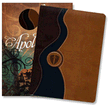
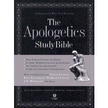
Actually, to be fair to myself, one of them IS a gift. I promised my niece-in-law Olivia that I would buy her a nice new copy of the Apologetics Study Bible for Students; it was on sale at Lifeway so I picked it up there. It's an awesome HCSB Bible that's full of supplemental articles covering tons of issues that young people are likely to run into in college (or even in high school). How about an article on "If I Can't See God, How Do I Know He's Real?" or one about "Does the Bible Contain Errors?" or maybe "How Important Is Darwinian Evolution?" or "Aren't All Religions Basically the Same?" or "Can God Make A Rock So Big He Can't Lift It?" The answers are well thought out, logical, and meaningful. Here's a little more about this Bible:


While I was there, I took advantage of another sale that was going on... I picked up a hardback copy of The ESV Literary Study Bible for ten dollars(!) You can't beat a $35 Bible for a ten-spot, and if you read my previous Study Bible Junkie post, you already know that I was planning on picking one of these up anyway. So I saved myself some cash and picked it up early!

Am I an addict? Is this bad? Am I just buying multiple Bible so I can be smug about my Christianity? Well, I haven't bought them because it makes me feel more Christiany; I've bought them because it gives me multiple ways to learn about God's Word. I haven't read all of them yet... but I will. The old joke... the only useful Bibles are the "red" ones, because if you don't read 'em they can't help you... these will all eventually be "read" Bibles. And hopefully I'm modeling a reverence for God's Word for my children, and at the same time making a resource available for them when they are old enough to use it.

I have maybe three or four more "study Bibles" in mind that I would like to get my hands on, but I'm in no hurry to buy more of them. The ones I have will literally take me years to get through without ever reading the same one more than once (although I'll be looking at the ESV translation twice, because I have two different study Bibles with that translation) and when I run out, there will be something else new to check out... but even if I make it through all of them and study Bibles have suddenly stopped being made, we have enough Bible knowledge in just the six study Bibles in our library to start again at the beginning and learn all new stuff. In the United States of America in the year 2010 we are so blessed in the amount of sheer Bible knowledge that is available to us for very limited amounts of money. Some people graduate from seminary knowing less about the Bible than the information on my one bookshelf. What a blessing!

I'm going to go read my Bible now!

Monday, April 5, 2010

Study Bible Junkie

On Easter of 2005, everybody in my family got new Bibles.

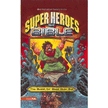
My baby girl wasn't born yet, but my little boy was almost 5 years old at the time, and we decided that it was high time he had his own kid Bible. My wife needed a new Bible too, and I had my eye on an ESV Bible (I had been a long-time NIV reader, but I wanted to switch to the more literal translation - and I've never looked back!) I had done some looking around and I had discovered what I believed (and still believe) is the most awesome kid Bible ever created: the NIrV Super Heroes Bible. Take a look at that cover: that's Moses parting the Red Sea! The Bible has forty of those incredible, comic book style illustrations of Bible "Super Heroes" like Elijah, John the Baptist, David (and Goliath), and even some of the awesome female super heroes of the Bible like Mary, Queen Esther, Deborah, and Ruth. The pictures are filled with action and humor, but are never irreverent. Perfect for getting a kid interested in looking at what's in their Bible! There are also over 200 profiles of Bible characters, written at a kid's level of understanding. (The ironic thing about these well-written profiles is that the vocabulary and sentence structure are actually harder than the NIrV translation itself is!) We bought this Bible for him partly because the translation is very easy for beginning readers. When he turns ten next week, we might think about upgrading to an NIV.

My wife Cathy picked out an NIV Life Application Study Bible. It has book introductions, maps, all of the regular Study Bible stuff, but the text notes on each page are focused on "How does this really apply to me? What does this mean to my life?" She actually had a tough time concentrating on the message in Church for a while because she would get distracted by the study notes! (This is the main reason I still to this day bring a more plain-jane Bible to church with me!)

That was my first brush with a study Bible... well, as a high school student I owned a New King James "Open Bible" (they are out of print now) and I really loved it a lot. As I remember, I gave it away to someone that I felt needed it more than I did. I really wanted a study Bible in the ESV translation, but at the time there really wasn't one! I went with a small ESV Compact Trutone Bible which is almost the opposite... no study notes, no book introductions, no cross-references. It actually served me very well for many years, but I still wanted a study Bible in the ESV translation.

The first ESV-translation study Bible I remember hearing about was the ESV Reformation Study Bible. I actually checked a copy out from the library, and enjoyed it quite a bit, but I was a little bit nervous that it is self-classified as a "reformation" Bible; I was concerned that the notes might be slanted toward "reformed" Theology, and I wasn't quite comfortable with joining that camp whole hog. I wouldn't at all mind having this Bible in my library, but it wasn't really "the one" that I wanted to have for my primary study Bible.

The next ESV study Bible that came out was The ESV Literary Study Bible.. This Bible focuses on the Bible as a book, a work of literature. This might trigger red flags for some, but really, it shouldn't. The Bible is a book. It's got characters, settings, and plots. It's also got poetry, historical accounts, and letters. The Bible is a book consisting of dozens of genres of writing, and it is valuable to understand those genres in order to truly understand the Bible. I was very interested in this Bible, but I really wanted something as my primary study Bible that would explain things like historical details, settings, that sort of thing, and this Bible focuses on the literary aspects. I wanted something that I could approach at a more basic level. I still want to pick one of these up, but it will be a future purchase.

Finally, I heard that The ESV Study Bible was coming out! This was the Bible I was looking for. It didn't look to be focused on one slant on the Bible to the exclusion of others, although it was conservative in its point of view. It had book introductions, study notes, cross-references, and articles about Bible topics. I picked up a sample of the Gospel of John from Mardel and read it straight through... I was hooked! I preordered a copy and picked it up on the day of release. It's my all-time favorite Bible! One of my first projects was to make my way through the book of Revelation, and I came away understanding it in a way I never understood it before. I started to see it as almost symphonic in nature, with a prelude, movements and interludes, loud sections and quiet sections. I'm a trained musical composer, so the fact that the ESV Study Bible caused me to see the Word in a way that made sense to me as a musician was a big deal!

When I decided at the beginning of this year to read my way through the whole Bible, cover to cover, of course my ESV Study Bible was at the center of the whole idea. But I never anticipated just how much having study notes to give me context and background would really help me to engage the Scripture. Reading the Bible isn't like reading the latest Tom Clancy novel; the Bible is a book that was written thousands of years ago in a different language in an ancient culture. There are things that would have been obvious to a Hebrew reader on 1,000 B.C. that just aren't obvious to an American in the year 2010. Some historical and geographical context is critical to really understanding what's going on.

I was so excited about the things I was learning in the Bible that I wanted more! I checked out The NIV Study Bible from the library to give it a test drive.I added it into my study times, reading the ESV text, then the ESVSB notes, then the NIVSB notes. To my surprise, the NIVSB was teaching me additional things that the ESVSB wasn't getting at! Occasionally there are notes in the two that disagree on some small point, but in general, the two simply have a different focus. This seems to be the case with study Bibles; no reference work will tell you everything there is to know about the text, so consulting different sources will often give you more insight into the passage. I bought one from CBD one day when they had it on sale (sometimes they announce one-day sales from their Facebook page), and now my Bible reading time includes two study Bibles!

A few weeks after I added the NIV Study Bible to the mix, I got a sale paper from Lifeway Christian Stores which led to another study Bible purchase. I had seen a video on the Internet talking about the Apologetics Study Bible for Students (you can view the video at that link if you like) and I was pretty impressed with the idea that a study Bible would have its focus specifically on explaining things about the Bible that people have a hard time understanding. I had seen the Web site for the (non-"Student") Apologetics Study Bible already, and so when I saw it on sale in the Lifeway flyer, I knew I needed to pick it up. The weekend of the sale at Lifeway was kind of crazy; it was a "spring sale" on the literal first day of spring, but the day before we had a freak snowstorm and there was like six inches of snow on the ground! I went anyway and picked up another new study Bible for less than twenty bucks, and it's been great. I did not try to add it into my daily Bible reading regimen (two is plenty... I could spend hours just reading notes and following links in those two study Bibles!), but this won't be my last trip through the Bible. The Apologetics Study Bible will probably be my companion on the trip next year, or the next, or the next! It was a good purchase anyway; we didn't have a full copy of the Holman Christian Standard Bible in the house yet, so it was another translation to add to our collection. The Holman translation is a good, solid translation, too... it's probably my second favorite now, next to the ESV. The NIV still holds a place in my heart, though; it's probably my #3 favorite translation.

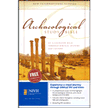
Now that I've become a bonafide Study Bible Junkie, I have my eye on some other study Bibles. I still want to pick up that ESV Literary Study Bible that I mentioned above; my plan is to buy one of those for myself as a reward for making it all the way through the Bible this year (or maybe I'll ask for it for Christmas!) A few years ago I spied an NIV Archaeological Study Bible that someone had accidentally left on the seat at church, and I leafed through it. It has full-color photographs to support the information it contains about the archaeology of the Bible. It's a beautiful Bible; although I haven't looked at one long enough to be able to report on the quality of the in-text notes, it's another one that I'd like to pick up a copy of sometime.

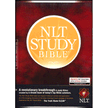
I've had an interest in the New Living Translation for a while, and the best way to satisfy my desire to have that translation and also to get a new study Bible would be to pick up a copy of the NLT Study Bible! The New Living Translation is kind of the child of the Living Bible Paraphrase from the 70s; the NLT is supposed to be a Bible with the clarity of language of the paraphrase, but with the precision of a new translation from the original languages (the paraphrase is a rewording of the text of the American Standard Version, with no reference to the original language texts. Kind of like "The Message" except from the 70s). I've briefly read some passages from the NLT and I liked what I saw; my concern is fidelity to the source texts. I'll just have to spend some time reading it to have a verdict on that. I hope to pick up this sampler of Genesis sometime and spend some time with it; it helped me get the feel of the ESV Study Bible to read a sample, so maybe that will help me with this one too! (If you don't mind reading on your computer, or if you have a Kindle or similar reader that can handle PDF files, you can download that Genesis sampler here.)

In my research about study Bibles, I ran across the NRSV New Oxford Annotated Bible with Apocrypha. I haven't actually seen one, so I'll probably want to spend some time browsing it before I buy (I expect a slightly liberal bias), but it sounds like a well-respected reference work. Plus, I would really like to have a copy of the Apocrypha in my library, again for reference. ("Bel and the Dragon?" What's that? And who is this "Susanna?" Oh wait, didn't she come from Alabama with a banjo on her knee?) Of course, I might just wuss out on that one and pick up the Apocrypha parts by themselves instead.

The Hebrew-Greek Key Word Study Bible sounds pretty cool for in-depth study. I would probably pick it up in the New American Standard version; I already have a beautiful NASB which I carry to church, but there is certainly no shortage of KJV Bibles around here, so since those appear to be the only two choices, probably I'd go with the NASB. I haven't seen one of these Bibles yet, though, so I can't recommend it (same with the Oxford one, and others in this post that it's clear I haven't spent time using).

If you are interested in study Bibles, CBD has a Study Bible Store that you could use for doing a little bit of research on what's out there. I got my NIV Study Bible and my Apologetics Study Bible each on sale for about $20 apiece; watch for sales and you can sometimes get a fabulous deal, particularly if you're cool with hardback copies (I prefer them, actually; they seem to do better on shelves, they're generally a little cheaper, and the covers have some personality to them!) For a deal from CBD, check the Slightly Imperfect Study Bibles store. That doesn't mean study Bibles with faulty Theology, or missing the book of Esther, or anything like that; it just means Bibles with maybe something wrong with the cover or some other minor manufacturing defect. Copies with a flaw that does not detract from their usefulness, but that makes them impossible to sell as though they were new. You can often get them for 40-50% off regular price, and sometimes never even notice the flaw.

There are tons of great Bibles out there, in zillions of translations, styles, designs, colors, and sizes. I've got probably a dozen different English translations in my library (and a couple in languages I don't even speak!), three study Bibles so far, and even one with the events of the entire Bible in chronological order. I even have a metal Bible! (I haven't picked up a waterproof Bible quite yet... then again, I don't read the Bible in the swimming pool!) But all the Bibles in the World can't help you a bit if you don't read them. When we picked out those Bibles five Easters ago, my goal was to find a Bible for each of us that we would like enough to open them up and read them. Pick a version and Bible that you enjoy reading, and get into the Word. These great study Bibles can help, but if cartoons of Bible characters are what it takes to get you to open up The Book, go with the cartoons. Just get into the Bible!


Useful Links
ESV Study Bible
ESV Literary Study Bible
ESV Reformation Study Bible
ESV MacArthur Study Bible
NLT Study Bible
HCSB Apologetics Study Bible

ESV translation
NIV translation
NIrV translation
HCSB translation
NLT translation