Subscribe in a reader or enter your address to get posts via email: 
Like this blog on Facebook!

Showing posts with label Bible series. Show all posts

Friday, February 11, 2011

A Good Read: Hide It ...Bible series, part 6 of 6

How about that... you've made it to the last part of my series about the Bible! You've learned how many Bibles are too many, why there are many different English translations of the Bible, a thing or two about a pile of the most popular English translations, some stuff about those fancy new Bibles with the crazy covers, and some stuff about Bible software. Or at least you learned my take on all of those things! But now lets get down to some nitty gritty. Let's get back to that whole "The best Bible is a red Bible" joke. Let's forget about the physical book for a second and talk about actually consuming the Word.

For a couple of months last summer, a church I pass on the way to my own church had this quote on its sign: "Buy the truth, and sell it not." I recognized the quote right away, although I did have to look it up to be able to tell you exactly where to find it (Proverbs 23:23). I know that it means to work to get wisdom, and once you've got it, keep it; don't forget the wisdom you learn, because it is valuable. But every time I passed that church sign, I wondered what the average non-Bible-literate person might have thought that it meant. For that matter, one trip I asked my own family what they thought it meant, and they pretty much came up dry. Out of context and as a sound byte, the proverb is very nearly meaningless. It's something that you have to pause, and ponder, and take some time out to try to understand. (Kind of a silly thing to put on a church sign, if you ask me, but they didn't ask my opinion!)

I think modern Christians, at least in this country, have sometimes gotten the idea that they have a pretty good grasp of what the Bible says, when in fact they have obtained only a superficial familiarity with and understanding of the Bible. The Bible is a long, complex book. Parts of it are interrelated (the prophetic books and the historical books, for example), and sometimes it seemingly repeats itself (the four Gospels, or the books of Kings and Chronicles). Authors of books that were written later in time often refer to or even quote parts that were written before their time, and the context of a Bible verse is of critical importance to its meaning. It's a real disservice to the Bible that we so often take it one verse at a time, pulling a verse out of a promise box or daily devotions book, and never even attempt to understand the big picture. My quest to read the Bible in a year (which has turned into a quest to read the Bible in two years) has resulted in a real appreciation for the continuity of the Bible. It contains a grand story of God's love for His chosen people, and their (often rebellious) response to His love. There is a continuity that runs throughout, and if you've never read the whole thing, you're coming in halfway through the movie. You're not going to understand everything that goes on.

Another serious deficiency in the understanding that many Christians have of the Bible is that they mostly are familiar with the New Testament. The New Testament is wonderful and important, don't get me wrong... but there's more to the Bible than that. Do an experiment for me: get a Bible (an all-66-books Bible, not a New Testament) and find Matthew 1:1. Stick your finger in there and close the Bible. Now, tell me... is there more Bible before Matthew 1:1, or after Matthew 1:1? The answer is that there is much more Old Testament than New Testament. If the only thing you know from the Bible is Matthew through Revalation plus Psalm 23 and a couple of random snippets from Isaiah and Proverbs, you are severely shortchanging yourself. You don't really know the Bible.

Why should you even bother to know about the Old Testament? Come on, I know you're thinking it. Well, there's a very good reason: Jesus Himself said it was important.
“Do not think that I have come to abolish the Law or the Prophets; I have not come to abolish them but to fulfill them. For truly, I say to you, until heaven and earth pass away, not an iota, not a dot, will pass from the Law until all is accomplished." (Matthew 5:17-18 ESV)
Jesus Himself said that the Old Testament was important; that's reason enough to take a look at it. But even if He hadn't specifically said that, there are good reasons to have a familiarity with it.

The Jewish people of Jesus' day knew about the Scriptures. The writers of the New Testament knew the Scriptures, and quoted from them. When you read one of these places where a New Testament writer quotes the Old Testament, you not only need to know the context of the verse in the New Testament, but you really need to know the context of the verse from the Old Testament as well. Each will illuminate the other, and sometimes knowing the context of the original passage will let you see things in the New Testament passage that you might not have realized otherwise. For an example that I ran across in my reading, see this post on "I believed, and so I spoke." In that particular case, Paul almost quoted the verse as sort of a shorthand, assuming that the reader would know what he meant by it. The phrase "May the force be with you" carries, in our culture, a whole world of meaning along with it. It makes you think of the characters and stories in the Star Wars movies, and it might also carry a pop culture irony with it, depending on how it is used. "I believed, and so I spoke" presumably was familiar enough to Paul's expected readers that he didn't feel the need to elaborate; it was self-explanatory. But unless you are as familiar with Psalm 116 as the Christians of ancient Corinth were, it's not self-explanatory to you! So in order to really understand that passage in the New Testament, you have to also understand the quoted passage in the Old Testament.

Another fallacy I see in our attitude toward the Bible is thinking that reading the Bible is the key to becoming better Christians. Reading the Bible is certainly critical, and it is the first step, but it's only the first step of many. In order to truly gain understanding of the Word, it requires study. You have to immerse yourself in what it has to say. Good tools, such as in-Bible cross-references, Study Bible notes, commentaries, Bible software, and so on can help you make great strides toward a fuller understanding of the Word. Paul advised Timothy to "Do your best to present yourself to God as one approved, a worker who has no need to be ashamed, rightly handling the word of truth." (2 Timothy 2:15 ESV) "Do your best" implies zeal, effort, diligence. If there's not any work involved... if you're just breezing through the Bible so you can say you did... then your gain from reading it will be minimal. Reading alone is not the key. Being serious about knowing the truth of God's word is.

But you know what? Bible study has an element of work in it, but with the right tools and a clear understanding of what you're trying to understand, Bible study can be incredibly fun. It can become addicting. Do you know why? Because you begin to love the Word of God. It becomes part of your intellectual makeup. You want to know more, understand more. You want to see all of the connections. When you fall in love with someone, you can spend hours just studying their eyes. When you fall in love with the Word, you can spend hours studying its teachings, and it feels like minutes. Why don't you try it? Look up your favorite Scripture passage at MyStudyBible.com and check out the "Bible Study Notes" window. If you see a small letter next to a word, put your mouse over it and see what related Scripture references come up. Follow a rabbit trail or two and see what you learn!

I've had a great time writing these six blog posts. I never knew I had so much to say about the Bible, and if you read all the way through all six posts, i sincerely thank you for hanging around. You're the person I wrote this for! If any part of them inspires you to open a Bible (or start up some software, or open a Web page, or install a phone app...) when you wouldn't have otherwise, then I'm thrilled that I was part of it. No matter what color your Bible is, the best Bible is always a "read" Bible... read yours today!

Wednesday, February 9, 2011

Softer Bibles ...Bible series, part 5 of 6

Diskettes 3M 02photo © 2005 Borja Fernandez | more info (via: Wylio)In part 1 of this series I mentioned the first Bible software I ever saw in operation. It was on about a dozen diskettes like the one you see pictured at right; a 5¼" square sleeve with a flimsy disc inside which was capable of holding 720kb of information (for comparison, most of the MP3 songs on my hard drive right now are ten times that size). A search of the Bible text, which was spread across many disks, involved starting the query, listening to the diskette drive thrash around for a while, then when the computer prompted you, taking out one diskette and inserting the next one... for every one of the diskettes. At the time, personal computer hard drives were a bit of a novelty. The software was a bit of a novelty at the time, too; I could look up the words in Strong's Concordance faster than I could look them up using the software. But it was a start!

Fast forward a couple of years. I was at some event, a Christian rock concert or something, and I picked up a demo disk of some software called "Gospel Godspeed." The disk had, I believe, just the four Gospels and not the whole Bible on it, but it was on a single floppy, and the search was lightning fast. The materials that came with the software indicated that the reason for the speed of the search and for the amount of data that would fit on the single floppy was a proprietary compression/indexing method that had been created by the developer. I thought it was incredible! I never ran across the full version, but to my surprise, it appears to still be available. Who would've thought that a piece of Bible software could last 20+ years? If you're under the age of about twenty, click the "Screens of GodSpeed in use and animated demo" link on that page and get a taste of what MS-DOS applications looked like, back before you were born!

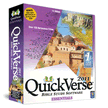
The first serious piece of Bible software I ever owned was called QuickVerse. It arrived on the newer 3½" diskettes (a WHOLE BUNCH of them!), and you could buy multiple translations to add in. By this time hard drives were commonplace, which meant that not only could you have the whole Bible available at once, but you could have multiple translations open at once. One of my favorite things to do with QuickVerse was to divide the screen into four quadrants and open a different translation in each one, and link the four parts of the screen so that when you went to another verse or passage in one window, the other windows would change accordingly. Instant parallel Bible!
This may sound commonplace today, but when I first bought QuickVerse, it was an MS-DOS application, and this seemed positively amazing. You could also unlink the quadrants and display different passages, or open a notes screen in one and take notes, including links to other verses. (I spent some time trying to create a notes file which linked parallel passages from different parts of the Bible; I completed the links between identical events in the Gospels, and did some work in the Old Testament, but I never really completed it. The project died a premature death when the disk file got corrupted somehow, but I learned a lot doing it!)

QuickVerse was good software. I used it for a long time, and even purchased the NIV translation and several other add-ons (I honestly don't remember how many translations were available or how many I had, but I do remember there were several to choose from.) I spent many hours looking up Strong's definitions, doing word studies, and generally having a great time with QuickVerse. Later on a book format called STEP was developed, and Bible-related books in STEP format are still there to be found out on the Internet. I stuck with QuickVerse into the era of CD-ROMs; I still have my CDs of an old version. QuickVerse is still going strong today, with multiple editions available. I haven't used the latest incarnations, but it served me well for many years.

The next Bible software that I came across was much cheaper than QuickVerse. It was free! e-Sword is world-class Bible software at below-the-bargain-basement pricing. Rick Meyers, the software's author (and, incidentally, father of Christian Rock artist Krystal Meyers), gives it away for free for no other reason than that he wants to share the Word with others. e-Sword is amazing software; I've recommended it to many people. There are 20+ translations available for free, and 15+ more available for purchase at a nominal fee; you can view and search Hebrew and Greek definitions, Bible (and otherwise) dictionaries, commentaries, and your own user-generated notes. There are even devotionals and maps to download! The software is easy to use, and if you don't have Bible software and aren't ready to invest in a retail package, give e-Sword a download. It might be everything you need and more that you ever dreamed of, or it might even whet your appetite for something more! e-Sword provides the basics of Bible study software. It's not fancy, but it works well and as advertised.

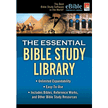
The first couple of copies of the ESV Bible that I bought had postcards in them for a free Bible software package. This software was called Libronix, and was related to a Bible package I had heard of but never tried called Logos. Libronix/Logos provides some pretty amazing tools; you can search for words or topics, or you can generate instant word studies and exegetical guides, or you can pull up several pages of information related to whatever passage you are studying. Within seconds you can literally generate as much information as would have taken a Bible School student a whole day to find 20 years ago. The quality and quantity of information is astounding. A far cry from spending 45 minutes swapping floppy disks to find all the times the King James Version uses the word "love"! The postcards still come free with some new ESV Bible purchases (although I didn't get one when I bought my ESV Study Bible), and the software CD itself comes with some other Bible purchases (The NKJV Study Bible, for example). There are other inexpensive entry-level packages that feature Libronix (like the Essential Bible Study Library, pictured at left); the Logos software packages are fairly high-end and expensive, but that's because they are positively packed with resources. It's great software to check out!

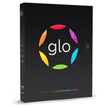
Almost a year and a half ago, I heard about some new Bible software coming out called, simply, "Glo." I looked into the software, and became so interested that I actually blogged about it before it was even released! Since then I have had a chance to try out the software, and it is genuinely revolutionary. That old post has some demo videos embedded that will truly knock your socks off, and the actual experience is just as exciting (and, dare I say it, FUN!) as the videos would lead you to expect. Since its release it has seen frequent updates, which is always nice to see (look back at the Godspeed part of this post for an example of what happens when Bible software is left alone without being updated!) It's even being ported to the Mac and to tablet devices like the iPad. If I had a computer capable of running it, Glo would be the main Bible software on my desktop... unfortunately, it requires a dual-core processor to run smoothly, and my home machine doesn't have that kind of horsepower (it's an older model; if you've bought yours in the past few years, it probably can handle it). I have a copy of it sitting on my bookshelf collecting dust until I get a new computer!

While I was writing this blog post, I installed e-Sword to refresh my memory of what it's like, but besides that I don't actually have any Bible software installed. Why is that? Because online Bible software has just become so darn awesome! Here are a few of my favorite online Bible sites:

BibleGateway.com - this is my go-to Bible site, particularly for viewing multiple translations (I mentioned it in my post about Bible translations last week, in fact). With 25+ translations in English, it's very easy to use for translation comparisons. It's also very link-friendly, so if you want to tweet a Scripture verse or passage, or email a friend a link, or post on Facebook... Bible Gateway is very easy to use. They are currently beta-testing the new version of their site; find that beta version here.

Blue Letter Bible - this oddly-named site is also oddly-designed, but once you get used to the weird "K-C-L-I-V-D" buttons, you will discover some fairly deep information. I use it all the time for Greek/Hebrew tools... it's my favorite place online for drilling down to the Strong's definition, and then spreading back out to find all of the places where that word is used in the original texts.

BibleStudyTools.com - another great multi-translation site. I used to use this one from time to time, but I find most of what I need on Bible Gateway or Blue Letter Bible, so it's not high in my bookmark priority list. But it's absolutely a great site to try out.

The makers of Logos and e-Sword actually have their own online Bible sites. Take a look at Bible.Logos.com or e-Sword LIVE to see what they've got!

Several years ago, the publishers of the ESV Bible began to make the full contents of their study Bibles available online. The first one I remember being that way was the ESV Literary Study Bible; there was a limited preview period, then you could pay a small fee to have your access continue indefinitely (their shopping cart has been broken for some time, so presumably the online access purchase option wasn't terribly popular). The Literary Study Bible doesn't particularly have a lot of study notes; it's primarily oriented toward book and section introductions, and lets the text mostly speak for itself. Because it's more about reading straight through than pinpointing a particular verse, I don't find digital access very useful (I own a paper copy), but you might. It's free to try out, anyway.

The next online study Bible I heard of was the ESV Study Bible. It was published simultaneously in bookstores and online, and if you bought a physical copy you also got a code you could use to access the online copy, which contains all of the same materials that are in the one on your bookshelf. The original site has been upgraded and now the ESV Study Bible Online lives at ESVonline.org. (I actually wish they would roll the Literary Study Bible site into this one too; it might give new life to that LSB material to have it on an upgraded platform.)

About four months ago I was at my local Christian bookstore looking for a demo copy of the HCSB Study Bible when I saw a sticker on one of them that said something along the lines of "Visit MyStudyBible.com!" I wrote the site name down and looked it up when I got home, and to my surprise, the site contains, and will always contain absolutely free, all of the material from the HCSB Study Bible! ESVonline.org and MyStudyBible.com have a lot in common, and they're both terrific study Bibles, so I would highly recommend both sites. I blogged about MyStudyBible.com here.

But what about when you're not at your computer? Well, there are tons of Bible apps out there for your cell phone, and there are online sites that have mobile versions, but I'll just mention the app that I consider the cream of the crop: YouVersion.
YouVersion
Their mobile offerings include apps for iPhone and iPad, Blackberry, Android, Palm, and even Java and Symbian. Any translation that is available on their Web site is also available over the air via the apps, and some of the translations are downloadable for offline use. And if your phone isn't up to apps, you can use m.YouVersion.com for a phone-formatted version of the Web site. YouVersion is completely free - it is a ministry of LifeChurch.tv church, and a lot of the work on the apps is actually done by volunteers. That doesn't mean that the apps are bad at all, but it does mean that depending on the availability of developers for the platform, some of the apps may have different feature sets than others. The church is deeply committed to YouVersion, and there are several full-time staff members there who are dedicated to it alone. Take a look at the YouVersion blog to see how excited they are about it!

Are digital Bibles making paper Bibles obsolete? Are online Bibles edging out Bible software? Is mobile the way of the future? Well, I'd say that computerized Bibles have made Bible study much quicker and easier, and mobile Bible offerings have made it much easier to read the Bible wherever you are, but I think there is still a place for physical Bibles, and for computer Bibles, and for mobile. To me, the mobile offerings are about convenience, while computer Bible study tools (online or installed software) are best for fast but still in-depth study, and physical Bibles are best just for the sheer joy of reading. I think each is a different experience, just like listening to the Bible on an audio CD is different from reading it yourself. But it's all the Word of God, and I think it's great to have many ways to access it! It's wonderful to live in a time in history when there are so many ways to hide the Word in your heart. Hide it today!


If you're interested in purchasing some Bible software, ChristianBook.com's Bible software store is a good place to start looking!

Monday, February 7, 2011

Boutique Bibles ...Bible series, part 4 of 6

In 2003, the book you see at left appeared on Christian bookstore shelves. It looks like a magazine for teenage girls, doesn't it? Inside, according to the cover, you will find a quiz called "Are You Dating a Godly Guy?" An article on "Beauty Secrets," one called "Guys Speak Out On Tons of Important Issues," "How To Get Along With Your Mom," and "200+ Blab Q&A's." You will find those things inside, but you will also find the entire New Century Version translation of the New Testament! This was the first "BibleZine" in a continuing series which includes 'Zines for teen girls (Revolve), teen boys (Refuel), women (Becoming), men (Align), and several more for children, Baby Boomers, whoever. The idea is to provide people with a New Testament in a format that feels familiar and non-threatening. To see a selection of them, check out this list of BibleZines at ChristianBook.com.

Should a Bible look like a magazine? I remember back when this first edition of Revolve came out, there was some controversy over whether it was really appropriate to present the Bible this way. I can't say I've ever had any desire to buy one, but I will say this: if it takes wrapping the Word of God up like Cosmo to get you interested, but once you get into the Word you stay there, bring it on. Bring on the Woman's Day clones, if that's what gets your attention. God can speak to you through the Bible, whether it looks like a leather-bound book, or a paperback novel, or a huge hardback book that covers your whole coffee table, or a glossy magazine.

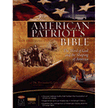
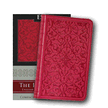
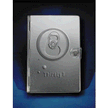
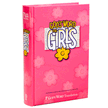
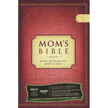
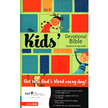
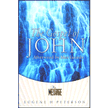
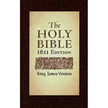
Once upon a time, if you wanted to buy a Bible, to borrow an old quip from the auto industry: "You could have any color you wanted, as long as it was black." At some point that began to change; people realized that paperback books were much cheaper per unit than traditional leather Bibles, making them perfect for outreach. People started liking the idea of having a red leather Bible, or a brown or green leather Bible, instead of just black. Some Bibles, such as the classic Amplified Bible with its distinctive red cover or the classic pea-green Living Bible, seemed to have a specific style all their own. And in recent years, things have changed even more, with Bibles every color of the rainbow, embossed with patterns or pictures, and sometimes, in the case of a few Bibles I've seen for kids, with the cover in 3D! If you dig it, it's probably out there. Want to see a few examples?


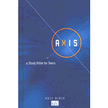
019457: KJV Axis: A Study Bible for Teens541538: The NKJV American Patriot"s Bible, Hardcover47359: ESV Classic Thinline TruTone Bible wild rose with floral design372334: NLT Metal Bible - Thirsty? (Pop-Top Design)
013263: GOD"S WORD for Girls Bible, Hardcover, pink537883: NCV Mom"s Bible: God"s Wisdom for Mothers, Hardcover712440: NIrV Kid"s Devotional Bible, Updated and Expanded Softcover060749: The Message: The Gospel of John

There are Bibles for men, women, mothers, fathers, brides, grooms, surfers, hipsters, teenagers, and children. There are Bibles for teachers, physicians, nurses, police officers, firemen, and members of each branch of the armed forces. There are Bibles with real leather covers, simulated leather covers, metal covers, rubber covers, paperbacks and hardbacks. There are Bibles every color under the sun. There are comic book Bibles and Manga Bibles. I once saw a "green-letter Bible" with the words of Christ in green for some unfathomable reason, and recently I've seen several Bibles that are completely waterproof, pages and all. This year Crossway is releasing an illuminated edition of the four Gospels with hand-painted illustrations and illuminations. If you can't find a Bible that you just superficially like the looks of, you're just not looking hard enough!

Many of these Bibles are simply regular Bibles with fancy covers, but sometimes there's more to the story. There may be more than one translation printed side by side (we talked about parallel Bibles last time). There are several editions of the Bible that are arranged "chronologically," interspersing the various sections of the Bible in the order that the events occurred. Many Bibles include cross-references right next to the text; you can learn an awful lot just spending fifteen minutes following those cross-references. Most Bibles have a concordance, either word-based or topic-based. But other Bibles go further; the Life Application Study Bible, for example, has notes and articles throughout, helping readers to focus on how the Scriptures apply to their daily lives. The Apologetics Study Bible for Students is filled with articles designed to arm students in high school and college to defend their faith in intellectual debates. The ESV Literary Study Bible is designed to help readers understand the Bible as the book it is, with stories, characters, plots, poems, wise proverbs, letters, and other literary forms. Bibles like this are wonderful for devotional times and light study.

Then there are the hard-core Study Bibles. Every translation seems to have at least one; these Bibles contain detailed articles, maps, photographs/illustrations, and detailed in-text study notes. Reading one of these Bibles is sort of like reading the Bible with a knowledgeable Bible scholar sitting next to you, filling you in on the details and pointing out amazing connections with other parts of Scripture. I can't recommend this kind of Bible highly enough; I spent last year reading the first half of two of them, side by side, and it was like a Seminary class in the Old Testament. I included links to one from almost every translation in my Bible Translations post, or you can take a look at this list of Study Bibles at ChristianBook.com and see if there's one you like. The ones I'm reading are the ESV Study Bible and the NIV Study Bible.

Even if you're the kind of person who simply doesn't like to read, we've got you covered. Bibles on CD are easy to come by, and I've even seen some Bibles on DVD! It's incredible what's out there! Seriously, there's no reason to not get interested in the Bible. Find one that looks stylish, that smells good, that matches your occupation, that matches your hobby. But whatever you do, find one. Find a Bible that makes you want to hold it in your hands. Find one that compels you to open it up and read it, frequently if possible. The ChristianBook.com Bible store is a good place to start. Proverbs 4:22 says that the words of wisdom contained within are "life to those who find them;" find some life today!

Friday, February 4, 2011

The Best Bible Translation ...Bible series, part 3 of 6

In my last post I talked a lot about why there are different translations of the Bible into English. Today I wanted to share some of my thoughts about several of the most popular translations available; you can actually find a list of the best-selling Bible translations right here. I'm not intimately familiar with all ten of them, but it so happens that the top six or seven (as of this month) are the ones I want to talk about anyway!

Keep in mind that there are tons of wonderful Bible sites out there where you can test-drive any translation, compare it to one you're already familiar with, that kind of thing. One of the best of these sites is BibleGateway.com, which has about 25 versions in English (depending on whether you count slightly different versions of the NIV as different translations). All of the translations I will mention today are available there. Next week I'll talk more about online Bible reading/study sites, but today I want to talk about the Bible translations themselves. I'm not going to give you a bunch of history on each; you can visit Wikipedia or other sites for that (I'll provide a few links). I'm just going to give my general impressions on each translation, and you can go from there.

King James Version
Wikipedia - Bible Gateway
I talked a lot about the King James Version in my last post; I won't repeat those details today. It's a beautiful, well-respected, accurate translation, and I would never dream of discouraging anyone from using it. For hundreds of years, millions of people have considered it THE Word of God. In fact, if you search Google for about ten seconds, you'll be able to find Web sites run by people who believe it is the only legitimate Bible translation in English. Best quip ever about the KJV: "If the King James Bible was good enough for the Apostle Paul, it's good enough for me!"

The KJV is considered a very literal translation; highly recommended if you're not afraid of the old-timey sentence structure. In fact, some of the things that seem like archaisms (the usage of "thee," "thy," "thou," and so on in addition to "you," for example) are not archaisms but conscious choices by the translators to make it more literal (in standard English, "you" can be either singular or plural; in KJV usage, "thou" is singular and "you" is plural). Despite language that is sometimes clunky by "front page of the New York Times" standards, the King James Version is of high quality and highly respected. It's worth your time.

New International Version
Official - Wikipedia - Bible Gateway
The NIV was almost the only Bible translation that I read for a good decade or more of my life. The English is clear, easy to understand, and for the most part, quite accurate. I have no idea how many times over the years that I heard a minister, preaching from the KJV, correct the translation to what I was looking at in my NIV, but the number is a big one. I even think it could be used from the pulpit; at this point, many Christians are as familiar with the NIV as they are with the KJV. I especially love the Psalms in the NIV; they seem quite musical to me. Over the years, though, the NIV has suffered from some criticism over certain verses, and that plus changes in the English language over the years were reasons for the attempt at releasing an updated NIV called Today's New International Version several years ago, and the new revision of the NIV which is available for reading online right now and which will be released in bookstores this year. To compare the classic 1984 NIV, the 2005 Today's NIV, and the upcoming 2010 revision, visit this page at BibleGateway.com.

The New International Reader's Version deserves a separate mention. This is a revision of the NIV designed for beginning readers. Basically, they simplified the more complex vocabulary, and they cut longer sentences into shorter ones. It's a good translation for young children who are just learning to read, but they will likely grow out of it quickly. One of the ironies of the NIrV Bible we bought for my son when he was five years old (read about that here) was that the dramatized "Bible stories" scattered throughout the text actually were harder to read than the text itself.

New King James Version
Official - Wikipedia - Bible Gateway
If you've ever heard a minister who was reading from the King James Bible but modifying the language on the fly to make it sound a little more "modern," that's a little bit like what you'll get with the New King James Version. The idea was to modernize the language of the classic KJV while still retaining some of the timeless qualities of that translation. I've used NKJV quite a bit myself (although it is not currently one of my actively-used translations) and enjoy and respect it very much. This is the translation my pastor generally uses when he is preaching. The only criticism I have of the NKJV is that the translators used (more or less) the same ancient texts as the translators of the original KJV had used back in the 1600s, which means that improvements in Bible manuscript scholarship since that time were not a big part in the translating process. Ironically, the NKJV has been soundly rejected by those KJV-only folks, even though the KJV they hold in their hands is quite a bit different from the KJV delivered to King James himself centuries ago! The KJV we read today is actually a "new" version of the KJV. If you ever have a chance to spend some time with an actual copy of the 1611 KJV, read a few chapters and then thank your lucky stars that it was re-edited and modernized over time! You would expect the KJV-only folks to have been the biggest supporters of the NKJV, but they apparently hate it.

Use the NKJV if you just like the KJV but want something written in a less-archaic style. Or, use it if your pastor reads from KJV and you can't follow what it means! Your NKJV will be essentially the same in most cases, but you'll be able to understand it better. It will be a little bit like reading captions while listening to someone speaking English with a heavy foreign accent.

English Standard Version
Official - Wikipedia - Bible Gateway
Years ago, the announcement of Today's New International Version translation created a controversy in some Christian circles. The uproar was over something called "gender-neutral" Bible translation. Basically, there are places in the original Bible texts where masculine pronouns are used in a non-gender-specific way. An English equivalent would be the word "mankind," which very rarely only refers to men but usually refers to men and women, the whole human race. An example from the Bible might be when Jesus said "Man shall not live by bread alone," not meaning that only men should depend on the Word of God but that all people should depend on the Word of God. A "gender-neutral" translation might render this phrase "a person does not live by bread alone." This may seem like hair-splitting; the pro-gender-neutrality people would say "That's what the original text means!" and the anti-gender-neutrality people would say "But it's not what the original text says, and people aren't so stupid that you have to rewrite the Bible so they can figure out the pronouns." In 1997, representatives of a number of ministries came together in Colorado Springs, Colorado, and drafted a set of "guidelines" for gender usage in Bible translation. These are known as the Colorado Springs Guidelines, and you can read them here. 

The ESV was among the first translations (maybe the first translation) that consciously sought to adhere to these guidelines. The ESV calls itself an "essentially literal" translation, and like the NKJV it seeks to retain the literary beauty present in the KJV, but the ESV uses the latest textual scholarship available at the time of its translation. The ESV is currently my favorite translation for reading and for study, and it is the translation I generally use on this blog and on the related Web site, ScriptureMenu.com. This year (and last year) I'm reading the Bible cover to cover from the ESV Study Bible and the NIV Study Bible, and there have been several times where the NIV Study Bible notes said things like "The same word is used to translate this word and this word in the original texts," and the NIV translates it with two different words but the ESV translates it using the same word. The ESV is sometimes not as fluid to read as the NIV or some other modern translations, but it is not nearly as difficult to absorb as the KJV or the NASB or other literal translations, and I actually like the fact that my brain is forced to engage when I'm reading it. And there are places, particularly in poetic sections like the Psalms and Isaiah, where the ESV preserves powerful metaphors that other translations gloss over.

The ESV is a great translation to have available to you. Make sure you keep one handy, and bookmark ESVonline.org to read it online.

Holman Christian Standard Bible
Official - Wikipedia - Bible Gateway
In the past year or so I have gained a growing respect and liking for the Holman Christian Standard Bible. It seems to me to have a fluid style like the NIV, but it leans a bit more to the literal side of the equation than NIV. My perception is that its fidelity to the original texts is a notch better than the NIV, but readability was not sacrificed for the sake of accuracy. I'm not sure I would recommend the ESV for young children to read, but I think they could handle the HCSB. By way of making a very subjective, emotional comparison, I would classify the ESV as "majestic," the NIV as "friendly" or maybe "non-threatening," and the HCSB as "warm" and "inviting." Any of the three is a good read; all three are currently favorites of mine.

Have an HCSB on your shelf, and bookmark MyStudyBible.com to read the HCSB Study Bible for free!

New American Standard Bible
Official - Wikipedia - Bible Gateway
Just over a year ago, I won a beautiful, and rather expensive, edition of the New American Standard Bible in an online contest. I actually have a little cheap paperback New Testament on my shelf in the NASB translation, but I can't say I've ever spent any time with it. And to be honest, I was hoping to win a nice ESV in the contest! But this Bible is so beautiful that I've been carrying the huge black thing to church every week ever since. Hopefully people don't think I'm carrying a big Bible to impress them! I'm absolutely not. It's a beautiful Bible, and it's a wonderful translation, with some rather surprising features.

The NASB has an interesting lineage. I mentioned before that the 1611 KJV was revised and modernized to what we now use; this revision, made in the 1880s, is called the "Revised Version." In 1901, a revision of the RV called the American Standard Version was released, and in the 1960s and 1970s this ASV was once again revised and released as the NASB. The NASB you are most likely to find in a Bible bookstore is the 1995 revision of this; this is the one I won in the contest. My paperback NASB New Testament is the earlier version. (The ESV is actually a revision of the Revised Standard Version, which is a revision of the ASV, so the two translations are related.)

The NASB is probably the most literal mainstream translation on the market; I find the sentence structure a bit clunky at times, but in general I like it a lot. And as I mentioned, there are a couple of very unique features of the translation, specifically in the New Testament. One thing I find very useful and interesting is that Old Testament quotations in the New Testament are printed in ALL CAPS, so they stand out clearly. This is actually more revealing than you might think, because not every quotation of the OT in the NT is clearly indicated as a quote by the OT authors. It's very interesting to run across the "hidden" ones that would have already jumped out to a Jewish reader. My other favorite feature in the NASB NT is that on occasion, verbs are marked with an asterisk: "*". The asterisk means that the Greek text actually uses a present tense verb in a spot where the English translation uses past tense; the authors used present tense to make the narrative seem more immediate. In formal English we don't switch verb tenses midstream, but it's not unheard-of in colloquial usage: "So I left my apartment and got to the laundromat, and I'm putting my clothes in the washer, and this lady says to me..." I doubt that knowing when one of those tense shifts has occurred will ever provide a deep spiritual insight, but I think it's fascinating to know about it.

New Living Translation
Official - Wikipedia - Bible Gateway
I haven't yet had a chance to really spend a lot of time in this translation, but what little I've read of it, I really liked. The original intention was to create a revision of The Living Bible, a paraphrase written in the 1960s, but eventually it was decided to create a new translation from the original texts. Although it is not as free with the text as an actual paraphrase, the NLT uses the "thought-for-thought" translation philosophy, which makes it easier to read but potentially less accurate at expressing shades of meaning. I did some side-by-side comparison with an ESV recently, and although I did spot the occasional difference that bothered me a little, overall I would consider it trustworthy for reading; for heavy study I would recommend something closer to the "word-for-word" end of the scale. That said, I have a NLT Life Application Bible sitting on my shelf, and I look forward to delving into it in the near future.

The Message
Official - Wikipedia - Bible Gateway
I'll be straight with you: I'm not a fan of The Message Bible. It is considered a paraphrase, not a translation, although it was paraphrased directly from the original languages (as opposed to the original Living Bible, which was paraphrased from the 1901 ASV). There is no effort to match the vocabulary or sentence structure of the original text or other translations; in fact, most editions don't even bother with chapter and verse numberings. The idea is to be almost like a novelization of the Bible. The language is fresh and immediate and colloquial, and it's certainly fun to read, but I don't feel like I'm reading a Bible when I read it; sometimes it almost feels like a parody of the Bible to me. However, I have friends that I respect very much who enjoy reading The Message, and as long as you don't assume that it's something that it's not, I think it's great if it gets people interested in what God's Word has to say.


Bible Translation Continuum
I mentioned before that there is sort of a continuum for Bible translations, with the most "literal" or "word-for-word" translations on one end, and the most "dynamic" or "thought-for-thought" translations at the other end. You could arrange these eight translations roughly in this order, starting with the most "literal" and ending with the most "dynamic":

New American Standard Bible
English Standard Version
King James Version
New King James Version
Holman Christian Standard Bible
New International Version
New Living Translation
The Message

But you don't have to choose just one; if you look around you can find "parallel Bibles" with two, four, or even more of these translations in them, side-by-side for comparison. The most interesting one I've seen is a The Message/NASB Parallel Bible which, with texts from exact opposite ends of the continuum above, must quiver while you hold it, ready to spontaneously split at any moment! But in all seriousness, if you want to carry several texts with you, there are some really good parallel Bibles out there. I'm kind of partial to this one, myself. We'll talk about electronic Bibles in an upcoming post (and I've already mentioned the Bible Gateway), so comparing translations has actually become quite a bit easier in recent years, but sometimes it helps to just have a couple of translations right on the table in front of you.

Again: which one is best? The "read" Bible is the best. Get one of them, and make sure you've "read" it! The Word of God in a book has the power to prop open a door; the Word of God in your heart has the power to transform lives.


"Basic to the Bible's canonical status is its 'inspiration.' This word indicates a divinely effected uniqueness comparable to the uniqueness of the person of the incarnate Lord. As Jesus Christ was totally human and totally divine, so is the Bible." - ESV Study Bible, "Reading the Bible Theologically"

Wednesday, February 2, 2011

Lost in Translations ...Bible series, part 2 of 6

The Bible Car: Driver Sidephoto © 2005 Alfonso Surroca | more info (via: Wylio)In my last post I blogged a little bit about why I (and some friends of mine, and I'm sure many Christians above a certain age) have an awful lot of paper Bibles lying around. But why are there so many Bibles in existence at all? Aren't they all the same? Today I thought I would talk about different translations, why they exist, and why you might be interested to see a few different ones.

This year is the 400th anniversary of the King James version of the Bible, which was first released in 1611. It was far from the first translation of the Bible into English. You can pick up some details in this Wikipedia article, but the short version is that even in 1611, there were several English translations of the Bible in existence. The King James Bible is special in a couple of ways, though, and it's worthwhile to look at those.

The KJV is what is known these days as a "literal" translation - the translators tried to stay as close to the actual wording of the original texts. They actually did a very good job; I suspect that's part of the reason that it has been so popular for so long. In fact, the KJV is generally seen as more literal than almost any other mainstream translation today. The KJV is artistically well-done, also; the text has been so admired over the centuries that its language and phrasing have entered deeply into the English language. In the early years of the United States, it was even used for classroom instruction. I consider the KJV a trustworthy translation (certainly, it is better in some ways than many modern translations!), but it does have its shortcomings.

The most obvious of these shortcomings is that it's just plain old hard to understand. We don't speak now the way people spoke English 400 years ago. There are words in the KJV that nobody even uses anymore, and even some words that you and I recognize easily have changed in meaning over time (see this page for some examples). If you are used to it, the KJV is a fluent, beautiful, trustworthy translation. Until you get used to it, it is confusing, wordy, and convoluted.

A second shortcoming is that scholars now understand what the original texts say far better than they did when the KJV was translated. There are words, phrases, and idioms that were not as well understood in 1610 as they are now, due to scholarship, archaeological discoveries of manuscripts that were lost until recently, that sort of thing. There are certain isolated places where the KJV's translation choice is now known to be just plain old wrong. These mistranslations are all minor matters; they are never things that affect the primary message of the Gospel. But the glitches remain, so even if you like the KJV very much (and I know many ministers still preach from it exclusively) it might be good to have a second, more modern translation around for cross-checking.

So, which one should you choose? Well, that boils down mostly to personal preference, but in order to even be clear enough on the differences to develop a preference, you need to understand what I meant by a "literal" translation.

There are two factors that come into play when a new Bible translation is being prepared: readability, and fidelity to the original manuscripts. Both things are taken into consideration during the preparation of every translation, but they are treated with different degrees of priority depending on the mandate of the translators, and every translation of any manuscript (it needn't even be the Bible) can be plotted along a kind of continuum, starting from the "most literal" (greatest fidelity to originals) to the most "dynamic" (easiest to read). I've seen this referred to as "word-for-word" versus "thought-for-thought." The main problem in translating one language into another is that there will be differences in grammar, idioms (things like "caught like a rat in a trap" which to most English-speakers is clear but when translated into another language might be total gibberish), even precisely which words are available (Bible Greek has many words that are usually all translated into English as "love," for example, although they have very different meanings in the Greek... we don't have the range of meaning in the English language to accommodate). A translator attempting a purely "literal" or "word-for-word" translation will try to directly map a Greek or Hebrew word to an English word, and as much as possible, even keep word order and sentence structure intact. A translator attempting a purely "dynamic" or "thought-for-thought" translation will read the text in the original language, figure out what he thinks the original author was trying to communicate, and communicate that same thing in English, not trying to reproduce vocabulary or grammar but trying to generate the same ideas and thoughts in the modern reader's mind that the original might have generated in the mind of a reader contemporary with the author. There is merit in both approaches; a literal translation might be very difficult to read because of awkward grammar, and a dynamic translation may unintentionally misrepresent a passage by adding to or removing from the original shades of meaning, or introducing theological biases of the translator. Both techniques certainly have strengths as well, though, and modern translations seek balance between the two (although occasionally you'll see a version come out that leans very far one way or the other, so make sure you know what you're reading!)

I've done some reading about the process of creating translations of the Bible for groups who do not have a Bible in their native tongue. Some people groups are multilingual, and there may be one in a language they understand (for example, a group may have an aboriginal language in which there is no Bible translation, but they may also understand French or Swahili, languages which have Bible translations already). But it means a great deal to those people groups when someone translates the Bible into their "heart language"... the language of their people, their birth, their home. And I think in some ways, choosing a Bible translation for your personal use is a matter of finding the one that's in your "heart language," even though all of them are already in English. If you can find a Bible that you know you can trust (because you're aware of the methods used by the translators) and which speaks to you when you read it, that's a good translation to claim as your own. Through the centuries, millions have chosen the King James as their own; through the past few decades, many thousands more have chosen the NIV as the translation that speaks to them. I'll discuss even more good modern translations in my next post. You may find a translation that speaks to you even better than any that I'll mention. The point is that you find a Bible that you want to open up and explore. As I said in my previous post, the only good Bible is a "read" Bible, so find one that you can say you have "read." Put yourself in a place where God can speak to your heart, and God will speak, and trust me, your life will never be the same!

Monday, January 31, 2011

Too Many Bibles? ...Bible series, part 1 of 6

Bookshelf with many Bibles on it

"Flash poll! How many Bibles do you have in your house?" That was the start of a post I made on Facebook a little while back. The discussion that followed unexpectedly became quite heated, and I wanted to address some of the things we talked about in that thread here in my blog. This will also be the first in a mini-series of posts about the Bible that I've been wanting to do for some time; stick with me this week and next week and see where this goes! Also, although I don't mention this very often, it's always true: the comments area is open for comments and even discussion. I personally approve each comment so that I don't wind up with a bunch of spam or profanity or whatever on the blog, but I don't censor honest differences of opinion. So comment away!

At my house I have more than twenty physical Bibles, most of which are full Bibles instead of just New Testaments. (My friends reported having as few as 2 physical Bibles, and as many as 15-19.) The Bibles you see pictured above came through many different channels before they wound up on my bookshelf, and I want to tell a few of those stories, but first I want to address something: 1980s Translation Fever.

I grew up in the 1970s and 1980s. Prior to the 1970s in the United States (and keep in mind that I am not a historian, so you may be getting a view that is slightly skewed by my own experience) the King James Bible pretty much reigned supreme in Protestant churches. Oh, there were other translations out there... the American Standard Version had been out since 1901, and the modern revision of it, the Revised Standard Version, had been released in the early 1950s. But I never saw much of those translations growing up. What I did see were more and more brand-NEW Bible versions popping up. The Living Bible, which is actually a paraphrase of the 1901 ASV and not a translation (but who understood about that back then?) came out in 1971. The Good News Bible, which actually is a new translation designed to be much easier to read, came out about five years later, followed closely by a translation that has enjoyed an incredible amount of popularity ever since, the New International Version. The early 80s saw the New King James Version in the Christian bookstores. I'm not at all trying to name every single translation that came out, because I've almost certainly missed some, but those are the ones that turned up on my "Hey, I can understand this Bible!" Christian kid radar.

Well, this wealth of new Bibles may have been bewildering to some, but to those of us who had become a part of the "Word movement," these new Bibles contained riches to be uncovered. We also discovered the Amplified Bible, which had come out slowly over the course of a decade or so in the 50s and 60s. These different translations provided different perspectives on what the Bible said, and I think most of us had in the backs of our minds the idea that we wanted to find the "best" translation, the one that was truest to what the original Hebrew/Aramaic/Greek texts said, and also the one that was easiest to read. (I'd say those qualifications are a lot more complex than you might think at first; I'll talk more about that next time.) Point being, there were good reasons for having at least a couple of translations around. If you were having trouble understanding something in one of them, look up the same verse in another translation and see if it could shed some light on it. It was like having several smart people standing around telling you what the Word said: if one of them couldn't explain it well enough, you turn to another one. In the circles I was in, quite often a minister would say something like "This doesn't mean what it says in the King James. I like how it says it in the [INSERT TRANSLATION NAME HERE]..." which made it seem like the King James was a very faulty translation (this is a misconception, and I'll talk about that more next time as well.)

All that to say, back in the day there were extremely good reasons for having two or even three or four translations at your disposal. And remember, for those of you younger than thirty years old, that personal computers were in their infancy then. They were very slow, and no home computer had enough memory to even think about holding even one entire Bible text in memory at a time. The first time I saw a computer Bible I was in high school, and it was King James and it was on about a dozen floppy discs (each of which could hold about 90kB of information... one "kB" is one one-thousandth of a megabyte!) and to search the whole Bible you had to put each disk in, one at a time, and wait several minutes while it searched that part. It took FOR EVER. Hard disks were a strange new world in those days; not many people had them. So in order to have multiple translations of the Bible, you had to open up space on a bookshelf.


Bibles from my childhood
And that's where several of my Bibles came from. I have my first NIV, which I bought for myself with money I was given for college (best purchase I made with that money!) ...you can see the spine of that green-cover Bible, worn to a frazzle, at the bottom of this post. I have a Good News Bible from back then, and a couple of King James Bibles I had as a kid. I have Bible or two that previously belonged to my parents, different translations that they let me keep because they had other copies of them.

I also have Bibles that I keep for sentimental reasons, like the little red King James Gideon Bible I was given (at school!) in high school. I actually carried that one with me for several years; the cover is about to fall off it, but it reminds me of being a Christian in high school. It's something I can show my own children one day if they wonder what I think about having a Bible at school. I have one or two beat-up Bibles that I owned as a child; it's fun to look back and see the things I wrote in them based on my limited kid understanding of the Word and the World. I have a Bible, signed "Oral and Richard Roberts", which was given to me when I graduated Oral Roberts University (all of the graduates got them). I have another Bible that was given me when I completed the membership class at a church I attended for many years. Those last two Bibles have never been read; for me they are symbols of milestones in my life, and I keep them for that reason.

I also have some foreign-language Bibles. One of the Spanish Bibles I have is actually a Spanish/English parallel Bible that I was given by my parents to take on a missions trip to Mexico during my college days. My folks signed it, and it's a keepsake that I won't part with (also, the English translation is the RSV, which I don't have another physical copy of).

2 Spanish Bibles and One Vietnamese Bible
If I remember correctly, the Vietnamese Bible is in my hands because of a small home group I once co-led which consisted of Vietnamese teenagers. I have another Spanish Bible, and I honestly don't remember where that one came from. I don't read Vietnamese at all and I don't read Spanish very well, so now that I'm thinking about it, I may donate those to congregations in my area who speak those languages. But they also represent seasons of my life, so it's nice to have them around for that reason.

For a long time after I bought my green NIV when I went off to college I didn't buy any new Bibles. I had what I needed, I loved my NIV, it fed me the Word. But when the English Standard Version came out a decade ago, I became very interested and bought a new one for myself (it's the translation I generally quote on this blog). The release of the ESV Study Bible piqued in me a new interest in study Bibles, which I had had limited exposure to before then, and now (as you know if you've been reading this blog for a while), I'm darn near obsessed. Many study Bibles are almost like a Bible and a commentary in one book, and I love being able to gain background information and insights along with my reading. So most of my recent Bible purchases have been study Bibles, although I've been trying to diversify the number of translations I pick up at the same time.

Is twenty Bibles too many? Twenty-five? Thirty? How about a hundred? A large Christian bookstore could quite easily have fifteen or twenty different translations on their shelves, and if you went shopping online you could find thirty or forty different translations (legitimate ones; I'm not even counting fringe translations, cult translations, etc.). Heck, there are currently four different versions just of the NIV, with a new one on the way to be published this year. How many do you need? How many is it okay to have? Well, the fact is, the Word of God is the Word of God, and as long as the people who translated your Bible were seeking to represent the truth of the Word to the best of their abilities, if you enjoy reading that Bible and spending time learning from it, that's the only Bible you need. That one Bible will serve you well for a lifetime. But what if you like reading different translations? Comparing, contrasting, seeing different aspects of the text in different phrasings? Is it bad to have many Bibles? Obviously, my answer is going to have to be "no!" It's not bad to have many Bibles. And honestly, if you live in the United States of America, you're not taking a Bible out of someone else's hand to have a new Bible. We're cranking out new ones every day, and if someone wants a Bible, there are churches and parachurch organizations (like the Gideons) who will give them their own Bible for the asking. In fact, if someone asked me for a Bible, I wouldn't hesitate to give them one of mine, or even buy them their own; I have some little paperback ESV New Testaments that I bought specifically for this purpose. Yes, there are people in other countries who have one Bible for their whole entire underground church, or who don't have access to a Bible at all... but if I didn't have the ESV Study Bible that's sitting on my nightstand, they wouldn't have it either. The guy who walked into the Christian bookstore after I did would have it on his nightstand. BUT: if you are concerned about peoples across the World who do not have access to the Bible, I encourage you to look into organizations such as Wycliffe Bible Translators, which supports missionaries who translate the Bible into languages which do not have it yet, or the American Bible Society or International Bible Society which send Bibles to places where they are needed and wanted. Get involved financially, or get involved in missions work or volunteer work within those organizations. Enjoy the Bible(s) you have at home, and make it possible for someone else to experience that same joy!

There's an old saying that if you don't have a red Bible, you might as well not even have a Bible. Oh, did I say "red?" I meant read. If you don't have a read Bible, you might as well not even have a Bible. If you haven't read it, it's not in your heart, and God can't really use the Bible on your shelf to change your life. Only by putting the Word of God in your heart can you gain any benefit from it. So no matter if you have one Bible or fifty, READ. Open them. Study them. Read the notes and follow the cross-references. Find out what God's Word has to say to you. Because no matter how many books you have on your shelf, the one Bible that really matters is the one you have in your heart.


Two Bibles With Covers I've Worn Out