In 1983, I sat in a movie theater and wondered something. I looked at the space station on the screen and wondered why the Empire would think that their design was so great that, even though the Rebellion had destroyed the first version, they should try to build another one. Didn't they have any other ideas? Didn't the guy who wrote the story have any other ideas?
I wonder how many times "Big Yellow Taxi" has been recorded. Never mind, Google, don't tell me... I don't want to know. I'm afraid I can't count that high! I personally can think of at least three or four versions off the top of my head, and I know there have got to be dozens more. What about "Heard It Through The Grapevine"? Of course, everybody knows the old Gladys Knight version and the CCR version, but what about the California Raisins' version? What about that one, huh? Hey, what about "Knockin' On Heavens Door?" Bob Dylan, Guns 'N' Roses, and tons more. A few months ago I learned to my surprise that Elvis Presley's "Hound Dog" was a rework of an older song by Big Mama Thornton. When someone else records an already-recorded song, the new recording is called a "cover" of the original. Often, these are not very different from the original versions. But sometimes they become more well-known than the originals (like "Hound Dog"), and sometimes both the original and the cover become ridiculously well-known (like "With A Little Help From My Friends", which was originally recorded by The Beatles and then covered with a completely different arrangement at Woodstock by Joe Cocker). Sometimes an artist even reworks his own song (Eric Clapton's two radically different takes on "Layla"). We just finished watching a movie whose soundtrack, for no apparent reason, consisted largely of cover versions of Beatles songs. Too strange.
I never realized how many cover songs there are in the Bible until I got into my "read the Bible in a year" project this year. Psalm 53, for example, is a revision of Psalm 14. The Psalm that David sang in 2 Samuel 22 is presented in a slightly modified form in Psalm 18. The song in 1 Chronicles 16:8–36 is reworked from pieces of Psalm 105, Psalm 96, and Psalm 106. And Psalm 136 has the earmarks of being a heavily reworked version of Psalm 135. There are many other examples of repetition of individual verses or verse clusters in the Psalms.
There are lots of Death Star-style examples of narrative being repeated, too. Take The Ten Commandments, for example: they appear in Exodus 20, and they appear again in Deuteronomy 5. Of course, a lot of the book of Deuteronomy is a repetition of material from Leviticus. Most of 1 and 2 Chronicles is derived from 1 and 2 Kings, and anyone who has spent any amount of time in the Gospels knows that some of the stories about Jesus appear as many as four times, once in each Gospel account. In a few spots in the Bible, whole passages are repeated: take, for example, 2 Kings 18-20 and Isaiah 36-38.
Why all the repetition? There's no one answer for all of the examples. I've been learning some of the reasons, though; Deuteronomy repeats Leviticus to teach a new generation of Israelites about God's law. The Chronicles are a retelling of the Kings for a different audience: the books of Kings were written before Israel had been taken into captivity in Babylon, and the Chronicles were written after they had returned. Some of the Psalms seem to have been repeated because different versions were intended for different uses. But it's fun to think that maybe years after Psalm 14 was written, some guy picked up his psaltery and recorded his cover version, which hit the charts as Psalm 53. Hey, why not? And if the writer of 1 Chronicles can piece together several existing Psalms to create a new one, then it's OK for me to use Bible language and thoughts in my own songs.
Saturday, August 28, 2010


Wednesday, August 18, 2010
Restoring the Kingdom
So when they had come together, they asked him, “Lord, will you at this time restore the kingdom to Israel?” He said to them, “It is not for you to know times or seasons that the Father has fixed by his own authority. But you will receive power when the Holy Spirit has come upon you, and you will be my witnesses in Jerusalem and in all Judea and Samaria, and to the end of the earth.”It seems like every time Jesus turned around, His disciples were trying to get Him to lead some kind of revolt against the Romans. They even argued about which one of them was better than the others, and who would be Jesus' second in command when He was king. I imagine they kept thinking back to the glory days of the Kingdom of Israel, when David and then Solomon were king and Israel was a superpower in the ancient world. Jesus was the promised heir of David's throne, and they all believed it meant that He would overthrow the Roman empire and once again make Israel a political force to be reckoned with. Jesus kept shutting them down, telling them that His Kingdom was "not of this world" (meaning, maybe, that it wasn't the kind of kingdom this world produces?) but that it was a kingdom that is "of Heaven" and "among you." It wasn't the kind of political kingdom they were expecting, and it wasn't the kind of political kingdom that was in their nation's history. In fact, if they had thought about it, they would have realized that the kind of kingdom that was in Israel's past was the result of their own human desires, not what God desired (God himself said that they had "rejected [Him, God] as their king"). Eventually the disciples got it... but it took them a while!
(Acts 1:6-8 ESV)
I was thinking about all that this morning, and suddenly the present day came into sharp focus. The founding fathers of the United States of America were, history tells us fairly clearly, believers in God and in the Bible. They were highly moral people, and principles from the Word of God guided their work in founding this nation. In recent decades there has been a significant hybrid political/religious push to force certain issues into the forefront of politics; call it the "moral majority" or the "religious right" or the "evangelical movement" or whatever you like. Now please don't get me wrong; I believe morality should be at the forefront of every law we make, and the Bible is the place to find your moral compass. But Jesus clearly wasn't training His disciples to become political leaders in the world's system of "kingdoms." Jesus was teaching His disciples to bring people into the Kingdom of God, which exists right in the middle of all of the kingdoms of this World. When you change the hearts of the people, the kingdoms of this world automatically begin to become more like the Kingdom of God. Israel didn't need a new David or Solomon as king, and maybe we don't need a new George Washington. Maybe we need to transform the hearts of the people, and when that happens, Godliness will begin to show up in lots of unexpected places!
One day, “The kingdom of the world [will] become the kingdom of our Lord and of his Christ, and he shall reign forever and ever.” Until then, we have our rights as citizens of this nation to be active politically, and as Christians we will act according to what we believe the Bible teaches about fairness and morality, but when we are doing that, we are not necessarily doing the work of God's Kingdom. The Bible teaches us to pray for our leaders, and that authority is given to them by God. And if your God-appointed vocation is to be involved in politics, or if you enjoy it and want to be involved, that's wonderful and important. My vocation is programming computers. I do my job as unto the Lord, but at my job, I am not building the Kingdom of Heaven... I'm building computer programs. Political leaders should not see themselves as building kingdoms for God - Jesus could have obtained a chariot and horses and an army and approached His ministry using the political tools of the day. He didn't do that, because He wasn't building a kingdom of the kind the World builds. Jesus, our example, built His kingdom on foot, right in the middle of huge crowds of people, teaching them about God, laying hands on them and healing them. Maybe as Christians we should look on ourselves the same way - we live in two worlds, one of Earth and one of Heaven. Our vocation and our politics are of the kingdoms of Earth. Those kingdoms need building, and we should be interested and involved in that process. But our ministry to others is of the Kingdom of Heaven. We need to make sure we don't think we're building God's Kingdom when we are actually building a kingdom of this World, because when it all comes down to it, every kingdom of this World (including the United States of America) will one day dissolve and be no more, but God's Kingdom is forever.
Saturday, July 31, 2010
Vacation Bible School 2010
I just posted a blog entry about our church vacation Bible school program, which happened last week, on my family blog. Take a look!
Thursday, July 29, 2010
The Book of Psalms (not just psalms in a book)
I've been learning all kinds of interesting details on my quest to read the Bible all the way through this year. I'm not just reading the text itself; I'm also reading the study notes from my ESV Study Bible and my NIV Study Bible (although for the book of Job, I decided to stick with the ESV Study Bible only, since interpretations on Job can vary widely and I didn't want to confuse myself).
Well, I'm partway into Psalms now, and I'm learning something I didn't know before! The Psalms are of course individual compositions (with a couple of exceptions where one finished work seems inexplicably to have been divided into two psalms), but the book is actually in some spots pretty tightly organized by theme. I mean, anyone who's read through the Psalms knows that there are sections called "Book One" and "Book Two" and so on, five in all, but even within those sections, things are often tightly organized.
Let's take the part I just finished reading: Psalm 15 through Psalm 24. These psalms are arranged in a mirror-image format, with a kind of "hinge" at Psalm 19. Let me show you what I mean. Take a look at Psalm 15:
The next partner, I realized, was Psalm 22, the psalm that begins with "My God, My God, why have you forsaken me?" and ends with the idea (but not the actual phrase) "It is finished." In the middle it describes the suffering of one anointed by God, begging for God's help to escape his enemies. The writers of the New Testament, particularly Matthew, used this Psalm in telling the story of Christ on the cross. I wondered how Psalm 17 was going to match up. See what you think in this excerpt:
Psalm 19 is the hinge between the halves of the mirror-image; it ties things together quite nicely. It particularly evokes the "Who?" and the focus on holiness from Psalms 15 and 24, but it also touches on nature themes like the ones in Psalms 23 and 24. The most prominent part of Psalm 19, verses 7-11, is a hymn to the perfection of the teachings given to humanity by God.
Maybe some people spot these kinds of connections between parts of the Psalms without any help. Certainly, someone was the first person to spot them. But great study materials do a terrific job of helping you see things you might not spot yourself without them. I've really been enjoying both of the study Bibles I've been reading, but for connections like this in Psalms, the NIV Study Bible has the ESV Study Bible beat hands down (the ESV Study Bible has its own strengths, though; it particularly seems to do a good job of directing you through the Scriptures like a tour guide, while the NIV Study Bible sometimes focuses on arcane details to the point of losing the forest in the trees). I would highly recommend either (or both!) of those study helps. Click one of the links at the head of this article and order one for yourself, or buy them from a Bible bookstore near you (I bought my ESV Study Bible locally, and bought my NIV Study Bible from ChristianBook.com). But even if you don't have a study Bible, get some Bible and spend quality time in God's Word. It is the most rewarding, valuable thing you will ever do.
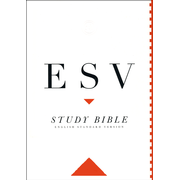
Well, I'm partway into Psalms now, and I'm learning something I didn't know before! The Psalms are of course individual compositions (with a couple of exceptions where one finished work seems inexplicably to have been divided into two psalms), but the book is actually in some spots pretty tightly organized by theme. I mean, anyone who's read through the Psalms knows that there are sections called "Book One" and "Book Two" and so on, five in all, but even within those sections, things are often tightly organized.
Let's take the part I just finished reading: Psalm 15 through Psalm 24. These psalms are arranged in a mirror-image format, with a kind of "hinge" at Psalm 19. Let me show you what I mean. Take a look at Psalm 15:
O LORD, who shall sojourn in your tent?Now take a look at verses 3-6 of Psalm 24:
Who shall dwell on your holy hill?
He who walks blamelessly and does what is right
and speaks truth in his heart;
who does not slander with his tongue
and does no evil to his neighbor,
nor takes up a reproach against his friend;
in whose eyes a vile person is despised,
but who honors those who fear the LORD;
who swears to his own hurt and does not change;
who does not put out his money at interest
and does not take a bribe against the innocent.
He who does these things shall never be moved.
Who shall ascend the hill of the LORD?Obviously, there's some synergy going on there! The two psalms are related. After I read Psalm 15 and the excerpt from Psalm 24, I went on to the lovely Psalm 16 (here's an excerpt):
And who shall stand in his holy place?
He who has clean hands and a pure heart,
who does not lift up his soul to what is false
and does not swear deceitfully.
He will receive blessing from the LORD
and righteousness from the God of his salvation.
Such is the generation of those who seek him,
who seek the face of the God of Jacob. Selah
The LORD is my chosen portion and my cup;I read that and thought, "What a beautiful, peaceful psalm! I wonder what it matches up to?" then I realized that its partner is the beautiful, peaceful, and much more famous Psalm 23!
you hold my lot.
The lines have fallen for me in pleasant places;
indeed, I have a beautiful inheritance.
I bless the LORD who gives me counsel;
in the night also my heart instructs me.
I have set the LORD always before me;
because he is at my right hand, I shall not be shaken.
(Psalm 16:5-8)
The next partner, I realized, was Psalm 22, the psalm that begins with "My God, My God, why have you forsaken me?" and ends with the idea (but not the actual phrase) "It is finished." In the middle it describes the suffering of one anointed by God, begging for God's help to escape his enemies. The writers of the New Testament, particularly Matthew, used this Psalm in telling the story of Christ on the cross. I wondered how Psalm 17 was going to match up. See what you think in this excerpt:
Keep me as the apple of your eye;Psalm 18 is a slightly modified version of 2 Samuel 22, where David is praising God for saving David from his enemies. Its counterpoint is actually two psalms: Psalm 20, a prayer by the people that God would give success in battle to their king, and Psalm 21, a psalm of praise from the king to God for the answer to the prayer of the previous psalm. It's easy to see that the themes, if not the exact content, of the three psalms are related.
hide me in the shadow of your wings,
from the wicked who do me violence,
my deadly enemies who surround me.
They close their hearts to pity;
with their mouths they speak arrogantly.
They have now surrounded our steps;
they set their eyes to cast us to the ground.
He is like a lion eager to tear,
as a young lion lurking in ambush.
Arise, O LORD! Confront him, subdue him!
Deliver my soul from the wicked by your sword,
from men by your hand, O LORD,
from men of the world whose portion is in this life.
You fill their womb with treasure;
they are satisfied with children,
and they leave their abundance to their infants.
(Psalm 17:8-14 ESV)
Psalm 19 is the hinge between the halves of the mirror-image; it ties things together quite nicely. It particularly evokes the "Who?" and the focus on holiness from Psalms 15 and 24, but it also touches on nature themes like the ones in Psalms 23 and 24. The most prominent part of Psalm 19, verses 7-11, is a hymn to the perfection of the teachings given to humanity by God.
Maybe some people spot these kinds of connections between parts of the Psalms without any help. Certainly, someone was the first person to spot them. But great study materials do a terrific job of helping you see things you might not spot yourself without them. I've really been enjoying both of the study Bibles I've been reading, but for connections like this in Psalms, the NIV Study Bible has the ESV Study Bible beat hands down (the ESV Study Bible has its own strengths, though; it particularly seems to do a good job of directing you through the Scriptures like a tour guide, while the NIV Study Bible sometimes focuses on arcane details to the point of losing the forest in the trees). I would highly recommend either (or both!) of those study helps. Click one of the links at the head of this article and order one for yourself, or buy them from a Bible bookstore near you (I bought my ESV Study Bible locally, and bought my NIV Study Bible from ChristianBook.com). But even if you don't have a study Bible, get some Bible and spend quality time in God's Word. It is the most rewarding, valuable thing you will ever do.
Wednesday, July 28, 2010
All Idea, No Time!
I sometimes use a service called Evernote. Evernote is kind of like a place to store things that are in your brain but you're afraid they might fall out; if you can imagine a folder on your computer containing as many documents as you could possibly want, all indexed and searchable and at your fingertips from any computer (or your cell phone, or whatever), that's Evernote. In Evernote, I have a folder full of ideas for this blog. There are easily the seeds of 20 blog entries in there! Why are they in Evernote and not on this blog? There are a lot of answers to that question, but I'll give you just one right now.
Yesterday I left work at 5pm, stopped briefly at home to pick up my 10-year-old son, and then went straight to church, put on a dress, and sat in the dark talking to little kids. Well... OK, that's not exactly the WHOLE story. My church is having Vacation Bible School this week, and my wife and I are volunteering to work with the kids. The VBS is Egypt-themed (you can see some of the setup in my photo set from the setup day) Last night I spent most of the time playing Joseph in jail. The kids came in with their "Egyptian families" (other children, and some adult volunteers) and I, as Joseph, told them the story of my life, starting with "Back in Canaan where I used to live, I have eleven brothers..." and ending with "One of the prisoners had a strange dream, and I told him it meant he would get out of prison, and I asked him to mention me to Pharaoh, but I think he forgot about me!" I'm not sure I was the most convincing or articulate Joseph in the history of theater, but the children seemed to respond well to what was going on, and I never completely lost my place, so that was good!
When they asked me if I would "be Joseph" the first night of VBS (they have another volunteer for the other nights), I said, "Sure!" I always like to help out where I can. But when I started digging into the script, I started to realize how much of an impact it could have on a child if he was experiencing something that was confusing or scary or difficult for him or her. I particularly wanted to make sure I cleraly communicated the message in this one paragraph near the end of the night's lines for Joseph, who had been demonstrating throughout his story that even if you cover a light with a basket, the light is still shining:
Children remember VBS. Children give their lives to Christ at VBS. I hope I did a good enough job last night that today, something I said comes back to the memory of a little boy or little girl, and helps him or her react with Godly wisdom to a situation that they would ordinarily react to in a different way. That would make it worth every second of the time I spent working on memorizing that script!
So anyway, that's why I wasn't blogging last night. There are other reasons I don't blog other nights... one night I got down the Candy Land game and played it with my 2-year-old girl. Another night I played some Super Monkey Ball with the 10-year-old. Sunday evening I was eating Taco Salad across from the beautiful lady who, for some reason, many years ago agreed to become my wife. Tonight I won't be blogging; I'll be at church. VBS starts back up Thursday and ends Friday. On Saturday I'll be... but you get the idea.
I guess I'm a busy guy. The Word says that if you are busy with the things of God, though, that's a good thing! As long as you rest when appropriate and don't burn yourself out, a busy life is God's gift to us.
But it doesn't leave much time for translating those vague thoughts in Evernote into coherent blog entries. Some of them will probably never be blog entries, because at this point I've forgotten what they were supposed to mean! But I pray that the ones that matter eventually make it out of my heart and onto your screen and take you somewhere with God that you wouldn't have gone otherwise.
That said... new blog entry tomorrow. Stay tuned! :)
Yesterday I left work at 5pm, stopped briefly at home to pick up my 10-year-old son, and then went straight to church, put on a dress, and sat in the dark talking to little kids. Well... OK, that's not exactly the WHOLE story. My church is having Vacation Bible School this week, and my wife and I are volunteering to work with the kids. The VBS is Egypt-themed (you can see some of the setup in my photo set from the setup day) Last night I spent most of the time playing Joseph in jail. The kids came in with their "Egyptian families" (other children, and some adult volunteers) and I, as Joseph, told them the story of my life, starting with "Back in Canaan where I used to live, I have eleven brothers..." and ending with "One of the prisoners had a strange dream, and I told him it meant he would get out of prison, and I asked him to mention me to Pharaoh, but I think he forgot about me!" I'm not sure I was the most convincing or articulate Joseph in the history of theater, but the children seemed to respond well to what was going on, and I never completely lost my place, so that was good!
When they asked me if I would "be Joseph" the first night of VBS (they have another volunteer for the other nights), I said, "Sure!" I always like to help out where I can. But when I started digging into the script, I started to realize how much of an impact it could have on a child if he was experiencing something that was confusing or scary or difficult for him or her. I particularly wanted to make sure I cleraly communicated the message in this one paragraph near the end of the night's lines for Joseph, who had been demonstrating throughout his story that even if you cover a light with a basket, the light is still shining:
"I've had hard times, times I didn't know what would happen next. But I do know that no matter what, God gives us hope. Even when things seem sad or scary or hard, He's still with us. It's kind of like these lights that shine in the dark. Just like the light, God is always there - in dark or hard times, and in good times."Wow.
Children remember VBS. Children give their lives to Christ at VBS. I hope I did a good enough job last night that today, something I said comes back to the memory of a little boy or little girl, and helps him or her react with Godly wisdom to a situation that they would ordinarily react to in a different way. That would make it worth every second of the time I spent working on memorizing that script!
So anyway, that's why I wasn't blogging last night. There are other reasons I don't blog other nights... one night I got down the Candy Land game and played it with my 2-year-old girl. Another night I played some Super Monkey Ball with the 10-year-old. Sunday evening I was eating Taco Salad across from the beautiful lady who, for some reason, many years ago agreed to become my wife. Tonight I won't be blogging; I'll be at church. VBS starts back up Thursday and ends Friday. On Saturday I'll be... but you get the idea.
I guess I'm a busy guy. The Word says that if you are busy with the things of God, though, that's a good thing! As long as you rest when appropriate and don't burn yourself out, a busy life is God's gift to us.
But it doesn't leave much time for translating those vague thoughts in Evernote into coherent blog entries. Some of them will probably never be blog entries, because at this point I've forgotten what they were supposed to mean! But I pray that the ones that matter eventually make it out of my heart and onto your screen and take you somewhere with God that you wouldn't have gone otherwise.
That said... new blog entry tomorrow. Stay tuned! :)
Saturday, July 3, 2010
FINALLY the girls get their book! James Dobson's "Bringing Up Girls"
When I was a freshman at Oral Roberts University in the late 1980s, one of the first things I learned was to hold doors open for the young ladies. There was no etiquette class for freshmen, no university-wide rule, no obvious reason for this at all. There was just a culture of the young men taking care of the young ladies. For anyone who wasn't born yet then who might be reading this, let me emphasize: this was the eighties, not the fifties. Holding a door open for a young lady when you weren't on a date (or maybe even when you were on a date) was certainly not the societal norm. But I think I learned more about servanthood and about respect for the opposite sex from that one tiny repeated act than anything else before, or maybe even since. What's more, the young ladies expected that kind of treatment; some would even refuse to go thorough a door with a young man unless he opened and held it for her. Training girls to understand that they deserve dignity and respect and should expect it from the males in their lives is a main focus of James Dobson's new book, Bringing Up Girls. To some the book may seem unforgivably old-fashioned in its treatment of the fair sex. Others will find something to get offended by, and some may even be astonished at some of the ideas expressed (I know I was!) But I think if you open your mind a little bit, forgive Dr. Dobson for some attitudes that may seem at first blush a little too much like something out of Leave It To Beaver for the twenty-first century, and look at the heart of what he is saying, you'll get some valuable insight before you're done.
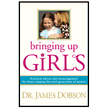 Bringing Up Girls: Practical Advice and Encouragement for Those Shaping the Next Generation of Women
By Dr. James DobsonThis book is, for most intents and purposes, a follow-up to Dr. Dobson's 2001 book, Bringing Up Boys. If you've read that book, you will see a lot of similarities, particularly in the early chapters. Dr. Dobson seems to like to break the ice by including a few "lighthearted" letters from "fans" (in this case, some of them were unintentionally funny letters from child "anti-fans" who did not appreciate Dr. Dobson's stance on corporal punishment in previous books!) and telling a few stories about childhood. He has a grandfatherly sentimentality that is pretty hard to resist. But that sentimental side doesn't stop him from being brutally honest about some things, and that made some of the later chapters a tough read for me.
Like Bringing Up Boys, this book contains a lot of statistics about its subject: in this case, females of all kinds (not just little girls, but also teenagers and even grown women.) The basic theme of the second and third chapters, in fact, is that society is a dangerous place for females. There are extensive discussions about such things as the fragility of a girl's ego, the harmful effect of certain things in media, the aggressive marketing of those things to females, the accessibility of materials on the Internet through both computers and portable devices such as cell phones, the moral anti-absolutism of our 21st-century culture, and cultural changes such as the acceptance of public nudity. There was one section I found particularly difficult to get through - it was about "cutting," a practice in which people (often teenagers) will physically cut their skin with a knife or other implement in an attempt to dull emotional pain with physical pain. I've known that cutting existed for some time, but revisiting it in such detail was chilling. I found myself wading through those chapters as though I was hip-deep in toxic water; the information is awful to be exposed to, but you've got to get through it to get where you're going.
Then sometimes I would come to a spot in the book that seemed like a breath of fresh air. When I got to chapter 16 ("Good News About Girls") it was such a relief after spending the two previous chapters wallowing in the filth of media culture. The odd thing is that the whole point of the book is that the danger of a girl falling into those dire straits is greatly reduced by the presence of loving, involved parenting as she grows up. The kind of negative statistics in the "hip-waders" chapters would seem to be the kind of thing you would use to convince someone to read the book. Once I'm reading it, I've already decided that I want some help and advice; I don't need to be convinced. All that to say, I think maybe the book dwells on the negative a little more than is necessary; some parts are wastelands of discouraging numbers and trends. You can go for chapters and chapters and never actually learn anything practical to use in your parenting. Sometimes I felt like saying, "Okay, Dr. Dobson, you made your point twelve pages ago. Growing up is hard for girls. Can we get on to how I can help my girl now, please?"
And of course, the "how can I help" information is there, too. In fact, I would encourage any mother of a girl to at least take a look at chapters 5 and 7, and any father of a girl should at least take a look at chapters 8, 9, and 10. Chapter 8, in particular, is a must-see for dads: it is a series of heart-rending first-person stories, told by young women in college, of the huge effect their fathers have had on their lives. The basic message of the book is that girls need to be endowed with a sense that they are valuable, not commodities, and the girl's parents are in the primary position to do that for her as she is growing up. If we parents can help our daughters understand that they are valuable persons, they will be less likely to do things like using their sexuality to get what they want or trying to hold on to the affection of a boyfriend who is finished with the relationship. The idea is not to exert control over females, but to free them to control themselves as adult women. To empower them to not feel like they have to resort to drastic measures in order to get what they want. To free them to want what they really want, instead of what society all around them screams that they should want.
There are a number of opinions Dr. Dobson expresses in the book that strike me as controversial. He is against mothers of young children working outside of the home unless there is a dire need, for example. He is against same-sex couples raising children. He is against co-ed sports, particularly with teenagers (he believes that having members of the opposite sex on the team changes the dynamics of how the team works together and reduces the value of the whole thing for everybody). He believes in sexual abstinence before marriage for both genders. He says that casual sex with multiple partners physically rewires the brain and makes the eventual relationship with a lifelong partner less satisfying in the end. He seems to believe that body piercing is psychologically related to cutting (really? What about one earring per ear? Is that cutting? What about two? or three? Why is a belly-button different from an earlobe?) I could see many people being turned off by some of those assertions - although presumably, the kind of person who is going to strongly disagree with those kinds of things is probably not going to be reading books by James Dobson anyway. I personally have very little trouble with most of them, and I see at least a grain of truth in each. But if any of those statements bothers you more than a little tiny bit, you might seriously consider whether you want to get into this book.
I found his discussion of what he calls the "princess movement" particularly interesting. This is the same thing that I've referred to for years now as the "pink aisle"... you know, the toy aisle that is almost blindingly pink because it's where all of the "girl toys" are. These days, a lot of the "pink aisle" toys have Ariel, Snow White, Cinderella, Pocahontas, and other "princesses" from the Disney repertoire on them, and little girls eat them up. He characterizes the movement as a (mostly) positive thing, giving girls an outlet for their natural "girliness" and showing them that it's OK to not be the same as the boys. However, he does criticize culture's obsession with "beauty" in a lengthy section that, oddly, turns a very sympathetic eye on celebrities Anna Nicole Smith and Farrah Fawcett, both of whom suffered during their lifetimes because they were physically desirable (he quotes Farrah as saying, "How would you like to be photographed every day of your life?") The general sense is that a girl needs to be taught that she is a princess, yes, but not only because of physical beauty; she is a princess because she is a child of God.
Chapter 11 discusses the Father Daughter Purity Ball movement. This is a kind of formal party, sort of like a prom, to which dads take their daughters. Dads and daughters dress up in formal clothes, they dance, and the daughter pledges to her dad that she will keep her virginity until marriage, and the dad pledges back that he will help her protect her virginity. That probably oversimplifies things a bit, but that's the main gist of it. I had heard of this before, and it has always seemed a bit odd to me, maybe a little bit creepy... and this chapter did not change my mind. The whole thing extends the (perfectly okay) princess fantasy unnaturally from childhood nearly into young adulthood, and uses it to convince a girl to sign a contract that specifies what they will do sexually. But the way I see it, no document is going to change someone's mind in the heat of passion. And honestly, I'm not really sure that it's the father's job to "protect" his daughter's virginity; I think it's the father's job to teach the girl what she needs to know so that she will guard her own virginity. I'm going to teach my daughter what I believe the Word of God says about sexuality, but I'm not going to stand out on my porch with a shotgun waiting for her to come home from a date (I probably will wait up, though!) If she makes the wrong choice and has sex with a boy, what good will a written, signed contract do anyway? It will only make her feel guilty, and she'll hide the whole thing from me. That's not productive. It seems to me that taking your daughter to one of these things amounts to doing something outlandish to make up for years of not properly training her like you should have been doing all along. I'm sure in many or most cases it's not like that, and if one day my daughter asks me to take her to one of these, certainly I'll do it, but it seems over the top to me. Dr. Dobson's take on them is very positive, but personally, the whole idea strikes me as weird.
I had a similar reaction to the charm bracelet story in Chapter 17. Essentially, the story is about parents encouraging their daughter to stay away from any affectionate contact with boys until she is sure of the one she is going to marry. This includes kissing, saying "I love you," and even holding hands with a boy in addition to getting engaged and getting married. Their encouragement is in the form of a charm bracelet, the (rather expensive) charms of which must be given away to the first boy with which she has that sort of contact. The girl in the story, as it turns out, was wise enough to use that gentle pressure put on her by loving parents to keep her out of trouble, and after she was married, she still had the whole charm bracelet. But I have to wonder: is this bribery? Is this replacing a strong moral upbringing with a materialistic love for jewelry? It seems extreme to me, especially penalizing their daughter for even holding a boy's hand. (For that matter, what if she is in a class at school and everybody is holding hands as part of a lesson? What if they are holding hands in Sunday School for a prayer time? In my family, we hold hands to pray over our meals. Would those situations count if she happened to be next to a boy?) It's not my style to manipulate someone by giving them a gift with strings attached. Then again, maybe that's why I'm not a psychologist. Maybe that's the language that a little girl speaks most fluently, and I just don't know it yet.
All in all, though, I enjoyed the book very much. I didn't enjoy the "toxic statistic" parts, but I enjoyed the rest of it, even the parts with which I had a difference of opinion, because I enjoy seeing someone else's perspective. I enjoyed hearing about Dr. Dobson's daughter Danae, in part because her love of dogs reminded me of my little girl. In fact, it wasn't just my daughter that I saw reflected in the pages... I sometimes saw my wife there, too! I came away from the book understanding that for girls and women, relationships are the number one key to everything. If I can maintain a healthy relationship with my girl, she has a way-better-than-average chance at leading a very successful, happy life. If daughters of loving fathers look for a mate who is like their dad, I want to make it next to impossible for my daughter to find a man who will measure up, not because I want her to be alone (I don't) but because I want her to be with someone who loves her, and who loves God, at least as much as I do.
Are Dr. Dobson's perspectives old-fashioned? Sometimes, maybe... or maybe they're not old-fashioned, but a jarring reminder of a higher standard that should be held toward and by women. Girls and women are valuable and precious, and should be treated as such. If we all treated our daughters like princesses (not the spoiled kind, but the kind who know that royalty also comes with responsibility), and they all acted like princesses... wouldn't the world be a great place to be? When my princess grows up, I hope she still has the same attitude she had the other day when she wanted her mama to take her somewhere. "We can't go right now, sweetie," my wife told her. "Daddy has the car." My little girl replied simply, "Okay. I fly!"
I received a complimentary review copy of this book from Tyndale Publishing.
Bringing Up Girls: Practical Advice and Encouragement for Those Shaping the Next Generation of WomenBy Dr. James Dobson
Like Bringing Up Boys, this book contains a lot of statistics about its subject: in this case, females of all kinds (not just little girls, but also teenagers and even grown women.) The basic theme of the second and third chapters, in fact, is that society is a dangerous place for females. There are extensive discussions about such things as the fragility of a girl's ego, the harmful effect of certain things in media, the aggressive marketing of those things to females, the accessibility of materials on the Internet through both computers and portable devices such as cell phones, the moral anti-absolutism of our 21st-century culture, and cultural changes such as the acceptance of public nudity. There was one section I found particularly difficult to get through - it was about "cutting," a practice in which people (often teenagers) will physically cut their skin with a knife or other implement in an attempt to dull emotional pain with physical pain. I've known that cutting existed for some time, but revisiting it in such detail was chilling. I found myself wading through those chapters as though I was hip-deep in toxic water; the information is awful to be exposed to, but you've got to get through it to get where you're going.
Then sometimes I would come to a spot in the book that seemed like a breath of fresh air. When I got to chapter 16 ("Good News About Girls") it was such a relief after spending the two previous chapters wallowing in the filth of media culture. The odd thing is that the whole point of the book is that the danger of a girl falling into those dire straits is greatly reduced by the presence of loving, involved parenting as she grows up. The kind of negative statistics in the "hip-waders" chapters would seem to be the kind of thing you would use to convince someone to read the book. Once I'm reading it, I've already decided that I want some help and advice; I don't need to be convinced. All that to say, I think maybe the book dwells on the negative a little more than is necessary; some parts are wastelands of discouraging numbers and trends. You can go for chapters and chapters and never actually learn anything practical to use in your parenting. Sometimes I felt like saying, "Okay, Dr. Dobson, you made your point twelve pages ago. Growing up is hard for girls. Can we get on to how I can help my girl now, please?"
And of course, the "how can I help" information is there, too. In fact, I would encourage any mother of a girl to at least take a look at chapters 5 and 7, and any father of a girl should at least take a look at chapters 8, 9, and 10. Chapter 8, in particular, is a must-see for dads: it is a series of heart-rending first-person stories, told by young women in college, of the huge effect their fathers have had on their lives. The basic message of the book is that girls need to be endowed with a sense that they are valuable, not commodities, and the girl's parents are in the primary position to do that for her as she is growing up. If we parents can help our daughters understand that they are valuable persons, they will be less likely to do things like using their sexuality to get what they want or trying to hold on to the affection of a boyfriend who is finished with the relationship. The idea is not to exert control over females, but to free them to control themselves as adult women. To empower them to not feel like they have to resort to drastic measures in order to get what they want. To free them to want what they really want, instead of what society all around them screams that they should want.
There are a number of opinions Dr. Dobson expresses in the book that strike me as controversial. He is against mothers of young children working outside of the home unless there is a dire need, for example. He is against same-sex couples raising children. He is against co-ed sports, particularly with teenagers (he believes that having members of the opposite sex on the team changes the dynamics of how the team works together and reduces the value of the whole thing for everybody). He believes in sexual abstinence before marriage for both genders. He says that casual sex with multiple partners physically rewires the brain and makes the eventual relationship with a lifelong partner less satisfying in the end. He seems to believe that body piercing is psychologically related to cutting (really? What about one earring per ear? Is that cutting? What about two? or three? Why is a belly-button different from an earlobe?) I could see many people being turned off by some of those assertions - although presumably, the kind of person who is going to strongly disagree with those kinds of things is probably not going to be reading books by James Dobson anyway. I personally have very little trouble with most of them, and I see at least a grain of truth in each. But if any of those statements bothers you more than a little tiny bit, you might seriously consider whether you want to get into this book.
I found his discussion of what he calls the "princess movement" particularly interesting. This is the same thing that I've referred to for years now as the "pink aisle"... you know, the toy aisle that is almost blindingly pink because it's where all of the "girl toys" are. These days, a lot of the "pink aisle" toys have Ariel, Snow White, Cinderella, Pocahontas, and other "princesses" from the Disney repertoire on them, and little girls eat them up. He characterizes the movement as a (mostly) positive thing, giving girls an outlet for their natural "girliness" and showing them that it's OK to not be the same as the boys. However, he does criticize culture's obsession with "beauty" in a lengthy section that, oddly, turns a very sympathetic eye on celebrities Anna Nicole Smith and Farrah Fawcett, both of whom suffered during their lifetimes because they were physically desirable (he quotes Farrah as saying, "How would you like to be photographed every day of your life?") The general sense is that a girl needs to be taught that she is a princess, yes, but not only because of physical beauty; she is a princess because she is a child of God.
Chapter 11 discusses the Father Daughter Purity Ball movement. This is a kind of formal party, sort of like a prom, to which dads take their daughters. Dads and daughters dress up in formal clothes, they dance, and the daughter pledges to her dad that she will keep her virginity until marriage, and the dad pledges back that he will help her protect her virginity. That probably oversimplifies things a bit, but that's the main gist of it. I had heard of this before, and it has always seemed a bit odd to me, maybe a little bit creepy... and this chapter did not change my mind. The whole thing extends the (perfectly okay) princess fantasy unnaturally from childhood nearly into young adulthood, and uses it to convince a girl to sign a contract that specifies what they will do sexually. But the way I see it, no document is going to change someone's mind in the heat of passion. And honestly, I'm not really sure that it's the father's job to "protect" his daughter's virginity; I think it's the father's job to teach the girl what she needs to know so that she will guard her own virginity. I'm going to teach my daughter what I believe the Word of God says about sexuality, but I'm not going to stand out on my porch with a shotgun waiting for her to come home from a date (I probably will wait up, though!) If she makes the wrong choice and has sex with a boy, what good will a written, signed contract do anyway? It will only make her feel guilty, and she'll hide the whole thing from me. That's not productive. It seems to me that taking your daughter to one of these things amounts to doing something outlandish to make up for years of not properly training her like you should have been doing all along. I'm sure in many or most cases it's not like that, and if one day my daughter asks me to take her to one of these, certainly I'll do it, but it seems over the top to me. Dr. Dobson's take on them is very positive, but personally, the whole idea strikes me as weird.
I had a similar reaction to the charm bracelet story in Chapter 17. Essentially, the story is about parents encouraging their daughter to stay away from any affectionate contact with boys until she is sure of the one she is going to marry. This includes kissing, saying "I love you," and even holding hands with a boy in addition to getting engaged and getting married. Their encouragement is in the form of a charm bracelet, the (rather expensive) charms of which must be given away to the first boy with which she has that sort of contact. The girl in the story, as it turns out, was wise enough to use that gentle pressure put on her by loving parents to keep her out of trouble, and after she was married, she still had the whole charm bracelet. But I have to wonder: is this bribery? Is this replacing a strong moral upbringing with a materialistic love for jewelry? It seems extreme to me, especially penalizing their daughter for even holding a boy's hand. (For that matter, what if she is in a class at school and everybody is holding hands as part of a lesson? What if they are holding hands in Sunday School for a prayer time? In my family, we hold hands to pray over our meals. Would those situations count if she happened to be next to a boy?) It's not my style to manipulate someone by giving them a gift with strings attached. Then again, maybe that's why I'm not a psychologist. Maybe that's the language that a little girl speaks most fluently, and I just don't know it yet.
All in all, though, I enjoyed the book very much. I didn't enjoy the "toxic statistic" parts, but I enjoyed the rest of it, even the parts with which I had a difference of opinion, because I enjoy seeing someone else's perspective. I enjoyed hearing about Dr. Dobson's daughter Danae, in part because her love of dogs reminded me of my little girl. In fact, it wasn't just my daughter that I saw reflected in the pages... I sometimes saw my wife there, too! I came away from the book understanding that for girls and women, relationships are the number one key to everything. If I can maintain a healthy relationship with my girl, she has a way-better-than-average chance at leading a very successful, happy life. If daughters of loving fathers look for a mate who is like their dad, I want to make it next to impossible for my daughter to find a man who will measure up, not because I want her to be alone (I don't) but because I want her to be with someone who loves her, and who loves God, at least as much as I do.
Are Dr. Dobson's perspectives old-fashioned? Sometimes, maybe... or maybe they're not old-fashioned, but a jarring reminder of a higher standard that should be held toward and by women. Girls and women are valuable and precious, and should be treated as such. If we all treated our daughters like princesses (not the spoiled kind, but the kind who know that royalty also comes with responsibility), and they all acted like princesses... wouldn't the world be a great place to be? When my princess grows up, I hope she still has the same attitude she had the other day when she wanted her mama to take her somewhere. "We can't go right now, sweetie," my wife told her. "Daddy has the car." My little girl replied simply, "Okay. I fly!"
I received a complimentary review copy of this book from Tyndale Publishing.
Monday, June 21, 2010
how to live holy in youth days..how to serve lord jesus in youth days.what god is accepting from my youth life?
I received the above question on Formspring, a site that allows people to ask questions of others. You may have heard about it on the news; in some places teenagers are using it to heckle other teenagers. I'm not using it for that, as you can see below.
The book of Ecclesiastes says "Remember also your Creator in the days of your youth, before the evil days come and the years draw near of which you will say, 'I have no pleasure in them' " (http://esv.to/Eccl 12/). The writer of Ecclesiastes tried everything he could think of to make himself happy - entertainment, money, superior knowledge, sex, everything. What he discovered was that anything you do in your life apart from God is meaningless. The point of the book of Ecclesiastes is to start out early, when you are a young person, following after God's will for you... and then when you get older, you won't have to look back and say, "Well, THAT was a waste of time!"
Now, as to "how" to follow God so that you don't one day look back and say that... I'm afraid that's not a question that can really be answered for you by somebody else. You probably know some of the key things you can do: learn everything you can about God's Word, spend time praying and worshiping God, that sort of thing. Another key is found in 2 Timothy 2:22 - "So flee youthful passions and pursue righteousness, faith, love, and peace, along with those who call on the Lord from a pure heart." (http://esv.to/2 Tim 2:22/ ) By "youthful passions" Paul wasn't just talking about sexual passion (although that certainly qualifies) but he meant that you should remain cool-headed and not make big decisions based on the emotion of the moment. Check every decision against the Word of God and the voice of the Holy Spirit within you (meaning, pray about it and then listen to what God says back) and you won't spend your life messing up.
It also means that there are times when you literally should "flee" something that you know better than to get mixed up in. Recently a woman was telling my wife and me about how proud she is of her teen-aged daughters, who have a habit of calling or texting their mom when they are with friends and it looks like things might go in the wrong direction. "Mom, call me and tell me I have to come home right now!" is a text message she's received several times from her girls. They are fleeing from a situation they know they don't want to be in. A famous example of this "get out of there!" strategy is found in Genesis 39:1-23. (http://esv.to/Gen 39:1-23/ )
I would advise you to read that passage in Genesis, and also take a look at Ecclesiastes. Ecclesiastes can seem quite depressing (because the author was kind of down when he wrote it), but you need to look at it as an example of what will happen if you do not choose to follow God. I can't tell you step by step exactly what to do to serve Jesus - I don't know your situation (where you live, what needs might be around you that God might call on you to fill, what your gifts and talents might be, etc.) but I do know that young people face temptation (old people do too!) and need to resist it. And I do know that God had something in mind for you when He placed you on Earth, and He has no intention of keeping it a secret from you. Hook up to him - plug in like plugging lamp into a wall socket - by getting your mind filled with what the Bible says and by spending time in His presence in prayer and worship, and when the time comes for you to make a decision about what to do with yourself, make your decision based on God's counsel and not your own "youthful passions" and you will do just fine.
Now, as to "how" to follow God so that you don't one day look back and say that... I'm afraid that's not a question that can really be answered for you by somebody else. You probably know some of the key things you can do: learn everything you can about God's Word, spend time praying and worshiping God, that sort of thing. Another key is found in 2 Timothy 2:22 - "So flee youthful passions and pursue righteousness, faith, love, and peace, along with those who call on the Lord from a pure heart." (http://esv.to/2 Tim 2:22/ ) By "youthful passions" Paul wasn't just talking about sexual passion (although that certainly qualifies) but he meant that you should remain cool-headed and not make big decisions based on the emotion of the moment. Check every decision against the Word of God and the voice of the Holy Spirit within you (meaning, pray about it and then listen to what God says back) and you won't spend your life messing up.
It also means that there are times when you literally should "flee" something that you know better than to get mixed up in. Recently a woman was telling my wife and me about how proud she is of her teen-aged daughters, who have a habit of calling or texting their mom when they are with friends and it looks like things might go in the wrong direction. "Mom, call me and tell me I have to come home right now!" is a text message she's received several times from her girls. They are fleeing from a situation they know they don't want to be in. A famous example of this "get out of there!" strategy is found in Genesis 39:1-23. (http://esv.to/Gen 39:1-23/ )
I would advise you to read that passage in Genesis, and also take a look at Ecclesiastes. Ecclesiastes can seem quite depressing (because the author was kind of down when he wrote it), but you need to look at it as an example of what will happen if you do not choose to follow God. I can't tell you step by step exactly what to do to serve Jesus - I don't know your situation (where you live, what needs might be around you that God might call on you to fill, what your gifts and talents might be, etc.) but I do know that young people face temptation (old people do too!) and need to resist it. And I do know that God had something in mind for you when He placed you on Earth, and He has no intention of keeping it a secret from you. Hook up to him - plug in like plugging lamp into a wall socket - by getting your mind filled with what the Bible says and by spending time in His presence in prayer and worship, and when the time comes for you to make a decision about what to do with yourself, make your decision based on God's counsel and not your own "youthful passions" and you will do just fine.
Subscribe to:
Posts (Atom)

 Posts
Posts


