I appeal to you therefore, brothers, by the mercies of God, to present your bodies as a living sacrifice, holy and acceptable to God, which is your spiritual worship. Do not be conformed to this world, but be transformed by the renewal of your mind, that by testing you may discern what is the will of God, what is good and acceptable and perfect. Romans 12:1–2 (ESV)
What I see here is that Paul is going to give us some instructions on how to live a life fully committed to God, not only in spiritual things but also in the physical realm (so, not just thinking nice thoughts, but actually taking action). He prepares us for a mental paradigm shift, then he goes on in the next few verses to explain that in the body of Christ (meaning, all who has put our faith in Him, not the head and torso and arms and legs and hands and feet he had when he walked on the Earth) has lots of members with different functions to perform, different jobs to hold, and all of them are important.
Then we get to that passage I mentioned last time starting in verse 9. There are 13 verses from there to the end of the chapter, and I noticed something interesting. Out of the 13 verses, I only see two verses that are about doing something solitary. "Do not be slothful in zeal, be fervent in spirit, serve the Lord." (verse 11) "Rejoice in hope, be patient in tribulation, be constant in prayer." (verse 12). The rest of the verses are all about how we treat other people! We love them (9-10), we take care of their needs (13), we bless them, even the mean ones (14), we empathize with them (15), we are friendly even to the ones that are different from us personally (16, 18), and we choose to treat them well even if they treat us badly (17, 19-21). All that stuff in verses 6-8 - prophecy, teaching, exhorting (persuading people), giving lots of money, leadership, all of the things we tend to think are cool important things that we want to do - all of that stuff winds up being secondary to just being able to treat people like Christ treated them.
To come back full circle - this chapter started off telling us how to worship God with our whole selves, even our bodies. We each have gifts and callings, but in the end, it is doing physical acts of service for others that somehow turns around and becomes a spiritual act of worship to God!
I've been thinking lately about Romans 12:9-21. I actually took a picture with my phone of the passage, and I keep looking at it and thinking about it. Basically, it's a description of how to really live out your faith as a Christian. Every day I take a look at it and take stock of how I'm doing, sort of like a checklist before launching a rocket ship. Here are things I've been thinking about in some of the verses:
Verse 9 "Let love be genuine." If you know about Greek words for "love" - this word is "agape" which means the kind of love that comes directly from God. It doesn't say that we should force ourselves to love - it says we should let the genuine love flow from God through us. I think in the Christian life sometimes we think we have to make something happen, when in reality if we sort of let go of the reins, God will make it happen (see 1 Thessalonians 3:12). Let God's love happen in you!
Verse 10 "Love one another with brotherly affection." This is not "agape" love. This is human affection. Basically this verse is talking about loving other believers in Jesus like family, like brothers and sisters. People don't always get along with their brothers and sisters very well, but in a loving family, they'll stand up for each other when the chips are down. I'm so glad I go to a church where people do care about each other! At your church, when the service is over, do people immediately leave and go to lunch? Not at my church. At my church, people are still there chatting and enjoying each other's company well after the service is concluded. Some of my favorite people are there - I want to talk to all of them! No church is perfect, but I think that's what this Scripture is saying.
Verse 11 "Do not be slothful in zeal, be fervent in spirit, serve the Lord" We have a vibrant volunteer culture at our church. I'm not sure how visible it is to members who aren't involved, but I'm on two different teams - worship arts and children's ministry - and in both of those contexts people are fired up about what we're doing for the Lord. I don't hear people talking like they are doing it because they feel obligated or because they want to be special (and that can be a real problem on worship teams!) - people genuinely see that God is doing something and we just want to be part of it.
Verse 15 "Rejoice with those who rejoice, weep with those who weep." This past year my wife went through a serious health problem (maybe I'll talk about it in a future post), and it was really hard, but as soon as our brothers and sisters in Christ found out about it, they went out of their way to help us out. They prayed for us, brought us food when we were going through a rough patch, and when my wife wasn't able to come to church with me because of her treatments, everyone asked how she was doing. Do you know what effect it had on me? It made me want to be that person for someone else one day. I guess that's that whole "iron sharpens iron" thing, huh?
Verse 21: "Do not be overcome by evil, but overcome evil with good." Do you notice what that does not say? It doesn't say "Be careful because evil can totally beat you up, so try to run away if you can!" It completely puts you and me in the driver's seat. If evil happens to us, it's because we let it overcome us. Instead we need to overcome it! It wants to beat us, but it can't unless we let it! That doesn't mean that evil won't come - ref: my wife's health problems last year. But when evil comes and tries to overcome you, the correct response is to apply good to the situation and overcome it instead!
In my previous post I outlined some thoughts related to the recent Chick-fil-A hoopla, and the response of the Christian community. This morning a detail fell into place for me in a way that put two and two together to make something that was more like "four" than anything I've heard yet. Maybe I'm turning into a wild-eyed conspiracy theorist, but hear me out and maybe you'll at least see where I'm coming from.
Since this thing started to percolate up into the brouhaha it eventually became, I've been puzzled over how a few comments in such obscure venues became such a big deal. I mean, who is this Ken Coleman with the radio show? I've never heard of him before now, and I'd guess I've at least heard the names of most nationally-known Christian leaders. (Actually, I'm assuming he is a religious speaker of some kind, although I don't immediately find anything specifically addressing that on KenColemanShow.com.) Best I can tell from his Web site is that he has a local show on a radio station in Georgia. And tell me: how many gay rights activists really read the Baptist Press? If I were gay and wanted to be part of a Christian church, I would most certainly NOT choose the very conservative Baptist denomination, and I would not read Baptist publications.
So here's the question to ask yourself. How did the LGBT community even know about these things Dan Cathy was saying? Are you telling me that gay people are spending their time reading Baptist publications and listening to Christian talk radio? Now, I did just do some quick research, and Wikipedia does report that Atlanta has a large gay population (source: http://en.wikipedia.org/wiki/LGBT_demographics_of_the_United_States) so it's possible that homosexual activists in that area might have stumbled across Coleman's radio show. But I've got to wonder whether that's really what happened, and here's why.
It appears that Chick-fil-A has actually been controversial within the LGBT community for at least a year and a half. Wikipedia reports that there was a flap over a marriage conference in January of 2011 (source: http://en.wikipedia.org/wiki/Chick-fil-A#Controversy_regarding_same-sex_marriage_stance) and if you check the references in that Wikipedia article, you'll find several other instances of LGBT activists becoming upset over something Chick-fil-A did. So essentially, Chick-fil-A seems to have been in their crosshairs for some time. What occurred to me this morning was that it is very likely that they were actually looking for the right time to attack Chick-fil-A in the national arena. This public denouncement of Chick-fil-A wasn't really in response only to those two interviews.
Now, here's where Christians either won the day, or got pie on our faces, and I'm going with option #2. Sure, CFA had a great sales day, and my guess is that they are continuing to have great sales days - the Saturday after the big chicken-athon I was at a mall with a CFA in it and the line was still longer at that restaurant than anywhere else in the food court. But really, did the chain really need saving? It's not like CFA is an ailing fast food chain that needs our support to keep it from going under. We gave them our money, but all that meant was that we had some tasty chicken.
Here's how we failed: the LGBT community was tryingto cause a division between themselves and Christians. Can't you see that that was the idea all along? They sought to show that Christians are mistreating gays, to consolidate gays against Christian organizations, to make sure that homosexuals would not seek to leave the lifestyle but would become more afraid and suspicious of organizations that would reach out to them.
I think we walked right into their trap.
I don't think that the LGBT activist community got things exactly like they wanted, because I think they really wanted to demonize and damage the chain and that just wasn't going to happen. But I do think that they've set Americans at each other's throats, and specifically I think they've set homosexuals against Christians. They've polarized people, shoring up their own power. Christians saved a fast-food restaurant that didn't really need saving, and hardline gay-rights activists built a stronger sense of "us-versus-them" community on both the gay side and the "religious right" side.
It's another row or two of bricks in the already towering wall between the Christians and the people that Jesus wants us to reach out to in love. And we laid the bricks ourselves.
No time for being lazy
No sleeping until noon
The world is cruh-cruh-crazy
Don't you get the news?
Get up, put on your armor
Yeah, we're at war with the world - from "War With The World" by DeGarmo & Key(listen: Spotify - ChristianBook.com)
Years ago there was a great deal of controversy over what was known in Christian circles as the "spiritual warfare movement." Christian rock bands with lyrics like this one (a different band called Petra even released an entire album called This Means War!) raised eyebrows with their use of combative language. War is a violent thing... should Christians be talking as though we are in some kind of battle? Isn't that what happened in the Crusades? Isn't that what we object to in radical Islam even today?
In the past couple of weeks, angry Christians have eaten thousands of chicken sandwiches in protest of people who protest at the Chick-fil-A founder's statements about marriage. Some say the controversy is about free speech (even though nobody restricted Dan Cathy's speech). Others say the controversy is about gay marriage rights (even though Dan Cathy denied nobody's rights to get married) or gay rights in general (although I have yet to hear any good solid evidence that Chick-fil-A has discriminated against anyone because of their sexual orientation). Others see the statements as a symptom of a corporate policy with which they disagree (the company has made charitable donations to religious organizations which seek to help homosexuals leave that lifestyle if they so choose, and the methods of some of these organizations have been questioned). In the Christian circles I frequent, I have seen a lot of defiance, some of it bordering on anger. Christians are frustrated, because they feel that homosexuals are trying to legalize something which they believe threatens their religious beliefs. Apparently, if homosexuals are allowed to call themselves "married" under the civil laws of the United States, it will be the first step in the crumbling of Christianity to dust.
But wait... is the Church really that fragile? Is Christ really not able to preserve his people if homosexuals quit eating at a fast food chicken place? Even if that place doesn't open on Sunday because of the owners' religious convictions? And, more importantly, are political ideas, even ones that are very important to us in America such as the right to freedom of speech, really a part of Christianity?
Are we at "war with the world?"
I think we've gotten our idea of what "the world" that we should be "at war with" mixed up. The second part of the song I quoted above is a little more specific:
The enemy's a liar
He wants to take your heart
The lure is the desire
That tears the heart apart
So don't go for the glitter
Yeah, we're at war with the world - from "War With The World" by DeGarmo & Key
"The enemy" that the song talks about is personified under the name Satan, but really "the world" that we are to oppose is the sinfulness that surrounds us, not everybody in the whole world who is not a Christian. In fact, in the Gospels Jesus never attacked the people around him who were considered "unclean" and "sinners" (in first-century Jewish thought, homosexuals would surely fall into this category, if any of them happened to show up). The people that Jesus most vehemently attacked were the self-righteous religious people who thought they knew all the rules and wanted to force everyone else to follow them.
Sound familiar?
The problem with this whole Chick-fil-A thing... in fact, with the whole "gay rights" thing and the response of Christians to it... is that it serves to create a division between Christians and the very people we should be seeking to reach with the message of Jesus' love. When you post that pro-Chick-fil-A image on your Facebook profile, think about this: is your lunch really worth the soul of a gay person who might see your profile and become hardened against the message of the Gospel because of it? What about your right to free speech? Is that worth the price of a human soul? What if a gay person wants to become "married" in the eyes of the State, but does not want to try to force a church to call them married as well. Is your opposition to that person's actions worth alienating someone from Jesus?
I'm not saying we should "wink at sin" and say that it's OK. Homosexuality is not OK. Neither are any of the other sins that most of us commit every day. If you break one part of the law, one rule, one sin - you've sinned just as thoroughly as the homosexual. There are no sins worse than others: every sin is a capitol offense without Jesus. But what I am saying is that we should pick our battles wisely. Even Chick-fil-A immediately tried to separate themselves from the controversy over gay marriage; maybe Christians en masse ought to take a cue from that and do the same. Free speech and chicken sandwiches are not worth anyone going to Hell over.
As I drove up to the movie theater this sunny Sunday afternoon to view the new Donald Miller/Steve Taylor film, Blue Like Jazz, I had Christian rock playing in my car. This is the song that came on as I drove up to the theater:
When I left the theater, I skipped back to the beginning of the song, listened to it again, and cried my eyes out. Then I called some friends to tell them about the movie, and then I hopped on the Internet with my phone and streamed some John Coltrane (you'll know why when you see the movie), and I cried some more. (Leave it to musician-turned-filmmaker Steve Taylor to use a jazz album as a metaphor for Christ.)
But I'm getting a little bit ahead of myself. Blue Like Jazz is based on the bestselling Donald Miller book by the same name. I read the book several years ago, wound up a bit puzzled at the end, and enjoyed the experience enough that I sought out more of Miller's work. When I heard that he and Steve Taylor were teaming up to bring it to the big screen, I was excited and mystified. Excited because I'm a long-time fan of Steve Taylor and I really enjoyed Taylor's movie a few years ago called The Second Chance (which in my opinion did not receive the respect it deserved), and mystified because the book really is not a narrative at all. It's a series of essays, or maybe memoirs, that are based on some of Miller's experiences in college. I had no idea how they would turn it into something coherent on the movie screen.
Of course the way they did it was by creating a story that includes elements of the anecdotes Donald relates in the book, but stringing them together into a plot that makes sense. In an almost self-referential twist, the movie is structured around a mantra from a writing class: setting, conflict, climax, resolution - the four elements of a successful story. The screenwriters did a good job of taking the book, applying those elements, and turning it into a narrative that takes you to uncomfortable places where we, as Christians, desperately need to go.
I really hate to give away too much of the plot, because it's best if you take the journey with Don (the main character is based on the book's author, since the main character in the book is the author) without knowing too much of what's going to happen ahead of time. Suffice it to say that it's about a teenager who goes to college and has a crisis of faith - or, maybe more accurately, has a crisis of faith and then goes to college. His college is far from home, and far out of his Texas Baptist comfort zone. The movie is about his struggle to get a handle on his faith, and at the end he has discovered something important, something that every Christian needs to discover.
Sounds like a wonderful, cuddly Christian after-school special kind of movie, doesn't it? Well, hang on tight and keep your hands and feet inside the ride at all times, because this is probably not a movie you want to take your 10-year-old to. This movie depicts alcohol being happily consumed by the Christian protagonist, an instance or two of drug use on-screen, a lesbian who does not become a Christian at the end, a shocking case of an unwanted pregnancy occurring outside of marriage, more profanity than some Christians are going to be comfortable with, people talking about sex using street slang, condoms (real ones and some very large ones with happy faces painted on them), an older man who has just had a sexual liaison with a young intern, and a back-story of sexual abuse of a child by a member of the clergy. What it does not contain are: sex scenes, nudity, violence, and the Plan of Salvation. What? A "Christian" movie where nobody becomes a Christian at the end? Tragedy! Blasphemy! Apocalypse!
Well, nobody does become a Christian at the end, but becoming a Christian is not what the movie is about. The point is that Don-the-movie-character, like Don-the-book's-author, learns how to be a better Christian by the end of the movie. He learns the vital, obvious but seldom-lived-out point that Jesus came to Earth because he loved sinners, and if we consider ourselves followers of Jesus, we should be loving them, too. On one of the most liberal college campuses in the country, Don gets through to one of the most liberal people on campus by showing him the love of Christ. Not by debating him about the Bible, not by telling him what a sinner he is, but simply by loving him. And that's why the theater erupted with applause when the credits rolled on the showing I was in. Because the film ends with one Christian young man making a heart-to-heart connection with a hardened, liberal, damaged non-Christian young man by, paradoxically, not being ashamed to say "I'm sorry."
One thing I really appreciated about this movie is the metaphors of Jesus that keep showing up. I've already mentioned the jazz records that represent Christ. There is also a young lady who is a Christlike character, and a Christlike Catholic priest who, at one point, offers a compassionate hand and pulls Don out of an overturned latrine. Not every Christian character in the film is Christlike (I won't give away a major plot point, but you'll know the main hypocritical Christians when you see them), but as Don is exposed over and over to Christlike figures in the middle of some of the most Godless situations imaginable, he finds himself transformed into a more Christlike Christian.
I've read some people's comments online about this film, and I've seen both glowing recommendations (I guess you can count this one among those) and some pretty harsh criticisms. The criticisms are not about the cinematography or the writing or the acting, but about some of the things that are depicted in the film, the lesbians-and-condoms-and-booze kind of stuff. Sadly, I think a lot of Christians are going to find something in the film to be offended by. And that's a real shame, because by Hollywood standards, this movie is seriously tame fare. I mentioned before, and I'll mention again, that this isn't a movie for children; it's a movie for adults, and maybe for older teens who are able to take in the subject matter involved. But come on... if you've watched the advertisements during the Super Bowl, you've seen more suggestive and offensive stuff than there is in this movie. It's a crying shame that some Christians will miss out on the amazing, life-changing, redemptive message because they allow themselves to be offended by a depiction of sinners doing what sinners do: sinning. Without the Godless "setting", the impact of the emotional "climax" would be all but eliminated. Sure, it would have been a safer film, but Steve Taylor has never been known for playing it safe. I'm so glad he and Donald Miller (and the tons of fans of the book who donated via a Kickstarter campaign to get this thing off the ground) took a chance and made this movie. If it helps one person to love others the way Christ did, like the single character of Don does at the end of the movie, then it will be worth it.
And that's why I was crying in my car on the way home this afternoon. I'm hoping that maybe, just maybe, that one person will be me.
It was one Wednesday night after church, and my mom and dad had suggested that we stop and get some ice cream on the way home. My not-quite-three-year-old daughter always gets orange sherbet, but "ice cream" is a little easier to pronounce. She was eating it when Mom asked her to give it away.
Keep in mind that Hannah LOVES this orange sherbet. I really have no idea why she's such a sherbet fan, but she always chooses it, and she usually finishes it. And she was clearly far from finished when she was asked to make the sacrifice and let Meme eat the rest. But you know what she did? After a very brief pause to think it over, she held out the spoon, already loaded up with sherbet, to her meme. Meme laughed about it, gave her a hug, and said, "I don't want your ice cream! I just wanted to see if you loved me enough to give it to me!"
Does that sound like a mean trick to pull? If it does, you might take a quick look at Genesis 22, where God does something very similar. The same kind of faithful, giving heart that knows that someone who loves you would never take something away without giving it or something better back (Hebrews 11:17-19) was returned to us later when God gave us the most valuable gift of all! (Romans 8:32)
So I decided to up the stakes. I actually walked out into the street toward him, yelling "Go home, doggie!" hoping to get him to leave the street (and danger) and get back into some yard or on the sidewalk. And he did leave the street... he started barking at me and backed me out of the street onto the sidewalk! He was a little dog so I wasn't afraid he was going to hurt me too badly, but he was pretty cranky and nobody wants to get bitten, even by a little dog. He barked and barked at me, and every time I tried to walk away he would advance. I had to back away with my satchel between me and him to make sure I didn't get teeth marks in my ankles! As soon as I was far enough away to suit him, guess what he did? He walked right back out there into the middle of the street, in the dark, with cars coming, and stuck his nose right back into whatever he was smelling before. From down the street I watched the next SUV come down the street, hoping I wasn't about to witness a doggiecide... fortunately they spotted and went around him (he stayed in the middle of the street the whole time)!
I was thinking... people are just like that sometimes. Some people, if you see a pitfall in their lives and say something to them about it, will take your advice and avoid the problem. Other people, if you give them even very good advice, will go on the defensive or even on the attack, and you wind up having a hard time extracting yourself from the situation without getting hurt by the person you were trying to help! Does this mean that we shouldn't try to help people (and little doggies) who are in danger? Of course it doesn't mean that. Jesus loved each of us, and Jesus certainly gave us a pretty strong picture of self-sacrifice to save someone who needed saving. I do think that Jesus used a great deal of wisdom and spiritual insight in selecting the people He was going to offer aid to, though; you don't really see people in the Gospels being offered help by Jesus and resisting it. So maybe if I had listened more closely to the Holy Spirit I would have left Mini-Cujo alone. And maybe there are some situations in which the Holy Spirit will guide you out of a situation instead of into it. The key is that just because this doggie went on the offensive it doesn't mean that I shouldn't try to help the next doggie who is out playing in the street. And if you get hurt by some person you are trying to help, don't be scared to help the next person. That person might receive your gift with thankfulness, and you may be able to change, or even save, that life.
I've known, in my lifetime, people who are antagonistic to Christianity. Maybe they grew up in a Christian church, and for whatever reason, they became disillusioned or angry. Maybe they saw injustices in the world and decided that a benevolent God wouldn't possibly let that kind of thing happen. Or maybe they've thought about it and thought about it, and just decided that if a God does exist, they don't think they care much for him. Often these people have looked quite carefully into the claims of Christianity, either in a search for truth or in order to arm themselves against being embarrassed by a Christian in a discussion about religion. Many of them are quite knowledgeable about the Bible and about what Christians believe.
On the other hand, I've met many, many Christians whose Theological depth barely reaches past about a dozen Scripture verses that they can quote (or misquote) by heart. They may be able to name the books of the Bible, but they certainly haven't read most of them. I'd be interested to know what percentage of the Christian world has read even one single book of the Bible straight through... even 3 John, which is only 15 verses long. I don't have any real statistics, but I wouldn't be surprised to find out that even 50 or 60 percent of Christianity has barely even opened a Bible. One of these poorly-read Christians is no match for an opponent who has spent any amount of time studying Christianity.
Among Christians who do actually know something about the Bible and their own belief system, an astounding number disagree on any number of things, even things they consider quite fundamental. You would think that adherents to a faith based on the contents of one single book would be much more unified, but apparently there is a lot of room for interpretation and reading between the lines. So oddly enough, two Christians debating some point of Theology with an atheist might even find more common ground with the atheist than each other.
There is only one thing that can convince someone who is antagonistic to religion of the existence of Christ: a Christian who is truly living out his faith. Two Christians that disagree on speaking in tongues, or faith healing, or transubstantiation, or predestination, or any number of other topics, will react to life situations in almost exactly the same ways when they shut up talking about doctrine and start living like they believe Christ would have them live. Honest-to-goodness Christians who are living their faith and not just talking about it are going to think alike and act alike. We know in our hearts how Jesus meant for us to live. And a life lived for Christ can't be refuted with clever intellectual arguments. A life truly lived for Christ is undeniable. Two Christians who disagree on doctrine but whose lives match because they live for Jesus constitute pretty convincing proof that something unites them. That something is Jesus.
"...By this all people will know that you are my disciples, if you have love for one another.” (John 13:35 ESV)


 As I drove up to the movie theater this sunny Sunday afternoon to view the new Donald Miller/Steve Taylor film,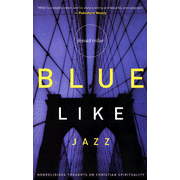


 Posts
Posts


