Subscribe in a reader or enter your address to get posts via email: 
Like this blog on Facebook!

Showing posts with label John. Show all posts

Tuesday, April 16, 2024

Seeing But Not Seeing

This morning I was reading a familiar story from John chapter 9. Jesus gave sight to a man who had been born blind. The reaction of his neighbors is predictable: "This man looks just like our friend the blind man! Wait, is this the blind man? No, it can't be!" The blind man was like, "Yep, I'm him!" Then he told them that Jesus had healed him, which is probably what got him into trouble. Don't ever forget: your witness for Jesus may get you into hot water from time to time. That's no reason not to do it!

Anyway, his "friends" took him to the Pharisees, a group of very influential religious leaders of the day, and the Pharisees questioned him. According to their rules (not God's rules!), Jesus was breaking religious law by essentially practicing medicine on the Sabbath. (Basically, if you've ever heard a Christian berating another Christian for having a job that has them working on a Sunday, that's the same idea.) It was clear to everyone around that someone could not perform this miracle of healing unless God sent him, but this flew in the face of the Pharisees' belief system. Instead of looking at the plain fact that Jesus' actions proved that He was from God and that their belief system was flawed, they chose to try to preserve their belief system by refusing to believe that the event had even taken place. They brought in the man's parents and asked them if this was the blind guy - they were afraid of being excommunicated, so they confirmed the facts of the situation (yes, he's our son, yes, he was blind when he was born) without ever saying whether they believed Jesus was from God. They just threw their poor son under the bus: "He's a grown-up, ask him what happened!"

They brought the man back in and questioned him again about Jesus. The man stuck to his guns - "I don't know if your rules are true, but I know I can see!" Then they asked him to tell them again how Jesus had done it, and the guy finally lost his patience. Basically, he said "I told you my story already. Why are you so interested in Jesus anyway?" Then he tossed some waterproof theology their way, and in return they threw him out of the church (the thing his parents were afraid was going to happen to them).

Now, the Pharisees knew Jesus had come from God. In John 3:1-2 one of them actually came to Jesus and told him as much. These guys weren't looking for knowledge or truth... they were looking for a way to force the truth to fit their flawed belief system.

As I was reading this, I was reminded of the controversy several years ago about "gender" - political and even scientific leadership were (and are) arguing that gender is somehow a mental or emotional state, or equivalent to the sexual activities in which one chooses to engage. When I was growing up, it was obvious to everyone that "gender" referred to the plumbing in one's body, not the state of one's mind. There were and are clearly two distinct configurations. Now, there have always been people who have the same configuration of body parts who were attracted to one another - I don't think anyone denies that fact. Many people of faith believe, based on things they read in the Bible, that sexual activity between persons with the same plumbing is contrary to Scripture, and thus sinful. But even people who thinks it is sinful do not deny that the attraction sometimes exists or that the activity happens.

The new thing in the past five years or so is that people with various sexual orientations (and well-meaning people who want them to feel included in society) are choosing to redefine the word "gender" and the noun "sex" to mean a whole host of things related to emotional states and sexual desires, leaving no word in the English language that means "I have a this and you have a that, so our bodies are different." It seems to me that this amounts to the same thing as "You can see and that would mean that Jesus is from God, but he can't be from God because he broke our rule." It seems like this attack on the English language is there to support preconceived ideas about sexuality and make it impossible to argue that certain behaviors are inherently wrong. Those that argue against it are "thrown out of the temple" by being censored or removed from social media, ridiculed by broadcast and published media, and basically shamed for their beliefs.

Now, you might argue that the people who think gender=body configuration at birth are the equivalent of the old-school Pharisees, wanting to keep things the same while a new progressive person challenges their belief system. I would argue that Jesus and His truth predated the Pharisees, who were seeking to add their own rules to God's reality - and the fact that the word "gender" historically referred to the physical state of one's body predates the idea that "gender" is how you feel at any given moment. The Pharisees were the ones trying to twist reality for their own gain; Jesus was just expressing the truth that had always been.

I don't deny anyone's right to engage in any kind of sexual activity that they want to, barring of course things that would bring harm to another. I don't even deny the right of a man to dress like a woman or a woman to dress like a man if they want to. As Americans, we believe people can do and say what they please, within the bounds of the law. But I do think it's not right to force people to change their very language to fit an ideological agenda in which they do not believe.

The more things change, the more they stay the same. We human beings are so prone to trying to justify our actions in any way possible, particularly if we are told that they are sinful - instead of humbly coming to God and saying, "We know Jesus is from You, so we're asking for Your truth in this situation. We're not trying to manipulate facts to suit an agenda. We are seeking to manipulate our agenda to conform to Your truth."


Tuesday, January 16, 2024

Epiphany 2024, part 2

Most years I start with my youngest and work my way up through her big brother and finally to my wife. This year I decided to reverse that and start with my wife and work my way backward. Her gift and word were a little heavy, and I didn't want to end on that note!

This year I also get some help from a friend and got some cards printed up. Each card has as a background an image I found of The Magi, then printed over that, their name, their "word", and a related Scripture. I'm no graphic designer, but I'm really happy with how they came out! I think I'm going to keep doing it in future years!

This year my wife has been in a battle with breast cancer. At the stage we caught it, it is a winnable fight, and we're in a good place now, but the treatments are no fun. They are time-consuming, and uncomfortable to the point of sometimes being painful. She had a surgery which left her flat on her back on the couch for several weeks, doctor's orders not to move unless she absolutely had to. Her word was "Second Chance". I reminded her that if we hadn't gotten treatment from some amazing doctors and medical technicians using tools that didn't even exist 5, 10, 15 years ago, she would be dead right now. I told her to consider this her reset button. This is the "turn it off and back on again" reboot. This is her video game "extra life". Now is her chance to do things she never did before, because "before" is over with and "second chance" is now. The gift I gave her was a beautiful pewter "ticket" like you see in the picture (it's actually a photo of two of them so you can see the front and the back) by an Etsy artist named Cynthia Webb. I left a message with my order telling her that this was for a gift and I was hoping the USPS would be quick about it, and in the package she included a sweet reply telling me she hoped it made it on time! (It did!) Click on the picture and take a look at her work! It's pretty fantastic stuff!

The Scripture I included for my wife is from Psalm 40:1-3 (I had to leave out part of it to fit it on the card, but the missing part applies too): “I waited patiently for the LORD to help me, and he turned to me and heard my cry... He has given me a new song to sing, a hymn of praise to our God. Many will see what he has done and be amazed. They will put their trust in the LORD.”

By the way... my daughter protested " 'Second Chance' is two words!" Of course it is, but a "word" can also mean more than one word. "I will take care of this problem, you have my word" - "I'm angry with that guy, I'm going to have a word with him!" ...or how about this one: we call the Bible the "Word of God". The sense I'm using it in, though, is in the "word of prophecy" sense. I do not have the ministry of a prophet of God, but I believe that as the father I have a similar ministry to my own family. So that's why I use the word "word" even when it's multiple words.

My son spent the last part of this year working at a pretty great job he got in order to pay off some school bills and get back on track for college. The word I had for him was "Focus". I wanted him to remember that even though he had a pretty decent job that he's working at right now, his college is to prep him for something even more amazing to come later! I actually gave him two Scriptures, Proverbs 16:9 and Hebrews 12:1-2: “In their hearts humans plan their course, but the LORD establishes their steps.” and “Let us strip off every weight that slows us down... and let us run with endurance the race God has set before us. We do this by keeping our eyes on Jesus, the champion who initiates and perfects our faith.” I gave him the cool nautical-style telescope at left (it's mostly for show and not as much to use, although it does actually work). The inscription on the telescope says “Go Confidently in the Direction of Your Dreams/Live the Life You Have Imagined.” I told him not to ignore the people God puts right next to him in this season, but also do not lose sight on the longer-term vision for his future.

Things were a little different for my daughter. For my wife and my son, the "word" almost felt obvious. For my daughter, it took a little more prayer this year. As a dad it would be easy enough to just make up something, but I deeply feel that it is important that whatever I give and say to them for Epiphany every year is inspired by God for that year. Finally something dropped into my heart for her: "Friends". Honestly, I don't even know exactly what that means to her, but I told her that what I felt in my heart was that she seems to have an easy time at making friends - people at school seem to know who she is and think favorably about her. Maybe there are kids who don't like her, but so far I haven't met anyone who seems to be uncomfortable talking to me, like a teenager is when they have to talk to the dad of someone they don't care for. I told her that I think she needs to not be apprehensive about making friends with people. Open up and be a friend when someone needs a friend. I gave her John 15:12-13: “This is my commandment: Love each other in the same way I have loved you. There is no greater love than to lay down one’s life for one’s friends.” I don't think, though, that the application of that Scripture ends with literally giving up your life for someone, as in getting hit by a train while you're pushing someone else off the tracks. I think that "laying down your life for your friends" might mean just laying down your cell phone when someone needs to talk, or laying down a book you're enjoying to enjoy the human being right next to you. When she was opening up the twin necklaces you see above, I made sure she understood that I wasn't trying to call her names - I just knew that she would think it was hilarious (she did). I told her she was welcome to keep both necklaces if she wanted to, but I was hoping she would actually give one of them to a friend!

I hope reading this has inspired you to do something like this for your own family. You don't have to be the dad... you can be the mom, or a grandparent, or you can even be a brother or sister and seek the Lord for a word for someone. You might just be a friend, and the Holy Spirit might inspire you to share with someone. A small gift, a physical object, can hold meaning in the way that just words might not... it's why prophets in the Old Testament (and even the New Testament) used physical objects to communicate a message. It's also why we send greeting cards at Christmas and birthdays, and why we give flowers and candy on Valentine's Day. I always try to link to the things I pick out in case you want to share them as well, but please, her from the Lord on your own! The word He gives you is the Word that is needed by exactly that person at exactly that moment!

Thursday, November 24, 2022

What Jesus Did For You

It's a good day to think about what Jesus did for you! But let's go beyond John 3:16, shall we?

Did God save us because we were "good people"?

But when the goodness and loving kindness of God our Savior appeared, he saved us, not because of works done by us in righteousness, but according to his own mercy, by the washing of regeneration and renewal of the Holy Spirit, whom he poured out on us richly through Jesus Christ our Savior, so that being justified by his grace we might become heirs according to the hope of eternal life. - Titus 3:4-7 ESV

Do we have something to live for? Is there any hope for us?

Blessed be the God and Father of our Lord Jesus Christ! According to his great mercy, he has caused us to be born again to a living hope through the resurrection of Jesus Christ from the dead, to an inheritance that is imperishable, undefiled, and unfading, kept in heaven for you, who by God’s power are being guarded through faith for a salvation ready to be revealed in the last time. - 1 Peter 1:3-5 ESV

Some days I feel so angry about things! How can I ever be good enough for God?

And you, who once were alienated and hostile in mind, doing evil deeds, he has now reconciled in his body of flesh by his death, in order to present you holy and blameless and above reproach before him, if indeed you continue in the faith, stable and steadfast, not shifting from the hope of the gospel that you heard, which has been proclaimed in all creation under heaven... - Colossians 1:21-22 ESV

I'm nobody special. I don't even understand God. How could I be part of His family?

Blessed be the God and Father of our Lord Jesus Christ, who has blessed us in Christ with every spiritual blessing in the heavenly places, even as he chose us in him before the foundation of the world, that we should be holy and blameless before him. In love he predestined us for adoption to himself as sons through Jesus Christ, according to the purpose of his will, to the praise of his glorious grace, with which he has blessed us in the Beloved. In him we have redemption through his blood, the forgiveness of our trespasses, according to the riches of his grace, which he lavished upon us, in all wisdom and insight making known to us the mystery of his will, according to his purpose, which he set forth in Christ as a plan for the fullness of time, to unite all things in him, things in heaven and things on earth. - Ephesians 1:3-10

Happy Thanksgiving! 


Monday, November 25, 2019

Perfect peace 4: No Fear

FLYING HIGH HANNAH from Flickr via Wylio
© 2011 Shaun's Wildlife Photography, Flickr | CC-BY | via Wylio
Peace I leave with you; my peace I give to you. Not as the world gives do I give to you. Let not your hearts be troubled, neither let them be afraid. - John 14:27 ESV
Ever get afraid? I certainly do. I get afraid for my own safety sometimes, or my children's safety or my wife's. I get afraid that the money won't be there for whatever. I get afraid that I won't make a difference in the world. I get afraid of the sound outside my house at 3am that I don't know the cause of. I get afraid when I watch the news and see what's going on in politics, or when I think about how we are slowly polluting our world, or when I think about the fact that there are weapons in existence that could literally kill pretty much every living thing on planet Earth, certainly including all of the human beings. There's a lot out there to be afraid of.

But you know what? Jesus clearly said in the Bible verse above that we can reject fear. We can simply not let it be part of our experience of the world. Apparently there's a way to put up a stop sign: sorry, Mr. Afraid and Mrs. Troubled, you're not allowed here! Doesn't that sound ridiculous? Again, remember, I'm not making it up. It's in the Red Letters, right there!

So how do you do that? Well through the rest of this mini-series we've learned that it's done by focusing on the things of God. If you haven't read the other posts, I invite you to click "Back to the beginning" below and go through them all. Let's practice turning that stoplight red, putting down that gate, and not letting fear in. Wouldn't a life free from fear be an amazing thing?

Back to the beginning

Saturday, November 2, 2019

Perfect Peace

Recently I was reading a little book given to me by a friend that is just Scripture verses arranged by topic, and I came to a section on peace. A few verses jumped out at me, and I wanted to share them along with some brief comments of what went through my mind as I was reading them. I will list the references at the end of this post.

You keep him in perfect peace whose mind is stayed on you, because he trusts in you.
If we focus on God as we go through our day and trust Him, the gift we will receive is perfect peace.

The kingdom of God is not a matter of eating and drinking but of righteousness and peace and joy in the Holy Spirit.
"Eating and drinking" here are not limited to food intake. Those two things here represent things in the physical world around us, specifically things we need (or at least think we need). God's Kingdom is not effected one way or another by the things around us.

For to set the mind on the flesh is death, but to set the mind on the Spirit is life and peace.
Not only does focusing on the things of God result in a life of righteousness, peace, and joy - but the reverse actually results in death! I am of the camp that believes that once you receive God's Salvation through Jesus, you cannot take it back, so I don't think this is talking about spiritual death in Hell. I think this is talking about emotional decay and rot (anxiety, stress, worry) and eventually physical sickness and maybe even untimely physical death.

Peace I leave with you; my peace I give to you. Not as the world gives do I give to you. Let not your hearts be troubled, neither let them be afraid.
Jesus said two things: (1) He was leaving us His peace. HIS peace. Imagine the peace that was present inside of Jesus as He walked the Earth. That's what He left for us. (2) We should not "let" our hearts be troubled and afraid. That implies that if we begin to feel those emotions, there is a mechanism available to the Christian to eliminate those things. WHAT? I can switch fear off like I'm turning off a light?? Seems like Jesus was saying that if you are fearful, it's because you let the fear happen.


I'm going to further elaborate on each of these over the next few weeks, so plan on stopping back by - if you want to read more thoughts about peace between now and then, here are some links to a series I wrote about peace a couple of years ago: Part 1 - Part 2 - Part 3 - Part 4 ...or you can click "peace" in the "labels" section at the bottom of this post.


Scriptures quoted (from the English Standard Version of the Bible): Isaiah 26:3, Romans 14:17, Romans 8:6, John 14:27

Monday, June 27, 2016

Song thoughts: "Friend of God"


I am a friend of God!
I am a friend of God! He calls me "friend"!
-lyrics to Friend of God by Michael Gungor & Israel Houghton
When this song was new to most people, a worship leader friend of mine told me something that surprised me. It seemed that she was getting pushback from members of the congregation who didn't like the almost chummy way the phrase "friend of God" feels. Presumably they felt that God was their Lord, their King, their Father... but never just their plain old "friend."

The problem is that the Bible itself says otherwise. The inspiration for the song was James 2:23, which says "...and the Scripture was fulfilled that says, “Abraham believed God, and it was counted to him as righteousness”—and he was called a friend of God."

"But that's Abraham," you might say. "He's a special case. He's like THE father of faith!" Well, I would disagree with you that Abraham is a special case, but let's talk about a group of people who essentially started the body we now call the Church. Jesus' twelve disciples are the "us" in the Gospels. They were just people who loved Jesus, like us, and Jesus said to them, "No longer do I call you servants, for the servant does not know what his master is doing; but I have called you friends, for all that I have heard from my Father I have made known to you." (John 15:15)

Guess what? In those very same Gospels, Jesus revealed to us that same information that qualified His first 12 disciples as "friends." God called Abraham his "friend" and He called His disciples "friends"... and He calls you His "friend" too!

Who am I that You are mindful of me, that You hear me when I call?
Is it true that You are thinking of me, how You love me? It's amazing!

I am a friend of God!
I am a friend of God! He calls me "friend"!

God Almighty, Lord of Glory, You have called me friend!

Tuesday, June 7, 2016

Song thoughts: "Your Love Awakens Me"

I'm writing up a series of short devotionals for the worship team at my church, based on the songs we do during the service, and I thought it would be cool to share them here too. Here's the first one!


“In him was life, and the life was the light of men. The light shines in the darkness, and the darkness has not overcome it.” – John 1:4-5 ESV
I love how this song uses the images of death/darkness interchangeably, and life/light interchangeably. In our culture when we think of light, we tend to think of knowledge – which is a totally valid way of looking at it, and when Jesus brings “light” to our lives by saving us, spiritual understanding is certainly a part of it. But to ancient peoples, light was synonymous with life itself. With no sunshine, your crops will die, and eventually so will you. The light that Jesus brings is more than a source of knowing stuff about God… it is a source of life itself!

I also love the way the first verse uses words that relate to being imprisoned, but then in the pre-chorus we realize that the prison we were released from was actually death! How vivid is that idea of being in a cold, dark, deathly prison – but then suddenly God bursts in, kicking down walls and tearing off chains, and leading us into bright sunshine and light!

Did you notice that the first verse and pre-chorus are in past tense – things Jesus has done – and the chorus and second verse are in present tense? God did something for humanity on the Cross, and the effects continue to be felt and to cause things to happen. None of us is perfect – there are things in each of our lives that still haven’t found their way into the light of God’s life. Jesus continues to draw us out, wake us up, bring those parts of us back to life! Everything in creation sings “We’re alive ‘cause You’re alive!”, and we shout it out too!
There were walls between us,
By the cross you came and broke them down – You broke them down!
There were chains around us,
By Your grace we are no longer bound, no longer bound!
You called me out from the grave, You called me into the light!
You called my name and then my heart came alive!
Your love is greater!
Your love is stronger!
Your love awakens, awakens, awakens me!
Feel the darkness shaking!
All the dead are coming back to life, oh, back to life!
Hear the song awaken, 
All creation singing “We’re alive ‘cause You’re alive!”
You called me out from the grave, You called me into the light!
You called my name and then my heart came alive!
Your love is greater!
Your love is stronger!
Your love awakens, awakens, awakens me!
What a love we found!
Death can’t hold us down!
We shout it out, “We’re alive ‘cause You’re alive!”
Your love is greater!
Your love is stronger!
Your love awakens, awakens, awakens me!


Friday, May 8, 2015

Peace, part 1 - epilogue

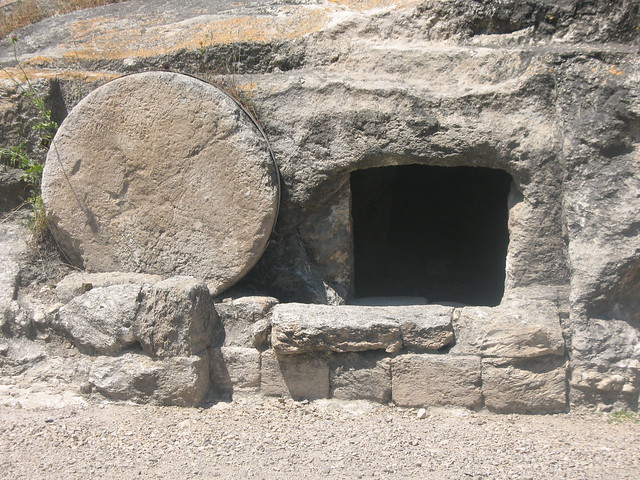
Opening of roadside tomb_0654 from Flickr via Wylio
© 2007 James Emery, Flickr | CC-BY | via Wylio
A few days after I wrote this post, I was listening to John chapter 20 in audiobook form, and I heard this familiar story:
    Early on Sunday morning, while it was still dark, Mary Magdalene came to the tomb and found that the stone had been rolled away from the entrance. She ran and found Simon Peter and the other disciple, the one whom Jesus loved. She said, "They have taken the Lord’s body out of the tomb, and we don’t know where they have put him!"
    Peter and the other disciple started out for the tomb. They were both running, but the other disciple outran Peter and reached the tomb first. He stooped and looked in and saw the linen wrappings lying there, but he didn’t go in. Then Simon Peter arrived and went inside. He also noticed the linen wrappings lying there, while the cloth that had covered Jesus’ head was folded up and lying apart from the other wrappings. Then the disciple who had reached the tomb first also went in, and he saw and believed—for until then they still hadn’t understood the Scriptures that said Jesus must rise from the dead. Then they went home.
As many times as I've heard this, this part struck me as weird. They did what? A hysterical woman ran to find them and showed them evidence of the most amazing miracle in the history of the world, and they took a look and then just... went home?
    Mary was standing outside the tomb crying, and as she wept, she stooped and looked in. She saw two white-robed angels, one sitting at the head and the other at the foot of the place where the body of Jesus had been lying. "Dear woman, why are you crying?" the angels asked her.

     "Because they have taken away my Lord," she replied, "and I don't know where they have put him."

     She turned to leave and saw someone standing there. It was Jesus, but she didn’t recognize him. "Dear woman, why are you crying?" Jesus asked her. "Who are you looking for?"

     She thought he was the gardener. "Sir," she said, "if you have taken him away, tell me where you have put him, and I will go and get him."

     "Mary!" Jesus said.
     She turned to him and cried out, "Rabboni!" (which is Hebrew for "Teacher").
     "Don't cling to me," Jesus said, "for I haven’t yet ascended to the Father. But go find my brothers and tell them, 'I am ascending to my Father and your Father, to my God and your God.'"

     Mary Magdalene found the disciples and told them, "I have seen the Lord!" Then she gave them his message.
Peter and John ("the other disciple" was John) came to the tomb, understood what had happened, satisfied their minds, and went home. Mary, on the other hand, was so emotionally wrapped up in her love for Jesus that she stayed around... and was there long enough to experience Jesus.

Don't be satisfied to approach Jesus intellectually, Theologically, methodically. Take time to reach out to Jesus with your heart. When you do, He will show up.

Tuesday, November 12, 2013

Loving Blindly

During the day I often have an MP3 player running on random shuffle - it's fun (and sometimes jarring) to hear different songs from 30 years of accumulating CDs jumbled in together. A few days ago this song by 4 Him started playing, and one single line popped out at me every time they sang it:


The line that bothered me is the line that says that one of the basics of Christianity is "a love that is blind". The reference in the song is of course that God's love does not consider someone's looks, or social standing, or race, or anything else in order to determine whether to love them. But I think this is a dangerous phrase to use to describe that idea.

The phrase "love is blind" is generally used to describe the idea that someone who has fallen in love seems to think the one they love is perfect. "A person who is in love can see no faults or imperfections in the person who is loved" is how it is summarized on Wikitionary, and that seems to be an apt definition. But that's not actually "love," not in the way I believe the Bible describes it. That kind of blind love is only the first stage even of romantic love, and I would more accurately call it "infatuation." And that kind of love isn't for strangers, anyway.

I don't think real love, the deep kind that comes from God, the kind that loved each of us so much that it came to Earth and died to save us, is ever "blind". If it's real love, it is exactly the opposite of ignorant blindness to the faults of the one being loved. True love means that you can see the faults of the other, usually in perfectly clear high definition, and you choose to love that person anyway. Jesus wasn't ignorant to the faults of the people around Him. Very often He told them to "Go, and sin no more",,, I don't see Him saying "Go, and I'm so glad you're already perfect!" He had no problem bringing up the sins of individuals when they needed bringing up. “You are right in saying, ‘I have no husband’; for you have had five husbands, and the one you now have is not your husband. What you have said is true” He said once. He was even known to tell his disciples off in no uncertain terms if they weren't doing right. When Jesus was on the Cross, He both forgave someone who was being executed alongside Him (and who confessed his own guilt willingly) and forgave those who had just put Him there, even though He would have to have been massively blind to not notice the sins being committed in both cases.

God loves each of us, even though He knows about our faults better than we ourselves do. That's the kind of love that is a basic of Christianity. In fact, I think that if we are actively listening to the Holy Spirit, we will actually have a sharper view of the shortcomings of others, because He will tell us things we couldn't know otherwise. But if we are actively listening to the Holy Spirit, He will also be telling us how much God loves each person, and inspiring the same love for each of them in us.

Blind "love" is the kind of thing that ignores children's misconduct because it is uncomfortable to discipline them, ignores a friend's path of alcoholism or promiscuity or dishonesty or whatever because it seems like it's "not my place to say something to him", ignores signs that a friend's wife is being abused because "my buddy's just not like that." I once knew a lovely older Christian woman who always tried to look at the "good" side of everyone's conduct, even when that conduct was clearly wrong, and even malicious. That kind of "love" is at best ignorant and dangerous, and at worst, it is selfishness. This woman was often taken advantage of by people because she wouldn't let herself see that they were likely to do something bad to her; she even seemed to think that the bad things that happened to her were somehow her own fault. I guess, in a way, since she refused to see the proverbial freight train coming down the tracks and get out of the way, she was partially right.
 
God's love does not ignore sinfulness; God's love confronts it. It confronts it at the right time and in the right way, but God's love does not leave sin alone. Because if a sinner is left with his sin, that sin will ultimately destroy the sinner, and injure everyone around him.

I think the 4 Him lyric probably makes perfect sense to Christians in general. We aspire to love others despite how they look or act. I think the lazy adaptation of the cliche "love is blind" without maybe totally thinking it through was unfortunate, because I think it could be misunderstood, but the concept is true: God's love does not reject people. God's love is always ready to accept another person, no matter what they might look or sound or smell like. That's the takeaway from that one line in this one song. Don't be blind, though; be completely, 100% aware, but be completely, 100% accepting.

Tuesday, April 2, 2013

Stranger on the Shore

Cooking seasoned fish I've always been fascinated by the final chapter of the Gospel of John. John is the Gospel where Jesus is revealed as Deity, where His "God-ness" is most at the forefront. The final chapter has always struck me as mysterious, mystical, and full of questions. I think it's positively mesmerizing. What's so interesting about it? Let me fill you in on some of the things that came to mind last week as I was listening to an audio reading of it.

By this time, Jesus has been crucified and resurrected, and has revealed Himself to the Twelve Disciples personally at least twice. Chapter 20 ends with verses 30-31: "Now Jesus did many other signs in the presence of the disciples, which are not written in this book; but these are written so that you may believe that Jesus is the Christ, the Son of God, and that by believing you may have life in his name." Sounds fairly final, doesn't it? It sounds like John is signing off. So the first big question about chapter 21 is: why is it even there at all?
After this Jesus revealed himself again to the disciples by the Sea of Tiberias, and he revealed himself in this way. Simon Peter, Thomas (called the Twin), Nathanael of Cana in Galilee, the sons of Zebedee, and two others of his disciples were together. Simon Peter said to them, “I am going fishing.” They said to him, “We will go with you.” They went out and got into the boat, but that night they caught nothing.  (John 21:1-3 ESV)
When Jesus first called the Disciples, most of them were fishermen. He never told them to return to being fishermen, at least not fishers of fish. Don't they sound discouraged in these verses? They seem at a loss as to what to do with themselves, so they decide to go back to what they know. Why were they so discouraged? Jesus had risen from the dead! The text doesn't really say... all we can do is speculate.
Just as day was breaking, Jesus stood on the shore; yet the disciples did not know that it was Jesus. Jesus said to them, “Children, do you have any fish?” They answered him, “No.” He said to them, “Cast the net on the right side of the boat, and you will find some.” So they cast it, and now they were not able to haul it in, because of the quantity of fish. (John 21:4-6 ESV)
Why would the Disciples obey such stupid advice from a stranger? Granted, it had worked for them once, but in that case they had been listening to Jesus' teachings and may have had some idea that He was something special. This was just some stranger yelling at them from the shore... why would they even entertain the idea of doing what he was saying? They didn't even realize it was Jesus yet:
That disciple whom Jesus loved therefore said to Peter, “It is the Lord!” When Simon Peter heard that it was the Lord, he put on his outer garment, for he was stripped for work, and threw himself into the sea. (John 21:7 ESV)
Why didn't anyone but John (he calls himself "That disciple whom Jesus loved" in his Gospel) figure out that it was Jesus? It was so like the other time that Jesus had given them a miraculous catch that it should have been unmistakable. I also wonder if Peter might have been thinking that maybe he would be able to walk on the water again, but then when he didn't got too embarrassed to just climb back into the stupid boat!
When they got out on land, they saw a charcoal fire in place, with fish laid out on it, and bread. Jesus said to them, “Bring some of the fish that you have just caught.” (John 21:9-10, ESV)
Where did Jesus get His charcoal? Did He buy some on the way? Did He materialize it out of thin air?

How did He start the fire? Matches? Lightning?

Where did Jesus get His fish? Did He go fishing and catch them? Did He call them out of the sea and they just jumped out? Did He materialize them out of nowhere when He materialized His charcoal?

Why didn't He bring enough fish? Why did He need to get some from the Disciples' catch?
So Simon Peter went aboard and hauled the net ashore, full of large fish, 153 of them. And although there were so many, the net was not torn. (John 21:11 ESV)
The risen-from-the-dead Jesus Christ is sitting there with them cooking them breakfast. Who's the nut who's counting fish?
When they had finished breakfast, Jesus said to Simon Peter, “Simon, son of John, do you love me more than these?” He said to him, “Yes, Lord; you know that I love you.” He said to him, “Feed my lambs.” (John 21:15 ESV)
"Do you love me more than these..." what? Other disciples? Tasty fish sandwiches? I wish I could see what Jesus was pointing at when He said that.

(I won't even TRY to sort out all of the interpretations of why Jesus used different words for "love" and "lambs/sheep" in the Greek version of this passage. That ground's been covered a zillion times already!)

Truly, truly, I say to you, when you were young, you used to dress yourself and walk wherever you wanted, but when you are old, you will stretch out your hands, and another will dress you and carry you where you do not want to go.” (This he said to show by what kind of death he was to glorify God.) And after saying this he said to him, “Follow me.” (John 21:18-19 ESV)
Isn't it weird that John recorded this? It seems like a rather personal moment to me. We have historical accounts of the fates of the Disciples (including Peter), but the Bible doesn't really record them. I wonder if the whole reason this chapter is even in the Bible at all is because people had heard that Jesus said John would not die until Jesus returned (see the next few verses) and John just wanted to set the record straight.
Now there are also many other things that Jesus did. Were every one of them to be written, I suppose that the world itself could not contain the books that would be written. (John 21:25 ESV)
Now, what's more mysterious than ending a book about Jesus that way? "There's a lot more to tell, but I'm going to quit right now. Good luck finding out the rest of it!" And maybe John is hyperbolizing a little bit, but I think back to my life (and I'm older than Jesus was when He died) and if someone managed to write down everything that I've ever done, the book would most definitely not fill up the entire world. So either this is a bit of an exaggeration, or Jesus was a much busier fellow than anyone has realized.

But you know, I think the mystery is perfect for the last chapter of the last of the Gospel accounts. It's a good reminder that although we can know lots of things about Jesus, we're never going to know everything. There's always going to be something we don't understand, because Jesus is God. And God is something more than we are. Even if someone did write that world-filling book, and even if we read it cover to cover — there would still be more to know. Jesus Himself was a mystery which was revealed (see Ephesians 3:1-13) but I think the mystery that is Jesus probably always going to be a little bit bigger than our created human brains can handle.

That's OK with me. I love a good mystery!


(This post was named after a Michael Card song (Listen on Spotify or Rhapsody) which I think captures the mysterious flavor of the story quite well!)


Is this chapter mysterious to you? Do you have questions about it that I haven't answered, or answers to my questions? A personal theory about the sheep and the lambs, or Peter's prophecy, or Jesus' charcoal fire? Sound off below by clicking the "Comment" link!

Monday, February 11, 2013

A Matter Of Procedure

'Hearts Wrippled in Time' photo (c) 2008, LadyDragonflyCC <3 Canon~vs~Samsung - license: http://creativecommons.org/licenses/by/2.0/Recently a reader posted a comment on one of my blog entries from a couple of months ago, and although I replied there in the comments, the reply was getting long and I wanted to develop it into something more in its own post. The original comment (which oddly seemed to have little to do with the original blog entry) is:
Your verse in john 3:16 has a miss print "He that believes and is baptized shall be saved " there are plenty if others here's a couple mark 16:16 Jesu says it again ,acts 2:38 the whole bible is inspired by God not just what we edit for what ever reason Billy Gramm once said he don't preach baptism because he wouldn't have as many followers oops I give anyone $500 if they can prove you don't need baptized
My reply was as follows:
Acts 16:30-31 - the Philippian jailer asked "Sirs, what must I do to be saved?" Paul and Silas simply replied, "Believe in the Lord Jesus, and you will be saved, you and your household." Although the jailer did ultimately get baptized, Paul and Silas, in a simple answer to a simple question, did NOT include it as a requirement. He was saved as soon as he believed in the Lord Jesus.

Romans 10:9 states the requirements for salvation this way: "...if you confess with your mouth that Jesus is Lord and believe in your heart that God raised him from the dead, you will be saved." Again, no requirement of baptism is included.

I've matched your Mark 16:16 and your Acts 2:38, which seem to include baptism as a requirement, with two verses that absolutely do not include it as a requirement. Maybe the "misprint" you're talking about is in your two verses? I'm feeling pretty safe in saying that John 3:16, which is probably the most popular Scripture verse in the whole entire Bible, has been gone over with a fine-toothed comb any number of times. Do I get $500, or since I proved it twice do I get $1,000?
I don't expect to hear back from commenter "Mark" - at this writing I haven't. If I do, I expect it to be mostly an argument containing a lot of Theological hair-splitting. In fact, I can split some of those hairs myself... if you look at the two verses I cited, they say that if you believe in the Lord Jesus, you will be saved. It doesn't say you immediately are saved. So there's room for bullying people into getting baptized with those two Scriptures too, if you want. But I don't see things that way.

In 1 Samuel 16:7, it is recorded that God said to Samuel "For the Lord sees not as man sees: man looks on the outward appearance, but the Lord looks on the heart." God's not as interested with the procedures we follow as with what's in our hearts when we follow them. The Old Covenant provided tons of procedures that you could follow to bring you nearer to God, and I truly believe that if someone had been able to follow them perfectly, they would totally not have needed the salvation that Jesus brought. They would have been made righteous by the Law alone. The fact is, though, that until Jesus, nobody was able to do it. Everyone had the disadvantage that they were creatures hindered, let's say, as if by a birth defect. We couldn't walk straight, because we were born with a lame leg. No matter how hard we try, we simply are unable to live up to the rules and regulations which, if we had been able to live up to them, would have provided righteousness to us. That's what the Law was given to teach us: we just can't do it. Rules and regulations don't work for us. We needed someone to finish the work for us and give it to us as a gift. That person was Jesus.

Which brings me back around to my point. God spent thousands of years driving home His point that we are unable to obtain righteousness through performing the correct activities. Why would God turn around and load another activity on us as a requirement to come to Him? Wasn't Jesus' work sufficient? Didn't God tell Samuel that He looks at the heart, not on outward appearance? Baptism is an outward act, there to be a sign to other human beings. It's an "outward appearance" thing; it happens to your body, not within your heart.

I am a firm believer in baptism. I think baptism is a wonderful sign of the change that has happened to the believer. I do think that there is something spiritual that happens when you are baptized. But I do not think it is a requirement for Salvation. I just don't think God is looking for excuses to keep people out of Heaven. "Hello, Mr. Jones. I see here in the Book of Life that you believed in the Lord Jesus in your heart... very good, very good... and you even confessed Him as your Lord with your mouth, that's wonderful! Oh... oh no. Mr. Jones, I'm afraid you never were baptized. I'm sorry, but even though you made a heart decision to choose Jesus as your Savior and follow Him, because you did not get baptized, you're going to have to go to Hell instead of Heaven. Too bad for you." The idea just seems kind of ridiculous to me.

I've been baptized. I recommend that everyone who becomes a Christian get baptized. It's a very special, valuable experience. But I think that people become Christians immediately, as soon as they allow the Holy Spirit to change their hearts. I think Jesus did the job completely. I think he purchased the gift, wrapped it up and put a bow on it, and offered it to anyone who would accept it. I just don't think there's any extra requirement for Salvation after that.

Monday, October 31, 2011

Righteousness - convinced of it

Yesterday my pastor based his message on this passage, which quotes Jesus talking about the Holy Spirit, from the New Living Translation:
But in fact, it is best for you that I go away, because if I don’t, the Advocate won’t come. If I do go away, then I will send him to you. And when he comes, he will convict the world of its sin, and of God’s righteousness, and of the coming judgment. The world’s sin is that it refuses to believe in me. Righteousness is available because I go to the Father, and you will see me no more. Judgment will come because the ruler of this world has already been judged. - John 16:7-11 (NLT)
Verse 10 ("Righteousness is available because I go to the Father, and you will see me no more.") caught my attention, because it seemed subtly different in the New American Standard version I was reading:
But I tell you the truth, it is to your advantage that I go away; for if I do not go away, the Helper will not come to you; but if I go, I will send Him to you. And He, when He comes, will convict the world concerning sin and righteousness and judgment; concerning sin, because they do not believe in Me; and concerning righteousness, because I go to the Father and you no longer see Me; and concerning judgment, because the ruler of this world has been judged. - John 16:7-11 (NASB)
It occurred to me that the NLT makes explicit something that the more-literal NASB leaves you to figure out: that Jesus meant that the Holy Spirit's lesson about righteousness is that it is available because Jesus made it available by going to the Father. But as I read it, it seemed to me that what Jesus meant was that because He was the model of perfect righteousness while He was on Earth, when He left and that perfect model was gone, the Holy Spirit would have to reveal perfect righteousness to people instead! This seems to be the way the ESV Study Bible leans:
"Because I go to the Father means that Jesus will no longer be in the world to teach about true righteousness, and so the Holy Spirit will come to carry on that function, through illumination (v. 13) and through the words of believers who bear witness to the gospel." (ESV Study Bible)
Both of these statements are true: 1. Righteousness is only available because Jesus provided it; and 2. The Holy Spirit reveals that availability to us. Which did Jesus mean? Well, I still think in context it makes more sense to assume that Jesus meant that He wasn't going to be around to show us righteousness, so the Holy Spirit would have to take up that job. The NLT (which, by the way, I generally do enjoy reading because it's very comfortable English) doesn't leave you that option. It assumes that it knew what Jesus meant, and in this case, I disagree. Does it mean that the New Living is not a valid translation? Of course not! But it does highlight why it's a good idea to take a look at a number of translations and commentaries when you're studying the Scripture. Sometimes the insight in one version is different than the insight in another. Isn't it a blessing that we in the English-speaking part of the world have such a wealth of great information about the Bible available to us?

Thursday, September 15, 2011

Light of the Lamp

'Oil lamp' photo (c) 2009, Ralph Unden - license: http://creativecommons.org/licenses/by/2.0/
This little light of mine,
I'm gonna let it shine.
This little light of mine,
I'm gonna let it shine,
Let it shine, let it shine, let it shine!
A few nights ago I was intrigued when I read this passage to my son at bedtime:
When the crowds were increasing, he began to say, “This generation is an evil generation. It seeks for a sign, but no sign will be given to it except the sign of Jonah. For as Jonah became a sign to the people of Nineveh, so will the Son of Man be to this generation. The queen of the South will rise up at the judgment with the men of this generation and condemn them, for she came from the ends of the earth to hear the wisdom of Solomon, and behold, something greater than Solomon is here. The men of Nineveh will rise up at the judgment with this generation and condemn it, for they repented at the preaching of Jonah, and behold, something greater than Jonah is here.

“No one after lighting a lamp puts it in a cellar or under a basket, but on a stand, so that those who enter may see the light. Your eye is the lamp of your body. When your eye is healthy, your whole body is full of light, but when it is bad, your body is full of darkness. Therefore be careful lest the light in you be darkness If then your whole body is full of light, having no part dark, it will be wholly bright, as when a lamp with its rays gives you light.”
—Luke 11:29-36 (ESV)
What intrigued me was that I suddenly realized that I had no idea what verse 33 ("No one after lighting a lamp puts it in a cellar or under a basket...") had to do with verses 34-36 ("Your eye is the lamp of your body..."). I always thought that the "light" on the "lamp" was my testimony or my witness or something, and I was to "put it on a lampstand" by sharing the Gospel with others... but I certainly haven't put my eye into my body! So I started to think about it...
  1. The lamp is my eye
  2. The lampstand is my body
  3. God put my eye in my body
  4. Therefore, God lights the lamp
  5. ...And I do not
But how can my "eye" be "healthy" (or "good" or "single", as other translations express it), or in contrast how can my eye be "bad" (or "evil", as expressed in other translations)? One clue came to me in reference to the "red letters." I noticed that the red letters actually start in verse 29, and when I looked up "evil" in that verse I noticed that it was the same Greek word as "bad" in verse 34. So I expanded the scope of my verses, which started out as verses 33-36, to include the entire text quoted above. So this explains one way your "eye" can be "evil": you spend your time running around looking for miraculous manifestations instead of... what? And what exactly is the "sign of Jonah"? I found out from a parallel passage in Matthew:
Then some of the scribes and Pharisees answered him, saying, “Teacher, we wish to see a sign from you.” But he answered them, “An evil and adulterous generation seeks for a sign, but no sign will be given to it except the sign of the prophet Jonah. For just as Jonah was three days and three nights in the belly of the great fish, so will the Son of Man be three days and three nights in the heart of the earth. The men of Nineveh will rise up at the judgment with this generation and condemn it, for they repented at the preaching of Jonah, and behold, something greater than Jonah is here. The queen of the South will rise up at the judgment with this generation and condemn it, for she came from the ends of the earth to hear the wisdom of Solomon, and behold, something greater than Solomon is here.
The "sign of Jonah" was when Jesus died, was buried for three days, and rose again. So that must mean that for our "eye" to be "good" we have to keep our eyes on the death and resurrection of Jesus (the Gospel). (By the way... other passages parallel to parts of Luke 11:29-36 are Luke 8:16-18 and Matthew 6:19-24.)

Apparently this light is meant to shine out through our eyes, but how does it get into our eyes? We can't very well go back in time and look at Jesus on the Cross. How can we "look" with our eyes and see the Gospel?
For this light momentary affliction is preparing for us an eternal weight of glory beyond all comparison, as we look not to the things that are seen but to the things that are unseen. For the things that are seen are transient, but the things that are unseen are eternal.
We can actually "look" at things that we cannot see! And the thing we are to "look at" is the Gospel of God's Glory:
And even if our gospel is veiled, it is veiled only to those who are perishing. In their case the god of this world has blinded the minds of the unbelievers, to keep them from seeing the light of the gospel of the glory of Christ, who is the image of God. For what we proclaim is not ourselves, but Jesus Christ as Lord, with ourselves as your servants for Jesus' sake. For God, who said, “Let light shine out of darkness,” has shone in our hearts to give the light of the knowledge of the glory of God in the face of Jesus Christ.
...and that Glory shines first into our hearts, and then out of our hearts, just like in  Exodus 34:29-35  when Moses saw God's glory and his face shone with it afterward:
Since we have such a hope, we are very bold, not like Moses, who would put a veil over his face so that the Israelites might not gaze at the outcome of what was being brought to an end. But their minds were hardened. For to this day, when they read the old covenant, that same veil remains unlifted, because only through Christ is it taken away. Yes, to this day whenever Moses is read a veil lies over their hearts. But when one turns to the Lord, the veil is removed. Now the Lord is the Spirit, and where the Spirit of the Lord is, there is freedom. And we all, with unveiled face, beholding the glory of the Lord, are being transformed into the same image from one degree of glory to another. For this comes from the Lord who is the Spirit.
Jesus is actually the embodiment of "light":
In the beginning was the Word, and the Word was with God, and the Word was God. He was in the beginning with God. All things were made through him, and without him was not any thing made that was made. In him was life, and the life was the light of men. The light shines in the darkness, and the darkness has not overcome it.

There was a man sent from God, whose name was John. He came as a witness, to bear witness about the light, that all might believe through him. He was not the light, but came to bear witness about the light.

The true light, which enlightens everyone, was coming into the world. He was in the world, and the world was made through him, yet the world did not know him. He came to his own, and his own people did not receive him. But to all who did receive him, who believed in his name, he gave the right to become children of God, who were born, not of blood nor of the will of the flesh nor of the will of man, but of God.

And the Word became flesh and dwelt among us, and we have seen his glory, glory as of the only Son from the Father, full of grace and truth. (John bore witness about him, and cried out, “This was he of whom I said, ‘He who comes after me ranks before me, because he was before me.’”) And from his fullness we have all received, grace upon grace. For the law was given through Moses; grace and truth came through Jesus Christ. No one has ever seen God; the only God, who is at the Father's side, he has made him known.

And this is the testimony of John, when the Jews sent priests and Levites from Jerusalem to ask him, “Who are you?”
(note: the word "enlightens" everyone in that passage is the same as the phrase "gives you light" in Luke 11:36) ...and we can actually become that light also:
Let no one deceive you with empty words, for because of these things the wrath of God comes upon the sons of disobedience. Therefore do not become partners with them; for at one time you were darkness, but now you are light in the Lord. Walk as children of light (for the fruit of light is found in all that is good and right and true), and try to discern what is pleasing to the Lord. Take no part in the unfruitful works of darkness, but instead expose them. For it is shameful even to speak of the things that they do in secret. But when anything is exposed by the light, it becomes visible, for anything that becomes visible is light. Therefore it says,

“Awake, O sleeper,
       and arise from the dead,
and Christ will shine on you.”
So we can choose to "take part in the unfruitful works of darkness" (this passage is talking specifically about sexual immorality), but we are exhorted not to do that. In the original passage, I looked up the Greek words for "healthy" and "bad" in verse 34. The word translated "healthy" can mean things like simple, single, whole, or sound. The root words apparently mean something like tightly woven together... everything fits just right. The word translated "bad" means things like in bad condition, full of hardships and hard labor, diseased, wicked, or blind. The "god of this world" has "blinded" unbelievers, but if we as believers are blinded, Satan didn't do it... we have let our own eyes go bad by sinful actions.

It is interesting to know that it's not an on or off thing; verse 36 in the original passage implies that you can be partially bright and partially dark. That encourages me to keep working at the corners of my life that are still in shadow, so that I can "be wholly bright", lit up with rays of God's light!

So, to sum things up: the light on the lamp is not specifically your spoken witness, although that is part of it, and you cannot light the lamp yourself. God lights the lamp, and you keep it lit by keeping your eyes focused on the Gospel of Christ. Others can see God's Glory shining out when they look into your eyes, unless you blind yourself and block them from seeing it by sin; when sin is present, no light goes out and none comes in. The light also "lights" your whole body; although others may not see the Glory of God shining out through your fingers or your torso (your eye is the lamp, after all), what your body does is illuminated by the Gospel as well if you keep your eyes "healthy". As we continue to eliminate sin from our lives, our eyes can become brighter and our bodies can become more "illuminated" with God's Glory all the time!


This is an old post that's been up at ScriptureMenu.com for some time... a discussion about this passage last night at church led me to post it here!

Monday, February 14, 2011

You Rule!

Pepper & salt on tablephoto © 2010 Anita Hart | more info (via: Wylio)I came across the passage tonight in Isaiah:
Behold, a king will reign in righteousness,
        and princes will rule in justice.
     Each will be like a hiding place from the wind,
        a shelter from the storm,
    like streams of water in a dry place,
        like the shade of a great rock in a weary land.
     Then the eyes of those who see will not be closed,
        and the ears of those who hear will give attention.
     The heart of the hasty will understand and know,
        and the tongue of the stammerers will hasten to speak distinctly.
     The fool will no more be called noble,
        nor the scoundrel said to be honorable.
     For the fool speaks folly,
        and his heart is busy with iniquity,
    to practice ungodliness,
        to utter error concerning the LORD,
    to leave the craving of the hungry unsatisfied,
        and to deprive the thirsty of drink.
     As for the scoundrel—his devices are evil;
        he plans wicked schemes
    to ruin the poor with lying words,
        even when the plea of the needy is right.
     But he who is noble plans noble things,
        and on noble things he stands.
 (Isaiah 32:1-8 ESV)
In prophecy, often you find that passages have two applications: an immediate application, and a Messianic application. I think this passage actually has at least three different applications, but one really caught my attention, and it's the one I want to focus on, but first I'll mention the other two.

The king, in all cases, is God. The identity of the princes, though, is sort of up for grabs. The immediate application to Isaiah's time was to rulers over Israel; Godly political leaders (in our time as well as theirs) have a positive effect on the nation they rule. In New Testament times, this could be applied to pastors of churches; they provide the spiritual leadership that a Godly king might have provided in ancient times. A pastor who seeks God with all his heart will see amazing things happening in his congregation.

But the application that really jumped out at me tonight was that each one of us, every Christian, is one of those princes. Although we may not "rule" in a political sense in the spot where we live, each of us has a powerful influence over those around us. If we use that influence "in justice" (let God work through us), certain things will automatically begin to happen around us:
These things are all really aspects of Christ Himself; as we reflect Him (and as He reflects God the Father), the attributes of God become our attributes as well. We begin to influence the world in amazing, supernatural ways. Jesus wrapped it all up in two metaphors: "salt" and "light." Light to expose the good and bad of the world around us, and salt to influence it and make it better.

Spiritually take charge of the world around you today. Do not allow it to influence you; begin to influence it. "Rule it in justice," God's justice, and see the incredible things that God will cause to happen!

Thursday, September 2, 2010

Moving Pictures

(Before I start... there are a lot of links in this post. They are links to Scriptures. I encourage you to click them and read the original verses. Those verses will back up what you're reading, and help you to understand and digest the post. I'm not making this stuff up! It's in the Bible!)

I'm convinced that God expresses Himself constantly through visual aids. He paints pictures in His creation. I don't think that God used the word "father" to describe His relationship to His children because God looked down and saw someone with their father and said, that's what I'm like! I think that God is the original, and earthly fathers were created by God as a picture of His relationship to us. In fact, God even called the Israelite nation His "firstborn son" and delivered them physically from slavery in Egypt, in anticipation of His "only [one-of-a-kind] Son" Who would not be delivered, but Who would be the deliverer, bringing God's people out from spiritual slavery to sin.

Israel, as the "firstborn son," was God's "physical" people. They were delivered from physical slavery in Egypt. So "son" described God's relationship to His physical people, who are the children of Abraham by their bloodline. But God has always wanted something more. Over and over, especially in the prophets, we find God describing, almost wistfully, a time when they would be "His people" and He would be "their God". Here, for example. And here, and here, and here, and here, and here. Even when they messed up, God still wanted that intimacy with them.

The Church, on the other hand, has a relationship with God like that between a husband and wife. This is God's spiritual people, who are the children of Abraham via their faith. God wanted the Israelite nation to be His spiritual people as well, and when they messed up and worshiped idols, He even went so far as to call them a "faithless bride" (see Ezekiel 16 for a vivid picture of this), quite regularly referring to their attraction to idols as prostitution. God was seeking a bride who would approach Him by faith; a husband and wife desire to please each other, but without faith, we cannot please God. If we try to approach God without faith, we will wind up turning away from Him, prostituting ourselves to some idol or another. God wants us to draw near to Him, to submit to Him much as a wife is to submit to her husband. God wants us close!
 
How vivid is the image that when Christ looks on the Church, his emotional response is the same as the response a man has when he looks at his bride on their wedding day? That new husband loves, he wants and desires. He wishes to be close to his wife, to possess her, to never be away from her! And that is the way God feels about us. God's desire is not for a slave, a vassal, an underling... God's desire is for a companion. A lover. Our relationship with God has many facets... He is our Father, He is our King, we are His servants, we are His children. But at the end of this world, in the book of Revelation, the Church is not described in any of these ways, but as Christ's bride. And God's heart desire is once more spoken: "And I heard a loud voice from the throne saying, 'Behold, the dwelling place of God is with man. He will dwell with them, and they will be his people, and God himself will be with them as their God.' " (Revelation 21:3 ESV)

His people.

Their God.

Very possessive language.

Are you the possession of God today?

Is He yours?


(A previous post with some related thoughts is right here.)

Wednesday, August 18, 2010

Restoring the Kingdom

So when they had come together, they asked him, “Lord, will you at this time restore the kingdom to Israel?” He said to them, “It is not for you to know times or seasons that the Father has fixed by his own authority. But you will receive power when the Holy Spirit has come upon you, and you will be my witnesses in Jerusalem and in all Judea and Samaria, and to the end of the earth.”
(Acts 1:6-8 ESV)
It seems like every time Jesus turned around, His disciples were trying to get Him to lead some kind of revolt against the Romans. They even argued about which one of them was better than the others, and who would be Jesus' second in command when He was king. I imagine they kept thinking back to the glory days of the Kingdom of Israel, when David and then Solomon were king and Israel was a superpower in the ancient world. Jesus was the promised heir of David's throne, and they all believed it meant that He would overthrow the Roman empire and once again make Israel a political force to be reckoned with. Jesus kept shutting them down, telling them that His Kingdom was "not of this world" (meaning, maybe, that it wasn't the kind of kingdom this world produces?) but that it was a kingdom that is "of Heaven" and "among you." It wasn't the kind of political kingdom they were expecting, and it wasn't the kind of political kingdom that was in their nation's history. In fact, if they had thought about it, they would have realized that the kind of kingdom that was in Israel's past was the result of their own human desires, not what God desired (God himself said that they had "rejected [Him, God] as their king"). Eventually the disciples got it... but it took them a while!

I was thinking about all that this morning, and suddenly the present day came into sharp focus. The founding fathers of the United States of America were, history tells us fairly clearly, believers in God and in the Bible. They were highly moral people, and principles from the Word of God guided their work in founding this nation. In recent decades there has been a significant hybrid political/religious push to force certain issues into the forefront of politics; call it the "moral majority" or the "religious right" or the "evangelical movement" or whatever you like. Now please don't get me wrong; I believe morality should be at the forefront of every law we make, and the Bible is the place to find your moral compass. But Jesus clearly wasn't training His disciples to become political leaders in the world's system of "kingdoms." Jesus was teaching His disciples to bring people into the Kingdom of God, which exists right in the middle of all of the kingdoms of this World. When you change the hearts of the people, the kingdoms of this world automatically begin to become more like the Kingdom of God. Israel didn't need a new David or Solomon as king, and maybe we don't need a new George Washington. Maybe we need to transform the hearts of the people, and when that happens, Godliness will begin to show up in lots of unexpected places!

One day, “The kingdom of the world [will] become the kingdom of our Lord and of his Christ, and he shall reign forever and ever.” Until then, we have our rights as citizens of this nation to be active politically, and as Christians we will act according to what we believe the Bible teaches about fairness and morality, but when we are doing that, we are not necessarily doing the work of God's Kingdom. The Bible teaches us to pray for our leaders, and that authority is given to them by God. And if your God-appointed vocation is to be involved in politics, or if you enjoy it and want to be involved, that's wonderful and important. My vocation is programming computers. I do my job as unto the Lord, but at my job, I am not building the Kingdom of Heaven... I'm building computer programs. Political leaders should not see themselves as building kingdoms for God - Jesus could have obtained a chariot and horses and an army and approached His ministry using the political tools of the day. He didn't do that, because He wasn't building a kingdom of the kind the World builds. Jesus, our example, built His kingdom on foot, right in the middle of huge crowds of people, teaching them about God, laying hands on them and healing them. Maybe as Christians we should look on ourselves the same way - we live in two worlds, one of Earth and one of Heaven. Our vocation and our politics are of the kingdoms of Earth. Those kingdoms need building, and we should be interested and involved in that process. But our ministry to others is of the Kingdom of Heaven. We need to make sure we don't think we're building God's Kingdom when we are actually building a kingdom of this World, because when it all comes down to it, every kingdom of this World (including the United States of America) will one day dissolve and be no more, but God's Kingdom is forever.

Tuesday, June 15, 2010

Grief

But we do not want you to be uninformed, brothers, about those who are asleep, that you may not grieve as others do who have no hope. For since we believe that Jesus died and rose again, even so, through Jesus, God will bring with him those who have fallen asleep.
(1 Thessalonians 4:13-14 ESV)
Now when Mary came to where Jesus was and saw him, she fell at his feet, saying to him, “Lord, if you had been here, my brother would not have died.” When Jesus saw her weeping, and the Jews who had come with her also weeping, he was deeply moved in his spirit and greatly troubled. And he said, “Where have you laid him?” They said to him, “Lord, come and see.”

Jesus wept.
(John 11:32-35 ESV)
Everybody who was ever a kid in Sunday School who could earn a reward by memorizing Scripture verses knows that "Jesus wept." I wonder how many of those kids ever learn what it is that He was weeping about?

To give a little bit of background, Jesus had just arrived at the grave of his friend Lazarus. But Jesus wasn't crying for Lazarus. Lazarus was dead. He wasn't suffering. Besides, Jesus knew that He was about to bring Lazarus back to life! Jesus didn't weep because Lazarus had died; He wept because "he was deeply moved in his spirit and greatly troubled" because "Jesus saw her weeping." Jesus was weeping not for the death of the departed, but for the grief of the surviving. But Mary was weeping about her brother's death, and Jesus did not stop her. He let her grieve her loss, even though He knew He was about to give her brother back to her alive.

The Scripture I quoted above says that we as Believers in the resurrection of Jesus do not "...grieve as others do who have no hope," but it does not say that we "do not grieve." We do grieve. We grieve I think on two levels: on a conscious level, we grieve because we miss the loved one who has died, but on a spiritual level, we grieve because we know that death is an enemy. Dying is not something that was supposed to happen; it's not God's plan for the human race. And Jesus defeated Death when He rose from the grave (1 Corinthians 15:20-26). I think we have a visceral understanding that something isn't right about dying. I think that grieving over dead Believers is part of the groaning that Christians experience during life on this world (2 Corinthians 5:1-5).

Even doctors and psychologists will tell you that human beings need to go through a grieving process after the loss of a loved one. The Word of God does not disagree with this. If you've lost a loved one, do not grieve as those who have no hope... but do grieve. Even Jesus wept. It's OK for you to weep, too.

Sunday, December 6, 2009

Charges Dropped

Romans 8:1-2 is probably my favorite passage of Scripture:
There is therefore now no condemnation for those who are in Christ Jesus. For the law of the Spirit of life has set you free in Christ Jesus from the law of sin and death. [ESV]
I'm not one who remembers specific events in my life very well. I don't remember the setting, the date or time, or much of anything else about the circumstances the first time this verse impacted me, but I do remember very clearly the fireworks that went off on the inside of me. No condemnation? NO condemnation? There's nothing at all that is condemning me? None of my sin, none of my guilt? To me, the word "no" in that verse was nothing short of revolutionary. I felt a freedom that I had never felt before. And I grew up in the Church! My parents made sure I was exposed to the Word as a child. But this revelation hit home to me when I was in college. Some things you just have to pick up when you're ready for them.

I've been studying and just reading over and over the entire chapter 8 of Romans for the past 2 weeks, at the recommendation of our pastor (from the pulpit, not to me personally) and any number of things other than this verse have sort of woken up in me. One thing comes from this passage:
What then shall we say to these things? If God is for us, who can be against us? He who did not spare his own Son but gave him up for us all, how will he not also with him graciously give us all things? Who shall bring any charge against God's elect? It is God who justifies. Who is to condemn? Christ Jesus is the one who died—more than that, who was raised—who is at the right hand of God, who indeed is interceding for us. -Romans 8:31-34
I love the picture that everyone who could possibly press charges against the accused party is a family member and will not prosecute! Verse 34, "Who is to condemn? Christ Jesus is the one who died—more than that, who was raised—who is at the right hand of God, who indeed is interceding for us" reminds me of the story in chapter 8 of the book of John where Jesus is actually identified as the only one qualified to condemn a woman who is clearly guilty, and Jesus declines to condemn... he forgives and sends her away free.

Jesus says to us when we sin, when we confess our sin seeking forgiveness, that we are forgiven. He says to each of us, go and sin no more. He is interceding for us, and because of His work, there is no condemnation-NO condemnation-for those of us who are in Christ Jesus. Is that incredible or what?